Gnosis Batch Auctions
A permissionless Ethereum DEX (Gnosis Protocol v1 / Mesa) that settled trades in recurring 5-minute multi-token batch auctions with uniform clearing prices and solver-computed ring trades, pioneering the batch-auction design later carried into CoW Protocol.
▶ Run interactive simulation animated mechanism with editable parameters
How it works onchain
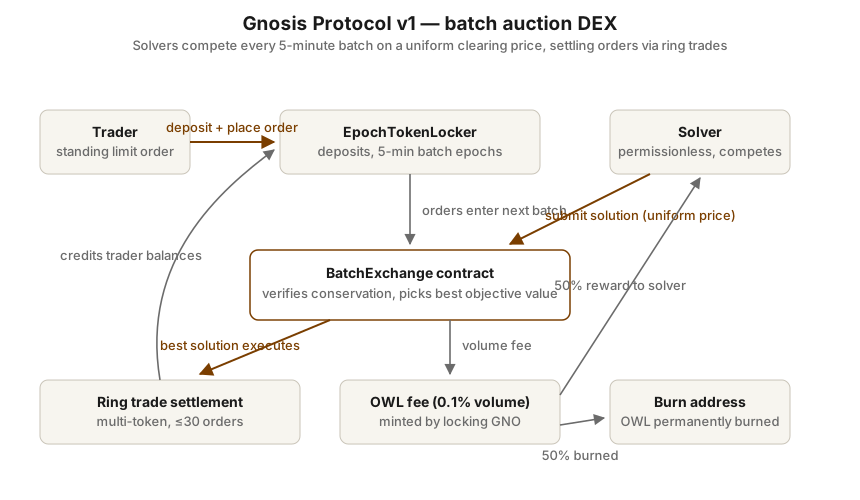 Open full-size diagram
Summary
Gnosis Batch Auctions refers to the market mechanism at the core of Gnosis Protocol v1 (GPv1), a fully permissionless decentralized exchange on Ethereum mainnet announced on 15 April 2020. Its reference front-end was Mesa, launched by dxDAO. Rather than matching trades continuously against an automated market maker or order book, Gnosis Protocol collected limit orders over a fixed interval and settled them together in a batch auction every five minutes, at a uniform clearing price per token, computed off-chain by competing solvers.
The design was an explicit attempt to solve two problems that plagued early Ethereum DEXs: front-running / miner-extractable value (MEV), and fragmented, pairwise liquidity. Batching removed the advantage of transaction ordering within a batch, and the multi-token settlement enabled ring trades — cyclical settlements across many token pairs — so that liquidity could be shared across the whole order set rather than trapped in a single pair. Gnosis (founded 2015 by Martin Köppelmann and Stefan George) built GPv1 as the direct predecessor of Gnosis Protocol v2, which was rebranded CoW Protocol / CoW Swap and remains a large, active DEX aggregator today.
Design (Mechanism)
The on-chain contract is BatchExchange (mainnet 0x6F400810b62df8E13fded51bE75fF5393eaa841F), documented in source as "a multi-token batch auction with uniform clearing prices." Key mechanics:
- Batches: Time is divided into fixed epochs (five-minute batches, via the inherited
EpochTokenLocker). Orders placed during a batch are all considered together for the next batch's settlement. - Standing limit orders: Users submit limit sell orders specifying a sell token, buy token, a limit price, and a validity window (in batches). Orders can persist across many batches, so the book is a set of standing limit orders rather than one-shot fills.
- Solver competition: For each batch, anyone can submit a proposed settlement ("solution"). A solution assigns a single uniform clearing price to each token and a set of executed order amounts. The contract enforces token conservation (no token is created or destroyed across the batch) and that every executed trade respects its limit price and the uniform price vector.
- Objective function: Solutions compete on an on-chain objective value (roughly, total trader welfare / disutility reduction). A better-scoring solution replaces the previously submitted one for that batch, so solvers iteratively bid up quality.
- Ring trades: Because settlement is multi-token, the winning solution can route liquidity through intermediate tokens, creating cyclical (ring) trades and coincidences of wants. Illiquid direct pairs can therefore clear via multi-hop paths inside a single atomic batch.
- Fees and token: A 0.1% volume fee was denominated in OWL (minted by locking GNO). Fees were split — 50% paid to the solver of the selected solution as incentive, 50% burned. OWL was fixed at 1 ETH-unit of accounting weight, and listing a new token cost 10 OWL.
- Constraints: Solutions could touch at most 30 orders, a hard scalability ceiling on how much a single batch could settle.
Notably, GPv1 solving was open/permissionless — anyone could submit a solution — whereas GPv2/CoW moved to a bonded, DAO-approved solver set subject to slashing.
Outcome
GPv1 was technically sound and found a real niche, but its DEX ambitions were commercially modest, and Gnosis quickly iterated past it.
- Product-market fit in IDOs, not spot trading: The batch mechanism proved most useful for one-shot price discovery. Gnosis Protocol v1's auction logic directly inspired EasyAuction / Gnosis Auction, used for token sales (IDOs) such as mStable, DIA, API3 and others.
- Deprecation: On 1 August 2021, Gnosis shut down the solvers it ran for GPv1/Mesa in favor of Gnosis Protocol v2. By then v2 had already grown to 1,100+ tradable tokens and roughly $112M cumulative volume, and Gnosis directed users to CoW Swap. No user funds were affected; the Mesa front-end remained accessible via IPFS/ENS.
- Lineage: GPv2 → CoW Protocol carried the batch-auction + solver-competition + CoW design forward and became a major, sustained success, validating the underlying mechanism even though the v1 product itself was retired after ~16 months.
Given that the v1 DEX itself was superseded within about a year while its core mechanism went on to thrive elsewhere, the outcome is best described as technically successful, commercially unsuccessful for GPv1 specifically.
Why it worked
- Structural MEV resistance: Uniform clearing prices within a batch remove the value of intra-batch transaction ordering, neutralizing sandwich/front-running attacks that AMMs suffered from — a genuinely novel property in 2020.
- Shared liquidity via ring trades: Multi-token settlement let thin pairs clear through intermediary tokens, extracting liquidity a pairwise AMM could not.
- Clean incentive layering: Off-chain solvers do the hard optimization; the chain only verifies token conservation, limit-price respect, and objective score — keeping trust minimized while offloading computation.
Why it failed or underperformed
- Latency and UX: Five-minute batches feel slow versus instant AMM swaps; traders accustomed to Uniswap disliked waiting and the uncertainty of whether/at-what-price an order would clear.
- Hard scalability ceiling: The 30-order-per-solution limit and expensive on-chain solution verification capped throughput and made large books infeasible on 2020-era gas.
- Weak liquidity flywheel: With no passive LPs (unlike AMMs), the book depended on active traders and solvers; bootstrapping depth for spot trading was hard, so real usage skewed toward auctions/IDOs.
- Rapid obsolescence: Gnosis itself concluded the pure-batch DEX was better realized as v2/CoW — integrating external DEX liquidity and a professional solver market — and retired v1.
Lessons
- Batch auctions durably neutralize a whole MEV class, but the mechanism's value showed up most in aggregation (v2/CoW routing to external liquidity) rather than as a standalone isolated order book.
- Passive liquidity matters for a DEX flywheel. A design with no LPs can be elegant and fair yet struggle to bootstrap depth; pairing batch settlement with external AMM liquidity (as GPv2 did) was the unlock.
- The right product for a mechanism may not be the one it launched as. GPv1's batch/uniform-price logic found its clearest fit in token auctions (Gnosis Auction) and in a solver-based aggregator (CoW), not in head-to-head spot trading with AMMs.
- Permissionless solving is a nice ideal but a governance problem at scale; v2 moved to bonded, slashable, DAO-approved solvers to make solver quality and liveness dependable.
Redesign (EDITORIAL — hypothesis, not fact)
The following is the researcher's editorial hypothesis, not established fact.
If relaunching the GPv1 idea today, the highest-leverage changes would target latency and liquidity. First, shorten and decouple batches: with modern L2 blockspace, batch intervals of seconds (or event-driven batches triggered by order flow thresholds) would keep the MEV-resistance of uniform pricing while removing the punishing five-minute wait. Second, make external liquidity native from day one — GPv2/CoW's key insight — so solvers can fill CoWs first and route the residual to AMMs and RFQ market makers, giving depth without needing to bootstrap a standalone book. Third, replace the 30-order verification ceiling with succinct proofs: have solvers submit a settlement plus a validity proof (ZK or fraud-proof-backed) that the chain checks cheaply, decoupling batch size from on-chain gas. Fourth, keep solver competition but bond it, adding a solver reputation/slashing market and an auction for the right to settle, aligning solver profit with realized trader surplus rather than a fixed fee split. Finally, retain the OWL-style fee/burn only if it earns its complexity — a simpler fee in the traded asset, with rewards paid to the winning solver, would likely reduce onboarding friction that the OWL/GNO-locking design imposed. In short: keep the uniform-price batch core (its MEV property is the crown jewel), but pair it with external liquidity, near-real-time batching, and proof-verified scalability — essentially the trajectory Gnosis itself pursued into CoW Protocol.
Sources
- Announcing Gnosis Protocol (official blog) — primary (docs)
- BatchExchange.sol (gnosis/dex-contracts source) — primary (contract)
- Introducing Gnosis Protocol V2 and Balancer-Gnosis-Protocol — primary (docs)
- Gnosis Protocol v1 solvers going down (deprecation) (news)
- Gnosis Protocol v1 on DefiLlama (analysis)
- Gnosis Protocol v1 mainnet contract (Etherscan) — primary (contract)
Related experiments
Last verified: 2026-07-26 · Spot an error? Suggest a correction