Ethereum Attestation Service
A tokenless, permissionless public-good protocol of two smart contracts that lets anyone register data schemas and make onchain or offchain attestations about anything on EVM chains.
▶ Run interactive simulation animated mechanism with editable parameters
How it works onchain
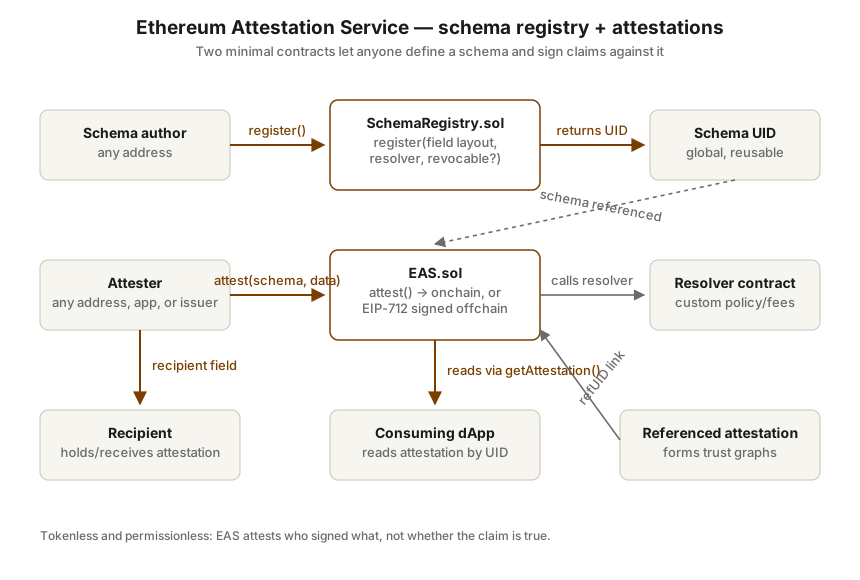 Open full-size diagram
Summary
The Ethereum Attestation Service (EAS) is an open-source, permissionless, tokenless infrastructure protocol — self-described as a public good — for making cryptographically signed claims ("attestations") about anything, either onchain or offchain, on any EVM-compatible chain. It was created by Steve Dakh (co-founder and CTO, a longtime Ethereum builder behind the early KryptoKit wallet) and Bryce Patrick, and went live on Ethereum mainnet on 2023-03-06 after earlier testnet and multi-L2 rollouts. Rather than being an application, EAS is deliberately a minimal base-layer primitive: two small smart contracts that let anyone define a data structure and then sign statements conforming to it. Its design goal is credible neutrality — no token, no API keys, no gatekeeper — so that identity systems, reputation systems, provenance records, voting, DAO roles, and account-abstraction authorizations can be built on a shared, standardized attestation layer instead of each project reinventing one.
Design (Mechanism)
EAS runs on exactly two core contracts:
- SchemaRegistry.sol — Anyone can call
registerto define a schema: an ABI-encoded field layout (e.g.,bool isHuman, string name), an optional resolver contract, and whether attestations of this schema are revocable. Schemas are global, reusable, and referenced by a unique schema UID. There is no permission to register. - EAS.sol — The
attestfunction creates an attestation against a schema. Each attestation carries an attester, an optional recipient, an expiration time, a revocability flag, an optional reference to another attestation's UID, and the encoded data. Each attestation gets its own UID.
Key mechanisms layered on top:
- Onchain vs offchain attestations. Onchain attestations are stored in state (permanent, composable, gas-costly). Offchain attestations are EIP-712-signed objects held by the holder; only a hash/timestamp need touch the chain, giving privacy and near-zero cost while remaining verifiable.
- Resolvers. A schema can point to a resolver contract that runs custom logic on every attestation/revocation — enforcing fees, gating who may attest, minting NFTs, or triggering governance. This is how EAS stays minimal while supporting arbitrary policy.
- Referenced attestations. An attestation can point to another's UID, enabling graphs of claims (attestations about attestations), which is how reputation and web-of-trust structures are composed.
- Revocation and expiration. Revocable attestations can be withdrawn by the attester; expiration times bound validity.
- Privacy via Merkle roots. Offchain attestations can encode a Merkle root so individual fields are selectively disclosable without revealing the whole payload.
- Tooling. The ecosystem ships an EAS SDK (TypeScript) and EASScan (easscan.org), an Etherscan-style explorer/indexer for schemas and attestations across supported chains.
The contracts are MIT-licensed and deployed at deterministic addresses across Ethereum mainnet and many L2s (Optimism, Base, Arbitrum, Polygon, Scroll, zkSync, Celo, Linea) plus testnets.
Outcome
EAS achieved rapid and durable adoption as canonical Ethereum-ecosystem infrastructure. Its most important early validation came from Optimism, which adopted EAS as the attestation base layer for its identity/reputation work (superseding its earlier bespoke AttestationStation and feeding Optimist profiles and retro-funding-style contributor records). Coinbase's Base network, the Ethereum Foundation, ETHGlobal, and Scroll are associated as ecosystem partners/backers, and Coinbase built its onchain "Verifications" (verified-account, country, accredited-investor) product on EAS. As a tokenless public good, EAS has no market cap or token-price outcome to judge; the relevant metric is that it became the default attestation primitive multiple major chains and apps standardized on, with a live explorer, active schemas across chains, and continued development (later positioning attestations as the trust layer for autonomous agents). Its outcome is best characterized as a major_success as infrastructure, with the important caveat that "success" here is adoption and neutrality, not revenue — the project intentionally forgoes a business model.
Why it worked
- Radical minimalism. By shipping only two contracts and pushing all policy into optional resolvers, EAS avoided over-fitting to any one use case and became a genuine primitive others could extend.
- Credible neutrality. Being tokenless, permissionless, free, and MIT-licensed removed the usual reasons projects distrust shared infrastructure (rent extraction, lock-in, governance capture), making it safe for competitors to standardize on the same layer.
- Right timing and a marquee anchor tenant. Launching as the Ethereum ecosystem was actively searching for identity/reputation and Sybil-resistance primitives, and being adopted by Optimism/Base, gave it immediate network effects.
- Offchain + onchain duality. Supporting cheap, private offchain attestations made real-world, high-volume use cases economically viable in a way a purely onchain design could not.
Limitations and criticisms
EAS's model carries several structural limits:
- No sustainability model. As a tokenless public good it depends on grants and founder/ecosystem goodwill; there is no built-in funding mechanism, which is a chronic risk for maintenance-heavy infrastructure.
- EAS attests, it does not verify. The protocol guarantees who signed what, not whether the claim is true. Trust still lives entirely off-protocol in the reputation of attesters, so garbage-in/garbage-out and Sybil concerns persist.
- Standardization is uneven. Because anyone can register schemas, the schema space is fragmented and unopinionated; discovering the "right" schema and bootstrapping trusted issuers remains a social, not technical, problem.
- Composability without curation can produce noise: an open attestation graph is only useful if consumers know which attesters to trust.
Lessons
- Ship a primitive, not a product. The two-contract design plus resolver hooks shows that leaving policy to the edges — rather than baking opinions into the core — is what let many competing teams adopt the same base layer.
- Neutrality is a feature you must design for. Explicitly refusing a token and API keys was a product decision that unlocked adoption by rivals; monetization would likely have fragmented the ecosystem into competing attestation layers.
- Cryptographic authenticity ≠ truth. An attestation layer solves "who said this" but deliberately punts on "is this true," meaning the hard problem (trusted issuers, Sybil resistance, reputation) is displaced upward to applications and never actually disappears.
- Onchain/offchain hybridity matters. Making attestations cheap and private via offchain signing + optional onchain timestamping was essential for real adoption; pure-onchain designs would have been priced out of most use cases.
Redesign (EDITORIAL — hypothesis, not fact)
The following is the researcher's editorial hypothesis, not established fact. EAS's biggest unresolved gap is the trust/curation layer: an open schema-and-attestation graph is powerful but leaves consumers to solve issuer discovery and Sybil resistance themselves. A redesign could add an optional, opt-in issuer-reputation and schema-canonicalization layer — a lightweight, still-neutral registry where communities can endorse "canonical" schemas and stake or vouch for trusted attesters, producing machine-readable trust weights without EAS itself becoming an arbiter of truth. This could be implemented purely as resolvers and referenced-attestation conventions to preserve the credibly-neutral core. On sustainability, rather than introducing a token (which would undermine neutrality), the protocol could formalize a protocol-guild / endowment funding model with public commitments from the L2s and apps that depend on it, insulating maintenance from grant cycles. Finally, first-class selective-disclosure and zero-knowledge verification (proving an attestation satisfies a predicate without revealing its contents) would push EAS beyond timestamped hashes toward genuinely privacy-preserving credentials, which is likely the highest-leverage direction as AI-agent and real-world-identity use cases grow.
Sources
- EAS Official Documentation (Welcome / FAQs) — primary (docs)
- eas-contracts GitHub repository (deployments, MIT license) — primary (contract)
- attest.org official site — primary (docs)
- EAS 'live on Mainnet' launch announcement — primary (news)
- Bankless #187 — The Ethereum Attestation Service (founders interview) — primary (retrospective)
- CoinDesk — Optimism to use EAS to promote user trust (news)
- QuickNode Guide — What Is EAS & How to Use It (analysis)
Related experiments
Last verified: 2026-07-26 · Spot an error? Suggest a correction