Soulbound Tokens
Non-transferable tokens that bind credentials, affiliations, and reputation to a wallet ('Soul') to encode identity and trust onchain rather than transferable wealth.
▶ Run interactive simulation animated mechanism with editable parameters
How it works onchain
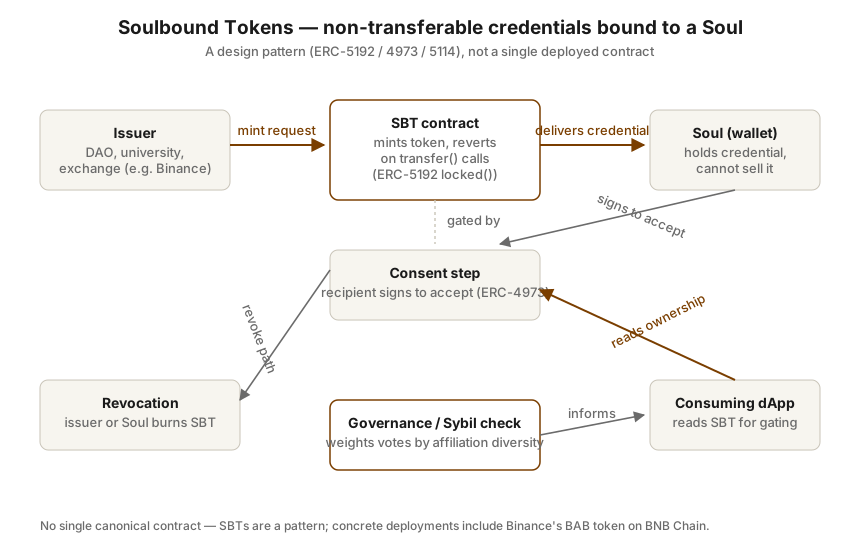 Open full-size diagram
Summary
Soulbound Tokens (SBTs) are non-transferable tokens that bind credentials, memberships, achievements, and reputation to a specific wallet — a "Soul" — rather than being freely tradeable like ordinary NFTs. The idea was popularized by Ethereum co-founder Vitalik Buterin in a January 26, 2022 blog post titled "Soulbound," which took its name and metaphor from World of Warcraft's "soulbound" items that cannot be traded once acquired, forcing a player to earn them personally. In May 2022, Buterin, economist E. Glen Weyl, and lawyer/technologist Puja Ohlhaver expanded the concept into a 37-page paper, "Decentralized Society: Finding Web3's Soul" (DeSoc), positing SBTs as the foundational primitive for an onchain society organized around identity and trust rather than transferable capital. SBTs are best understood as a design pattern and set of token standards (ERC-5192, ERC-4973, ERC-5114) plus a broad research agenda — not a single product, company, or contract.
Design (Mechanism)
The core mechanism is non-transferability. A Soul is a wallet that accumulates SBTs representing commitments, credentials, and affiliations (e.g., a POAP for event attendance, a university degree, a DAO role, a KYC attestation). Because these tokens cannot be sold, they signal "who you are and not just what you can afford," making credential markets and vote-buying much harder.
Vitalik's original post enumerated several implementation strategies, and the ecosystem later codified them into competing standards:
- Full non-transferability — the token contract simply reverts on transfer. ERC-5192 ("Minimal Soulbound NFTs," Final, proposed July 2022) adds a
locked()view function and an EIP-165 interface ID (0xb45a3c0e) so wallets can detect permanent non-transferability while staying fully backward-compatible with ERC-721. - Account/consent binding — ERC-4973 ("Account-bound Tokens") defines a minimal, non-ERC-721 interface where the recipient must sign to accept the token (consent-based minting), preventing unwanted "credential spam."
- NFT binding — ERC-5114 ("Soulbound Badge") binds a badge to another NFT at mint and freezes its metadata/URI forever, aimed at permanent certifications.
- Revocation — issuers (or the Soul itself) can revoke SBTs, which is essential for expirable or mistaken credentials and for a "burnable" identity.
- Privacy layer — the paper and blog discuss hashing, Merkle proofs, and ZK-SNARKs so a Soul can prove it holds a credential without revealing all its contents.
Beyond the token itself, DeSoc sketched higher-order applications: community recovery (a Soul's SBT-issuing communities help socially recover a lost wallet), Sybil-resistant and correlation-discounted governance (weighting votes by the diversity of a voter's affiliations to resist collusion), and plural, decomposable property rights.
Outcome
Status: partial_success. As a meme and research frame, SBTs were a runaway success — "soulbound" entered mainstream crypto vocabulary in 2022, the DeSoc paper became one of the most-cited crypto-social works of the era, and standards were drafted and finalized (ERC-5192 reached "Final"). Real deployments followed: Binance launched Binance Account Bound (BAB) on BNB Chain on September 8, 2022, described as the first-ever SBT on that chain — a non-transferable, no-monetary-value KYC credential airdropped to verified users and consumable by dApps for Sybil resistance and airdrops. Adjacent identity/attestation systems (Gitcoin Passport, POAP, Ethereum Attestation Service, and various DAO credentialing tools) adopted soulbound or attestation semantics.
However, the grander DeSoc vision — a society coordinated by Souls, community recovery, and correlation-discounted governance — was not realized at scale. No dominant consumer "Soul wallet" emerged, competing standards fragmented interoperability, and the privacy and revocation tooling needed to make SBTs safe for sensitive credentials matured slowly. Much of what SBTs proposed has, in practice, migrated toward the language of verifiable credentials and attestations rather than literal non-transferable tokens.
Why it worked
- A sharp, memorable framing. "Soulbound" gave a name to a real gap (identity/reputation) in a space otherwise dominated by transferable financial assets, and the World of Warcraft analogy made it instantly legible.
- Authoritative authorship. Buterin's involvement plus Weyl's mechanism-design credibility gave the concept immediate reach and legitimacy, catalyzing EIP activity and exchange-level deployments within months.
- Low technical barrier for the minimal version. Reverting on transfer is trivial; ERC-5192 required only a tiny addition to ERC-721, so builders could ship "soulbound" tokens cheaply.
Where the design broke
- Standard fragmentation. ERC-5192, ERC-4973, and ERC-5114 (plus ad-hoc "revert on transfer" contracts) coexist with different semantics, undermining the composability SBTs were supposed to unlock.
- Privacy problem. Publicly binding sensitive credentials (health, KYC, employment) to an address is a doxxing and profiling risk; the ZK/hashing tooling that would fix this was aspirational at launch and remained hard to deploy.
- Key loss and revocation are unsolved at scale. Non-transferability makes lost keys catastrophic; "community recovery" stayed largely theoretical, and revocation/expiry standards were immature.
- Weak demand for the full vision. Sybil-resistant, correlation-discounted governance is complex and rarely adopted; most real usage collapsed to simple attendance/KYC badges rather than DeSoc's ambitious social graph.
Lessons
- A naming and framing breakthrough can outrun the tooling. SBTs won the narrative war years before the privacy, recovery, and interoperability infrastructure existed to make the concept safe for high-stakes credentials.
- Non-transferability is a feature and a liability. Removing transfer solves credential-buying but reintroduces key-loss, revocation, and privacy problems that transferable assets never had to answer — those secondary problems, not the token itself, are the hard part.
- Standards should ship with policy, not just interfaces. Leaving revocation, expiry, consent, and privacy as "implementation choices" produced fragmentation; the durable descendants (attestations/verifiable credentials) baked more policy in.
- The market picks the minimal viable subset. Of a sweeping social vision, what actually shipped was the simplest slice (attendance and KYC badges), a reminder to design for the primitive people will actually use.
Redesign (EDITORIAL — hypothesis, not fact)
The following is the researcher's editorial hypothesis, not established fact.
A redesign would separate the three jobs SBTs conflated: the credential, the identity it binds to, and the privacy/revocation policy. Rather than binding a public token permanently to a raw EOA, bind attestations to a stable, recoverable identity abstraction (a smart-contract account or ENS-anchored identity) so key loss is survivable and "community recovery" becomes a first-class, standardized flow rather than a paper concept. Store credentials off-chain or as ZK commitments by default, with onchain state holding only a hashed/nullifier-based pointer, so a Soul can selectively disclose ("I hold an accredited degree") without publishing its entire reputation graph — treating privacy as the default, not an optional add-on. Make revocation and expiry mandatory fields in the standard so issuers can invalidate credentials and holders can burn them, converging the fragmented ERC-4973/5114/5192 landscape onto one attestation-centric schema (aligning with the direction the Ethereum Attestation Service and verifiable-credential ecosystems took). Finally, reframe governance uses around opt-in, correlation-aware weighting with explicit anti-collusion guarantees and small pilot scopes, since the fully general DeSoc governance model proved too complex to adopt. In short: keep the "who you are, not what you can afford" insight, but move from a public, permanent, single-token design to a private, recoverable, revocable attestation layer.
Sources
- Soulbound (Vitalik Buterin original blog post) — primary (docs)
- Decentralized Society: Finding Web3's Soul (Weyl, Ohlhaver, Buterin) — SSRN — primary (analysis)
- Decentralized Society: Finding Web3's Soul — Microsoft Research listing — primary (analysis)
- ERC-5192: Minimal Soulbound NFTs (Final) — primary (docs)
- EIP-4973: Account-bound Tokens (Ethereum Magicians) — primary (docs)
- ERC-5114: Soulbound Badge — primary (docs)
- Binance to Launch Binance Account Bound (BAB), First-Ever SBT on BNB Chain — primary (docs)
- What Are Soulbound Tokens (SBT)? — Binance Academy (docs)
- Review of Decentralized Society and Soulbound Tokens Paper — The Blockchain Socialist (analysis)
Related experiments
Last verified: 2026-07-26 · Spot an error? Suggest a correction