Coordinape
A peer-allocation compensation tool where DAO contributors distribute fixed GIVE tokens to rank each other's value, converting those rankings into treasury payouts.
▶ Run interactive simulation animated mechanism with editable parameters
How it works onchain
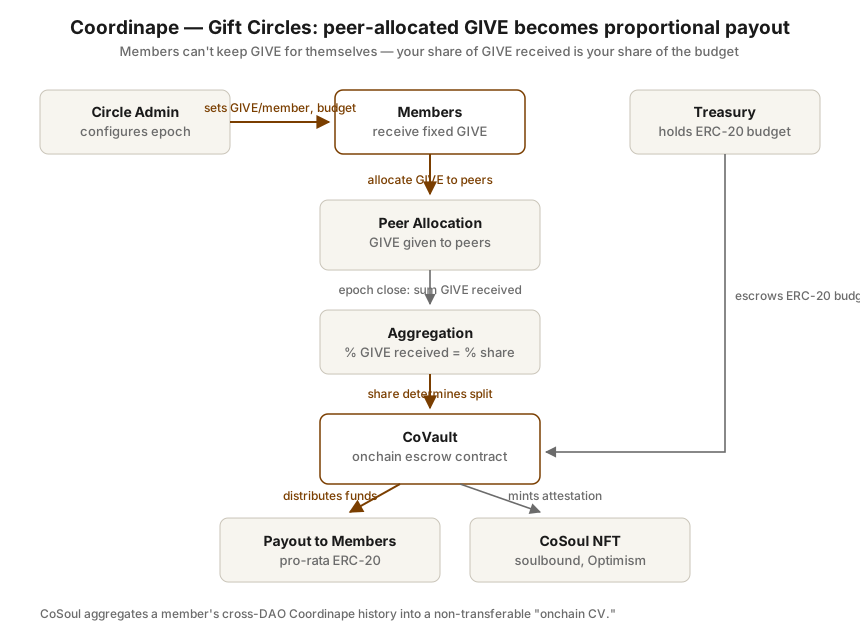 Open full-size diagram
Summary
Coordinape was one of the earliest and most widely adopted onchain compensation-coordination tools for DAOs. It was incubated inside Yearn Finance in early 2021 to solve a specific problem: how to fairly distribute a recurring community grants budget (roughly $40,000/month at Yearn) among pseudonymous contributors without a manager deciding who gets what. The core primitive was the "Gift Circle," in which every participant received a fixed budget of non-transferable GIVE tokens each epoch and allocated them to peers whose work they valued. Aggregating everyone's allocations produced a distribution that the treasury then converted into real payouts.
Yearn co-founder Andre Cronje publicly revealed Coordinape on March 31, 2021; the pseudonymous Yearn contributor Tracheopteryx had led its development since February 2021, alongside Zach Anderson and a contributor known as Zemm. It later spun out into an independent company. At its peak (2022) it was used by roughly 300 DAOs including BanklessDAO, Gitcoin, PoolTogether, Index Coop, and DAOhaus. The project expanded into onchain reputation (CoSoul, a soulbound NFT on Optimism) and a SocialFi network (CoLinks) before launching a $CO token on Base in 2025. The application was sunset in 2025, with the homepage now serving as a "monument" and governance/IP handed to a token-holder DAO ("CoDAO"). This makes Coordinape a canonical case of a mechanism that was influential and technically sound but never found a durable business model.
Design (Mechanism)
The atomic unit is a Circle — a group of contributors within a DAO. Circle admins configure three parameters: GIVE tokens per member per epoch (100 by default), epoch duration, and the budget to be distributed.
- Peer allocation of GIVE. Each epoch, every member receives the same fixed allotment of GIVE. Crucially, members cannot keep GIVE for themselves — they must give it to peers they believe added value. This inverts the usual self-advocacy dynamic of compensation into a mutual-recognition dynamic.
- Aggregation into payouts. At epoch close, each contributor's share of total GIVE received maps directly to their share of the budget. Receive 20% of the circle's GIVE and you get 20% of the payout pool. An interactive "circle map" visualizes flows for transparency.
- Opt-outs and vouching. Members can opt out of receiving (e.g., founders declining pay), and later features added CSV import and vouching to gate circle membership.
- CoVaults. Smart-contract vaults that let DAOs escrow ERC-20 funds and pay out allocation results directly onchain, removing a manual treasury step.
- CoSoul (2023). A free-to-mint, non-transferable (soulbound) NFT on Optimism (contract
0x47c2a56176335fb2b1ded8e7b5acb136d307dc2d) that aggregates a contributor's cross-DAO participation history into an "onchain CV," reportedly reaching 25,000+ mints. - CoLinks (2023) and $CO (2025). CoLinks was a reputation-weighted SocialFi network reusing friend.tech-style key contracts; in 2025 a $CO token launched on Base to power a "Social Oracle" attestation system before the app was wound down.
The mechanism is a lightweight, subjective form of computational social choice — closer to reputation-weighted peer review than to quadratic funding, though it shares the "many small signals aggregate to an asymmetric outcome" philosophy. Tracheopteryx cited Teal organizational theory (worker self-management) as an explicit design inspiration.
Outcome
Status: technically_successful_commercially_unsuccessful. The mechanism worked as designed and spread virally across the 2021–2022 DAO boom, becoming near-standard infrastructure for contributor compensation and grant distribution at hundreds of DAOs. It demonstrably enabled peer-based payroll at scale for pseudonymous teams. However, the project never converted this adoption into durable revenue. As the broader DAO wave receded (2022–2024), usage of recurring compensation circles declined, and the pivots into reputation NFTs, SocialFi (CoLinks), and finally a token (2025) did not restore momentum. The team sunset the application in 2025 and transferred IP/governance to a token-holder DAO, leaving 64,000+ onchain attestations permanently on Base as its legacy per the official site.
Why it worked
- It solved a real, acute pain. Early DAOs had money and pseudonymous labor but no fair, non-managerial way to compensate. Coordinape's gift-circle mechanism was a clean, immediately usable answer.
- Low-friction, high-legibility design. Fixed equal GIVE budgets plus a simple "your share of GIVE = your share of budget" rule made outcomes easy to understand and hard to game overtly, while the circle map made distributions socially visible.
- Distribution via a credible parent. Being incubated inside Yearn — a respected, heavily pseudonymous DAO — gave instant credibility and a template other DAOs copied.
- Perfect timing. It rode the 2021 DAO explosion when thousands of new organizations needed exactly this primitive.
Where the design broke
- No natural monetization. A tool that helps DAOs give away their own treasury has weak willingness-to-pay; the value it created accrued to users, not the protocol.
- Demand was tied to the DAO cycle. When DAO activity and treasuries contracted, recurring-compensation demand fell with them.
- Product surface expanded faster than the core wedge deepened. Compensation, soulbound reputation, SocialFi, and a token were each added as separate product categories with distinct users and go-to-market needs, spreading limited engineering and distribution resources across four markets instead of concentrating them on making peer compensation indispensable.
- Peer allocation has social failure modes. It can reward popularity, in-group visibility, and reciprocity ("I GIVE to you, you GIVE to me") rather than raw contribution, limiting trust in high-stakes payroll.
Lessons
- A viral coordination primitive is not a business. Coordinape proves you can achieve broad adoption of an elegant onchain mechanism while capturing almost none of the value — tooling that helps organizations spend their own money must find a monetization path orthogonal to the core action.
- Anchor to a durable demand curve. Because the product's demand was coupled to the DAO hype cycle, it had no floor when that cycle turned; mechanisms should be validated against demand that survives a bear market.
- Extending into adjacent categories has a resource-splitting cost. Reputation NFTs, SocialFi, and a token each added a distinct market and user base on top of the original one; without abandoning any of them, none accumulated enough sustained investment to become indispensable on its own.
- Subjective peer allocation needs anti-collusion design. Reciprocity and popularity effects mean naive "gift" mechanisms drift from merit; robust versions need sybil resistance, reciprocity dampening, or blinded allocation.
Redesign (EDITORIAL — hypothesis, not fact)
The following is the researcher's opinion, not established fact.
A redesigned Coordinape would treat peer allocation as a reputation oracle first and a payout tool second, and would monetize the oracle rather than the payroll. Concretely:
Anti-reciprocity mechanics. Introduce blinded or lagged allocation (you allocate before seeing others' allocations, and same-epoch mutual GIVE is discounted) plus a reciprocity-penalty term, so the signal reflects value rather than social back-scratching. Pair-wise reciprocity above a threshold could be down-weighted algorithmically.
Sybil-resistant identity as the moat. Bind circles to a proof-of-personhood or stake-weighted identity layer so the resulting reputation graph is trustworthy enough to sell — the defensible asset is a credible cross-DAO contribution graph, not the compensation UI.
Monetize the attestation layer, not the gift. Charge for verified reputation attestations, credentialing, and API access to the graph (recruiting, undercollateralized reputation-based credit, grant due-diligence) — buyers who benefit from trust, keeping the compensation tool free to maximize graph coverage.
Keep the wedge narrow and deep. Resist SocialFi/token pivots; instead make recurring peer compensation genuinely indispensable (integrations with payroll, tax, streaming payments like Sablier/Superfluid, and treasury tooling) so the tool becomes sticky operational infrastructure rather than a discretionary widget.
The through-line: the original design monetized the compensation tool rather than the reputation graph it generated. The value was always in the graph of who-values-whom; a second attempt should make that graph trustworthy, defensible, and directly sellable while giving the coordination tool away.
Sources
- Coordinape official homepage (sunset monument, 2021–2025 timeline) — primary (docs)
- Yearn.finance reveals 'Coordinape' decentralized grant distribution platform (news)
- Coordinape Is Decentralizing Compensation Decision-Making (CoinDesk) (news)
- This Free-to-Mint Soulbound NFT Tracks Your Web3 Work History (CoinDesk, CoSoul) (news)
- Coordinape Launches 'CoLinks' Professional Social Network (The Defiant) (news)
- Booting Up: CoLinks (Coordinape blog) — primary (docs)
- CoSoul NFT contract on Optimism (block explorer / OpenSea collection) — primary (contract)
- Tracheopteryx: Yearn, Coordinape, and pseudonymity (Into the Bytecode interview) (retrospective)
Related experiments
Last verified: 2026-07-26 · Spot an error? Suggest a correction