Proof of Humanity
A Sybil-resistant registry of unique humans built on Ethereum that combined video/photo submissions, social vouching, and Kleros-court dispute resolution, paired with a Universal Basic Income ($UBI) token.
▶ Run interactive simulation animated mechanism with editable parameters
How it works onchain
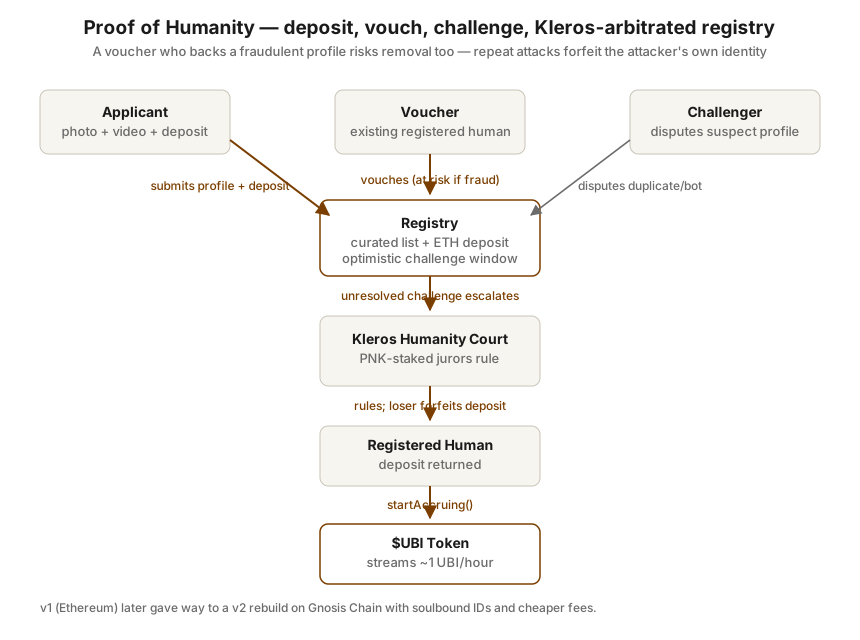 Open full-size diagram
Summary
Proof of Humanity (PoH) is a Sybil-resistant registry of unique, living human beings on Ethereum, launched in March 2021 by contributors from the Kleros Cooperative (Federico Ast, Clément Lesaege, Damjan Malbašić) in collaboration with Santiago Siri's Democracy Earth Foundation. It was one of the earliest and most-cited "proof-of-personhood" experiments: a person registers a profile containing their name, a photo, and a short video stating a required phrase, posts an ETH deposit, and is vouched for by an already-registered human. Registrations pass through an optimistic window during which anyone can challenge a suspected duplicate, bot, or impersonator; challenges are adjudicated by Kleros's decentralized "Humanity Court" of token-staked jurors. Verified humans became eligible to claim a Universal Basic Income token ($UBI) that streamed continuously to each unique identity, and the registry was intended as a foundational primitive for one-person-one-vote governance, airdrops, and anti-bot use cases. Within roughly two years v1 accumulated on the order of 17,000–19,000 registered humans. The project is a landmark of the "internet of humans" thesis but was hobbled by governance civil war, a collapsing incentive token, and the cost of on-chain video verification, prompting a v2 rebuild on Gnosis Chain.
Design (Mechanism)
- Curated registry with deposits. To register, a submitter deposits ETH and publishes a profile (name, photo, video). The deposit is at risk if the submission is successfully challenged, so honest submitters recover it while fraudulent ones lose it.
- Social vouching. A new applicant needs a vouch from an existing registered human. Crucially, a voucher who backs a fraudulent profile risks removal from the registry themselves — a "skin-in-the-game" self-policing loop that makes serial fraud expensive because an attacker's own identity is forfeit on a second failed attack.
- Optimistic challenge + Kleros arbitration. During a challenge period anyone can dispute a profile (e.g., duplicate, deceased person, not a real human, does not match another entry). Disputes escalate to Kleros's Humanity Court, where jurors stake PNK and rule; correct challengers are paid from the loser's deposit. This outsources subjective "is this a unique human?" judgment to a crypto-economic court rather than a central admin.
- Continuous identity + $UBI. Each accepted profile is a single "humanity" entry. Democracy Earth's $UBI ERC-20 accrued to registered humans at a fixed per-second rate, providing an economic reason to register and to keep one's profile valid.
- DAO governance. A PoH DAO governed parameters via Humanity Improvement Proposals (HIPs) and Snapshot voting; the inaugural board included Siri, Herb Stephens, Lesaege, and Ast.
- v2 redesign. After the v1 crisis, PoH 2.0 deployed on Gnosis Chain with cheaper fees, soulbound (non-transferable) IDs, and cross-chain readability, addressing Ethereum-mainnet gas costs.
Outcome
Status: partial_success. PoH v1 proved the core mechanism worked at meaningful scale — roughly 17,000–19,000 verified humans, adoption by high-profile users (including Vitalik Buterin), and heavy citation as a reference proof-of-personhood design. Kleros's court also demonstrably defended the system: the DAO reports the arbitration layer blocked more than $100,000 from being stolen during governance attacks. However, the experiment did not become the durable universal identity layer it aimed for. The $UBI incentive collapsed — a large early holder ("the Whale") dumped roughly $1M of UBI, driving the token from about $110 to $6 and destroying much of the registration incentive. Governance fractured in 2022 around HIP-49/HIP-50 (a proposal to replace Kleros as arbitrator with a UBI-token-based Kleros fork), a near-miss vote (failing by ~21 votes), and a personality/founder-legitimacy dispute with Santiago Siri. The community adopted a binding proposal to fork by end of 2022, and the effort effectively split, with the Kleros-aligned continuation moving to Proof of Humanity 2.0 on Gnosis Chain. So the mechanism succeeded technically while the social/governance and token layers underperformed.
Why it worked
- Novel, credible Sybil-resistance without a central verifier. Combining deposits, human video, vouching, and a decentralized court gave a plausible answer to "how do you prove one real human" without KYC or a trusted admin.
- Reused a battle-tested primitive. It extended Kleros's earlier token-curated-registry and dispute-court machinery, so the hardest component (adjudication of subjective claims) already existed.
- Strong economic pull. The $UBI stream and airdrop-style rewards gave ordinary users a concrete reason to onboard, driving tens of thousands of registrations quickly.
- Attack resilience in practice. The layered deposits and court showed real defensive value, reportedly preventing six-figure theft during contested governance.
Where the design broke
- Incentive-token collapse. UBI's price crash after a whale dump gutted the economic reason to register and stay verified, and tied the identity layer's fate to a speculative token.
- Governance civil war. Conflict between the Kleros Cooperative faction and the Democracy Earth/Siri faction — including disputed founder claims and the HIP-49 fork proposal — polarized the DAO along a single political axis and ended in a binding fork.
- High friction and cost. On-chain registration required a video, an ETH deposit, and vouching, and Ethereum-mainnet gas made onboarding expensive and slow, capping growth and pushing v2 to Gnosis Chain.
- Privacy and centralization tensions. Publishing name/photo/video on-chain is a serious privacy exposure, and dependence on Kleros as the sole arbitrator became a governance flashpoint.
Lessons
- Coupling an identity primitive to a speculative reward token is fragile: when the token collapses, the incentive to maintain honest identities collapses with it, and the whole registry's health becomes hostage to tokenomics.
- Proof-of-personhood is at least as much a governance problem as a cryptographic one: PoH's mechanism held up, but irreconcilable factions and founder-legitimacy fights, not code, caused the fork.
- Deposit + vouching + decentralized court is a genuinely powerful Sybil-resistance pattern that other designs can reuse — the self-forfeiting voucher makes repeat attacks expensive.
- Cost and privacy determine reach: mandatory public video plus mainnet gas limited PoH to tens of thousands rather than millions; cheaper chains and privacy-preserving verification are prerequisites for a universal identity layer.
Redesign (EDITORIAL — hypothesis, not fact)
This section is the researcher's editorial hypothesis, not established fact.
A redesigned PoH would decouple identity from any speculative token. Rather than streaming a volatile $UBI whose price crash destroys onboarding incentives, verification could be free-to-cheap and settle on a low-fee L2, with any rewards paid in a stable unit or granted as non-financial reputation. Privacy is the second lever: replace public on-chain name/photo/video with zero-knowledge proofs of uniqueness (e.g., biometric or liveness attestation hashed and proven, à la later "world ID"-style designs) so a person proves "I am a unique unregistered human" without doxxing themselves — retaining PoH's decentralized-challenge ethos by letting challengers dispute proofs, not raw media. Third, arbitration should be pluralistic and forkable by design: hard-coding a single court (Kleros) turned an economic dependency into a governance war, so a redesign would let the registry read from multiple competing dispute providers with a slow, credibly-neutral meta-governance process, reducing the payoff of factional takeover attempts. Finally, governance itself should minimize the single-axis polarization that led v1 to fork — smaller mandate for the core DAO, clearer separation between protocol parameters and community/communications control, and time-locked, quorum-gated forks so a 21-vote swing can't nearly destroy the protocol overnight. The bet: PoH's core deposit-vouch-challenge mechanism was sound; what needed replacing was the token dependency, the privacy model, the single arbitrator, and the winner-take-all governance surface.
Sources
- Proof of Humanity — official registry site — primary (docs)
- Proof of Humanity — Kleros documentation — primary (docs)
- Proof of Humanity: Building the Internet of Humans (announcement, Ast/Lesaege/Malbašić) — primary (docs)
- ProofOfHumanity v1 contract on Etherscan — primary (contract)
- Making sense of recent drama in Proof of Humanity — Clément Lesaege — primary (retrospective)
- Proof of Humanity: Ethnographic Research of a 'Democratic' DAO (Cossar, Merk, Kamalova, De Filippi) (analysis)
- How Blockchain Could Solve the Problem of Digital Identity — TIME (news)
- Kleros Project Update — May 2023 (v2 / fork context) (governance)
Related experiments
Last verified: 2026-07-26 · Spot an error? Suggest a correction