Fabric / Hypersub
Fabric's Subscription Token Protocol (STP) turned recurring subscriptions into time-based ERC-721 NFTs, and its Hypersub app became the de facto membership layer of the Farcaster creator economy before the company pivoted to DEX aggregation.
▶ Run interactive simulation animated mechanism with editable parameters
How it works onchain
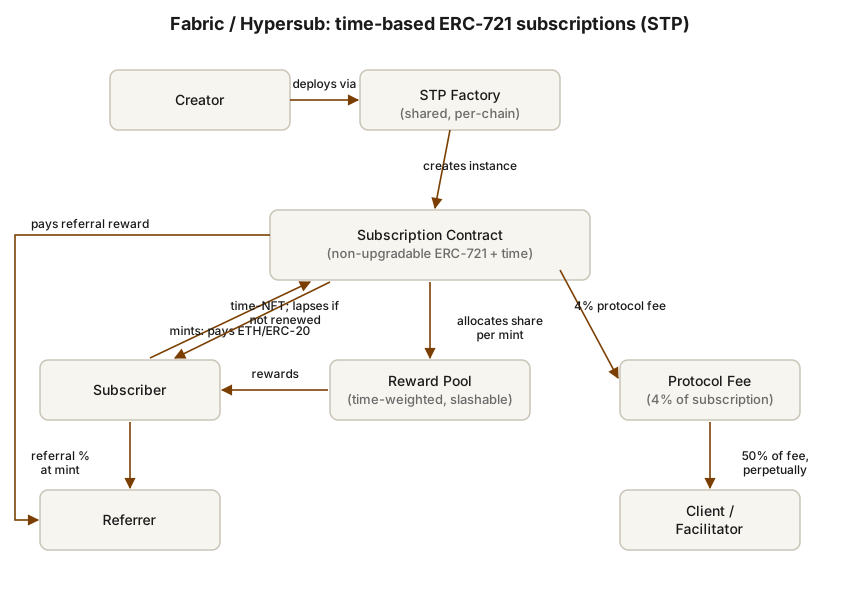 Open full-size diagram
Summary
Fabric Inc. (founded 2022 by Jonny Mack, Dan Simpson, and Chris Douglas; seed-funded by Polychain Capital, Eniac Ventures, Mischief, and Reverie) set out to build "permissionless capital coordination" primitives. After a modest first product — an onchain crowdfunding protocol launched April 2023 that raised ~$500k across 377 campaigns — the team shipped its flagship experiment on October 31, 2023: the Subscription Token Protocol (STP), plus a consumer app called Hypersub. STP extends ERC-721 with a temporal dimension: minting a subscription NFT buys time, and the token lapses unless renewed. Hypersub became the standard membership/recurring-revenue tool of the Farcaster creator ecosystem, ultimately routing about $1.2M to 2,279 unique creators from 45,287 unique subscribers. The protocol worked as designed and was widely integrated (token-gating, Splits, Neynar/Farcaster tooling), but the absolute revenue base was small; by 2025–26 Fabric had pivoted to DEX aggregation (spanDEX), repurposing its docs site, while the non-upgradable STP contracts and Hypersub site remain live.
Design (Mechanism)
- Time-based NFT subscriptions. STP is a non-upgradable, EVM-compatible extension of ERC-721. A creator deploys a subscription contract from a shared factory; subscribers mint by paying in ETH or ERC-20, which credits seconds of subscription time at the creator's chosen rate. The NFT is a standard token, so any system that supports token-gating (chat apps, content platforms, Farcaster channels) can check membership permissionlessly — the "payment-capable CRM" is interoperable by default.
- Lapse instead of cancel. There is no offchain billing agreement to cancel; access simply expires when purchased time runs out. Renewal is another mint. This sidesteps the classic problem that Ethereum accounts cannot be "pulled" from on a schedule.
- Subscriber rewards with slashing. Deployers can allocate a share of each mint into a subscriber reward pool. Earlier and longer subscribers receive larger allocations, aligning fans with the creator's growth. If a subscription lapses beyond a grace period (half the subscription length), the lapsed member's reward allocation can be slashed and redistributed — an onchain loyalty mechanism.
- Referral rewards. Deployers can set a percentage of subscription revenue (e.g., 10%) paid at mint time to whoever referred the subscriber, making growth marketing a protocol-level primitive.
- Fees and partner incentives. A 4% protocol fee applies to subscriptions; clients/facilitators that drive deployments earn 50% of that fee in perpetuity — an attempt to bootstrap a third-party client ecosystem.
- STPv2 (June 21, 2024). Added Tiers (multiple price points/offerings per contract, with pricing that can vary based on a wallet's token holdings), a redesigned rewards system with configurable reward curves, and role-based multi-manager access controls. Revenue can be directed to any address, including Splits contracts, multisigs, or DAOs. Hypersub later added cross-chain payments (subscribe with any token on any chain, settling in the creator's denomination).
- Deployments. V1 factories on Ethereum, Base, Optimism, and Zora; the V2 factory on Base (addresses in frontmatter, sourced from Fabric's own SDK config).
Outcome
Technically and culturally successful; commercially marginal. By the STPv2 announcement (June 2024), 600+ subscription contracts had been deployed and over 168 ETH (~$600k) moved since the November 2023 rollout. Fabric's own retrospective "About" page reports lifetime totals of $1.2M earned by 2,279 unique creators from 45,287 unique subscribers, with ~120+ active creators across nine categories at peak (art, memberships, writing, music, podcasts, freelance, apps, gaming, Farcaster channels). Hypersub became tightly woven into Farcaster's economy (channel memberships, Neynar integration docs, Splits interoperability) — but that host ecosystem itself stagnated; Farcaster's developer Merkle Manufactory was acquired by Neynar in January 2026. At ~4% of $1.2M, cumulative protocol fees were on the order of tens of thousands of dollars — not a venture-scale business. Fabric redirected to a DEX meta-aggregator (spanDEX); the STP contracts, being non-upgradable and permissionless, continue to function, and hypersub.xyz remains online. No exploit or security incident was found in research.
Why it worked
- It matched the medium. Renew-to-extend NFTs elegantly solved recurring payments on chains with no native pull-payments, without custodial billing or upgradeable trust assumptions.
- Interoperability as distribution. Because membership was a plain ERC-721, every existing token-gating tool became a Hypersub integration for free; Splits and Farcaster tooling composed with it.
- Incentive-complete design. Referral rewards, subscriber reward pools with slashing, and perpetual client fee-shares meant every actor (fan, promoter, client developer) had an onchain reason to grow the network.
- Right community, right moment. Farcaster's 2023–24 creator wave supplied dense, crypto-native demand that most NFT platforms lacked.
Where the design broke
- Small TAM inside a small ecosystem. The paying audience was largely Farcaster power users; $1.2M lifetime creator earnings across ~2.5 years is a rounding error next to Patreon or Substack, and a 4% fee on it cannot sustain a venture-backed team.
- Host-platform dependency. Hypersub's fortunes tracked Farcaster's; as Farcaster's growth stalled and it was ultimately sold to Neynar (Jan 2026), the subscription economy built atop it plateaued.
- Onchain friction for mainstream creators. Wallets, gas, and crypto-denominated pricing (partially mitigated by cross-chain payments) kept non-crypto creators — the ones with large audiences — away.
- No cash-flow flywheel for the protocol itself. Generous revenue-sharing (50% of fees to clients, rewards to subscribers/referrers) was good mechanism design but thinned already-small protocol economics.
Lessons
- Expiring time-NFTs are the durable pattern for onchain subscriptions: they need no pull-payment authority, no upgradability, and inherit the entire token-gating ecosystem as integrations.
- A mechanism can be excellent and still be capped by its host network's size — protocol-market fit inside a niche social graph is not the same as product-market fit at large.
- Loyalty mechanisms (time-weighted reward pools with lapse-slashing) are an underused primitive: they convert "subscriber" from a cost-center relationship into an aligned, equity-like one.
- Non-upgradable contracts decouple protocol survival from company survival: Fabric pivoted, but every deployed subscription keeps working — a real benefit of credible neutrality, and a caution for anyone assuming ongoing app-layer support.
- Fee-sharing with clients (50% forever) is a plausible way to seed an ecosystem, but only if gross volume is large enough for halves of 4% to matter.
Redesign (EDITORIAL — hypothesis, not fact)
This section is editorial speculation, not a record of fact. A revived STP would attack distribution rather than mechanism, since the mechanism largely worked. First, make fiat the front door: onramp-abstracted checkout (card → stablecoin mint) with prices denominated in USD, so a mainstream creator can onboard fans who never see a wallet. Second, decouple from any single social graph: ship membership-verification SDKs for Discord, Telegram, YouTube, and open-web paywalls, treating Farcaster as one integration among many rather than the home market. Third, exploit the loyalty primitive harder — let creators grant lapsed-slashing-funded "founding member" status, transferable at a market price, turning early subscriptions into tradable social assets (with royalty flow back to the creator). Fourth, restructure protocol economics: keep the 4% fee but replace the perpetual 50% client share with a decaying share, and route a portion of fees into a protocol-owned liquidity/insurance pool so the protocol accrues a balance sheet even at modest volume. Finally, an AI-agent angle: time-based NFT subscriptions are a natural billing rail for autonomous agents paying for APIs and services onchain (the "onchain SaaS" use case Fabric itself named) — a machine-to-machine market that may dwarf the human creator niche the protocol was born into.
Sources
- Announcing the Subscription Token Protocol (Fabric blog) — primary (docs)
- Subscription Token Protocol – V2 (Fabric blog) — primary (docs)
- About – Who is Fabric (team, investors, lifetime metrics, pivot) — primary (docs)
- Hypersub official site — primary (docs)
- withfabricxyz/stp-v2 — Subscription Protocol V2 contracts — primary (contract)
- withfabricxyz/protocol-sdks wagmi.config.ts (deployment addresses) — primary (contract)
- Fabric DEX Aggregator docs (current, post-pivot) — primary (docs)
- Hypersub: Revolutionizing subscriptions on Farcaster, now with cross-chain payments (Warpwatch, Paragraph) (analysis)
- Into the Bytecode #35 – Jonny Mack: Hypersub, building for the crypto-native creator (analysis)
- Jonny Mack personal site (Fabric 2022–present, $5M funding) (archive)
Related experiments
Last verified: 2026-07-26 · Spot an error? Suggest a correction