Mirror
A decentralized publishing platform that turned essays into onchain assets via Writing NFTs, crowdfunds, splits, and Arweave storage, before its features were unwound and the product was sold to Paragraph.
▶ Run interactive simulation animated mechanism with editable parameters
How it works onchain
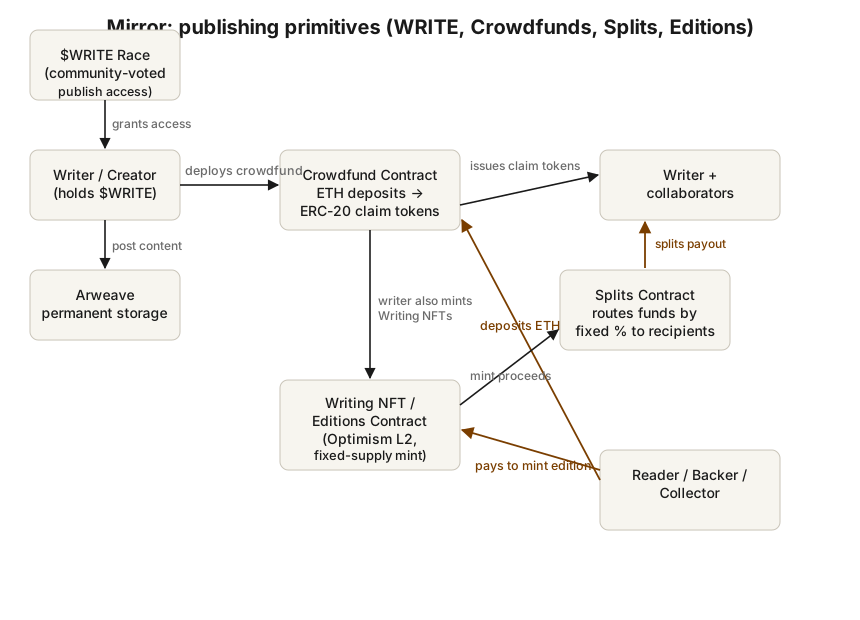 Open full-size diagram
Summary
Mirror was a decentralized publishing platform launched in late 2020 by Denis Nazarov, a former a16z crypto partner (and earlier co-founder of Mediachain, acquired by Spotify). Its thesis was that written content could be treated as a native onchain asset: essays could be minted as NFTs, funded by readers before they were written, split across collaborators automatically, and stored permanently on Arweave rather than on a company's servers. For a period in 2021–2022 Mirror was one of the most-cited "web3 creator economy" experiments, ranking among the top blockchain apps by traffic and hosting high-profile crowdfunds. It was raised at a reported ~$100M valuation with backers including Union Square Ventures and a16z.
Over time Mirror progressively removed its most experimental mechanisms, migrated storage away from Arweave, and in May 2024 sold the publishing product to competitor Paragraph, with Nazarov's team pivoting to a Farcaster-based social-commerce app called Kiosk. Mirror's publishing service was subsequently wound down and its content migrated to Paragraph.
Design (Mechanism)
Mirror combined several distinct onchain primitives, each an experiment in its own right:
- $WRITE token and the $WRITE Race: Early access to publish under a custom subdomain required a $WRITE token. Tokens were distributed through a weekly community-voted contest (the "$WRITE Race"), in which existing members voted to admit new writers. This created a curated, invite-gated membership rather than open signup.
- Crowdfunds: A smart contract on Ethereum let a creator raise ETH from readers before a project existed. Contributors deposited ETH and received ERC-20 tokens representing a claim on the project, so backers could share in the eventual value/revenue of the work. The best-known example was The Krause House DAO crowdfund (~1,000 ETH).
- Splits: Programmable revenue-sharing contracts that automatically routed incoming funds to multiple recipients by fixed percentages — used for collaborations and public-goods funding (e.g., a split across Gitcoin, ETHGlobal and The Mint Fund).
- Editions and Writing NFTs: Editions let creators mint a fixed-supply run of identical NFTs at a set price. Writing NFTs (launched May 2022) turned an individual article into a collectible; they were among the earliest NFT deployments on Optimism (an L2), cutting mint costs from roughly ~$6 to a couple of cents.
- Subscribe-to-Mint / web3 subscriptions: A later model tying subscription to minting/collecting behavior.
- Arweave storage: Post content was written to Arweave for permanent, censorship-resistant storage, central to Mirror's "data sovereignty" narrative.
Outcome
Outcome status: technically_successful_commercially_unsuccessful.
Technically, Mirror shipped and popularized primitives that outlived it — Splits and onchain crowdfunds became reference designs, and Writing NFTs on Optimism were an early proof that L2s made per-article NFTs economically viable. Per Mirror's own blog, over a million Writing NFTs were collected on Optimism, generating "upwards of 700 ETH" for creators. Third-party analyses cite peak traffic in the tens of millions of monthly visits and 100,000+ minted articles at its height.
Commercially and as a durable platform, it faded. From August 2022 onward Mirror removed the NFT/crowdfunding features that defined it, simplifying toward subscriptions. Traffic reportedly fell below ~2M monthly visits and out of the top blockchain-app rankings, and its valuation is said to have contracted sharply from the peak. In May 2024 the publishing product was sold to Paragraph (a deal reportedly brokered by common investor USV); Nazarov became an advisor and moved his team to Kiosk. Analyses also report that in early 2025 Mirror abandoned Arweave for centralized AWS storage — undercutting its original permanence promise — before the service was fully migrated into Paragraph.
Why it worked
- Right primitive, right timing: Framing writing as a mintable/fundable asset resonated during the 2021 NFT and creator-economy peak, giving Mirror strong early mindshare and a credible founder pedigree.
- Composability wins: Splits and Crowdfunds were simple, reusable smart contracts that fit naturally into the broader DAO/public-goods tooling stack, so they got adopted well beyond Mirror's own UI.
- Early L2 bet: Deploying Writing NFTs on Optimism made micro-priced collectibles viable and demonstrated a real product use case for rollups before it was common.
Where the design broke
- Speculative demand, not habitual demand: Collecting articles as NFTs and pre-funding essays was driven substantially by the bull-market collectible mania; when that receded, there was limited recurring reason to pay, and the token-gated $WRITE Race added friction versus free publishing tools like Substack.
- Retreat from its own thesis: Removing crowdfunds/NFTs in 2022 and later moving off Arweave to AWS hollowed out the differentiation ("permanent, onchain, creator-owned") that justified the platform's existence, leaving a product competing on ordinary blogging features.
- Consolidation over independence: A shrinking web3-publishing market couldn't support two players competing on the same feature set; the sale to Paragraph and pivot to Kiosk left standalone onchain publishing without a distribution layer large enough to sustain it as an independent product.
Lessons
- A novel asset wrapper is not a business model. Turning content into NFTs generated attention and one-time mint revenue, but sustainable creator platforms need recurring, non-speculative demand; a bull-market collectible loop is fragile.
- Composable primitives can succeed even when the host product fails. Splits and Crowdfunds arguably had more lasting impact as building blocks than Mirror-the-app did as a destination — value can accrue to the mechanism, not the platform that shipped it.
- "Decentralization" claims are only as strong as the least-decentralized dependency. Migrating from Arweave to AWS retroactively weakened Mirror's core promise; permanence/censorship-resistance narratives create obligations that are costly to keep and reputationally expensive to break.
- L2 timing matters. Being early to Optimism made a genuinely uneconomic mechanism (per-article NFTs) viable — infrastructure readiness can be the difference between a mechanism working or not.
Redesign (EDITORIAL — hypothesis, not fact)
The following is the researcher's editorial analysis, not established fact.
A redesigned Mirror would separate the durable primitives from the fragile consumer loop. The collectible-NFT-per-article mechanic should be optional garnish, not the core; the core value is (1) creator-owned distribution and (2) programmable money flows. I'd anchor monetization on recurring, utility-driven demand — token-gated archives, paid subscriptions settled onchain, and Splits-native collaborations — rather than on speculative minting, so revenue survives outside bull markets.
On credibility, permanence should be a verifiable, non-negotiable default: content-address every post (Arweave/IPFS) with an onchain pointer, and make any move to centralized storage impossible without an explicit, on-record migration that readers can detect. The lesson from the AWS switch is that trust in "onchain publishing" collapses the moment the storage story quietly changes.
Distribution is the missing piece: standalone publishing platforms lack a discovery flywheel, which is arguably why the team ultimately chose the social-commerce direction of Kiosk. A stronger design would have fused publishing with a social graph (e.g., Farcaster) from the start, so that reading, tipping, splitting, and collecting all happened inside one native feed — capturing habitual engagement rather than depending on writers to import their own audiences. In short: keep Splits/Crowdfunds as open, composable public infrastructure; make permanence provable; and win distribution through an integrated social layer rather than a walled publishing destination.
Sources
- Introducing Writing NFTs 2.0 (Mirror dev blog) — primary (docs)
- Mirror Taps Optimism for New Writing NFTs (The Defiant) (news)
- Web3 Publishing Platform Mirror Sells to Paragraph, Pivots to Social App 'Kiosk' (CoinDesk) (news)
- Paragraph Absorbs Mirror in Web3 Publishing Consolidation (CryptoNews) (news)
- History of Mirror: From Web3 Content Revolution Pioneer to 'Decentralized Bubble' Case Study (PANews / BlockBeats) (analysis)
- Mirror.xyz Review: How To Use MetaMask To Compete In The $WRITE Race (Consensys) (news)
- Denis Nazarov, NFTy 50 (Fortune) (news)
Related experiments
Last verified: 2026-07-26 · Spot an error? Suggest a correction