Yup Protocol
A social-consensus curation protocol that tokenized online influence, paying users in YUP for rating web content, before pivoting to a cross-posting social aggregator and being acqui-hired by thirdweb in 2025.
▶ Run interactive simulation animated mechanism with editable parameters
How it works onchain
 Open full-size diagram
Summary
Yup Protocol was an attempt to turn online influence into an on-chain asset and to pay people for the act of curating the web. Conceived around 2017–2018 by Columbia University students Nir Kabessa (CEO) and Vernon Johnson (CTO), Yup began life as an EOS social dapp and browser extension that let users rate any content on any website ("likes with skin in the game"). The YUP token launched on October 9, 2020 in an unusual dual-chain fair launch spanning Ethereum (liquidity, via a Uniswap YUP-ETH pool) and EOS (influence measurement and reward distribution), connected by an implementation of the DAPP Network ETH-EOS bridge. Roughly 85% of genesis supply was directed to community members, including a retroactive distribution to over 10,000 Twitter accounts scored by "social value." The protocol later migrated to Polygon, then pivoted in 2023 into a cross-posting aggregator for Farcaster, Lens, X, Bluesky, and Threads. In February 2025 thirdweb acqui-hired the team; the platform was wound down while the YUP token remained in circulation on-chain.
Design (Mechanism)
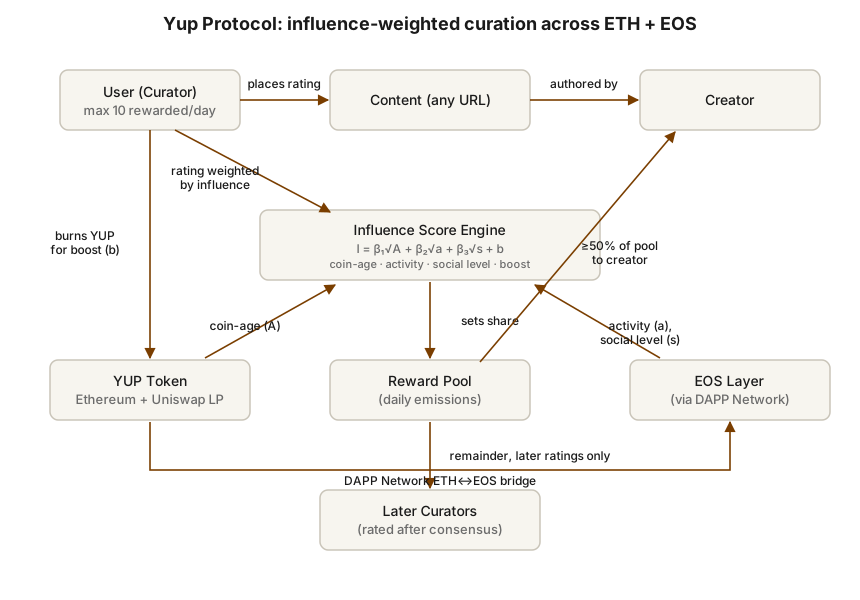
The core primitive was an influence score used to weight every rating. Per the protocol docs, influence was computed as I = β₁√A + β₂√a + β₃√s + b, combining:
- Coin age (A) — token holdings weighted by how long they were held (sum of input-transaction value times blocks elapsed), rewarding long-term holders over mercenary capital.
- Activity (a) — the cumulative rewards an account had previously earned, making influence path-dependent on past good curation.
- Social level (s) — a consensus-ordered social standing determined by network participants.
- Boost (b) — users could burn YUP to temporarily multiply the influence of specific actions.
The square-root terms dampened whale dominance (a quadratic-style concession), and a quota of 10 rewarded actions per day per account limited spam farming; actions beyond the quota earned negligible rewards or influence.
Rewards flowed from a phased emission schedule: 9,315,081 YUP genesis supply distributed over the first year (50% creators/curators, 23% liquidity providers, 22% team, 5% treasury), starting from a 100,000 YUP Phase 0 distribution (1:1 to legacy YUPX holders plus the Twitter airdrop), then daily emissions of 1.25% of supply, tapering to a fixed 10,000 YUP/day tail. Creators of rated content were guaranteed at least 50% of each reward pool (Rc ≥ R/2), with the remainder split among curators by influence share — and crucially, curators only earned from ratings placed after theirs, creating a discovery incentive: find good content early, before consensus forms.
Architecturally, Yup was an early experiment in pragmatic chain specialization: EOS (via the DAPP Network) handled high-frequency social actions cheaply, while Ethereum anchored token liquidity and fiat on-ramps. The team later consolidated onto Polygon, citing EVM composability and network effects.
Outcome
Yup shipped a working product cycle for over six years: browser extension, yup.io feed, dual-chain token launch (which the team described as the first of its kind), Polygon migration, and finally a well-reviewed multi-network posting client covered by TechCrunch (November 2023) and backed by investors including Nascent, whose thesis framed Yup as "open social aggregation." The curation-market economy itself never achieved escape velocity: the token traded around $0.001 on Etherscan by 2025–2026, and the influence-mining loop remained niche. On February 13, 2025, thirdweb announced it had acquired Yup; Kabessa and Johnson joined as senior product manager and senior software engineer respectively, the Yup platform was gradually shut down, and the YUP token was left circulating on-chain without an application. The verdict: repeatedly technically successful, commercially unsuccessful.
Why it worked
- Genuinely novel mechanism design. The influence formula blended stake, tenure, track record, and social standing with square-root damping — a more nuanced sybil/plutocracy trade-off than one-token-one-vote curation markets of the same era (e.g., TCRs).
- Early-curator incentive. Paying curators only from subsequent ratings created a real information-discovery game rather than a pile-on subsidy.
- Fair-launch credibility. Distributing 85% of genesis supply to users and 10k+ Twitter influencers seeded the network with actual social actors, prefiguring the retroactive-airdrop meta.
- Pragmatic engineering. Using EOS/DAPP Network for cheap actions and Ethereum for liquidity (and later Polygon for EVM composability) kept the UX viable before L2s matured.
Where the design broke
- Rewarding ratings invites reflexivity. When likes earn money, likes stop being honest signals; the daily quota and influence weighting mitigated but never eliminated farm-the-emission behavior, and organic demand for the YUP token (beyond boost-burning) was thin.
- No native distribution. Yup curated other platforms' content, so it depended on Twitter et al. for supply and audience while capturing little of either — the classic aggregator-without-leverage position.
- Serial pivots signaled unfound PMF. EOS dapp → dual-chain curation economy → Polygon → cross-posting client: at each stage the token economics remained built for a curation market, and never got redesigned to map onto whatever product the platform had become.
- Exit confirmed the economics. An acqui-hire that shuts the platform down while the token continues trading independently shows the value being acquired sat in the product and engineering capacity, not in the token's own value-accrual mechanism, which had no claim on the acquisition.
Lessons
- Paying for engagement changes what engagement means. Any "curate-to-earn" design must assume ratings become financial acts; quotas, influence weighting, and delayed-reward structures help but do not restore signal purity.
- Influence scores that combine stake, tenure, and track record age better than raw token voting — Yup's formula remains a useful reference design for reputation-weighted systems.
- Curation layers need a captive distribution surface. Value accrues to whoever owns the feed; a meta-layer over others' feeds struggles to monetize its own token.
- Token models don't survive pivots. If the product thesis changes, the token economy usually needs redesign or retirement; leaving a curation token attached to an aggregator app created a value-accrual orphan long before the shutdown made it official.
- Chain-specialization was a workable bridge strategy — but bridging complexity is a tax; when cheap EVM environments arrived, consolidation (Polygon) was correct and overdue.
Redesign (EDITORIAL — hypothesis, not fact)
This section is editorial speculation, not a description of the actual project. A modern Yup would separate the reputation asset from the reward currency: keep the influence score as a non-transferable, decaying reputation (Yup's formula, minus coin-age, plus time decay) attested on-chain, and pay curators not from inflation but from downstream consumers of the signal — recommender systems, ad markets, or token projects buying curated distribution. Build natively on an open social graph (Farcaster/Lens-style protocols solved the distribution-capture problem Yup faced), so ratings live in the same substrate as content rather than as an overlay. Replace the flat 10-action quota with stake-scaled prediction: curators lock small amounts against a rating and earn only if later consensus (or engagement-weighted outcomes) agrees, converting curation into a forecasting market with slashing for noise. Finally, make the early-curator payoff curve explicit and convex — Yup's "paid only by later ratings" rule was its best idea and deserves to be the centerpiece, not a footnote.
Sources
- Yup Protocol — Yup Docs (protocol specification) — primary (docs)
- Introducing YUP (official token launch post) — primary (docs)
- YUP Token Tracker — Etherscan — primary (contract)
- Yup Polygon Migration (official Paragraph post) — primary (docs)
- #BuiltOnDAPP: Yup — DAPP Network Blog (analysis)
- Yup hacks together a cross-posting app for X, Threads, Bluesky and others — TechCrunch (news)
- thirdweb acquires the decentralized social platform Yup — ChainCatcher (news)
- Nascent — Investing in Yup (open social aggregation thesis) (analysis)
Related experiments
Last verified: 2026-07-26 · Spot an error? Suggest a correction