Paragraph.xyz
Onchain publishing platform that fused newsletters with collectible posts, token-gating, and (later) creator coins — and absorbed rival Mirror to become the consolidated home of crypto writing.
▶ Run interactive simulation animated mechanism with editable parameters
How it works onchain
 Open full-size diagram
Summary
Paragraph is an onchain publishing platform — effectively "Substack with a crypto-native monetization stack." Founded by ex-Google/ex-Coinbase engineer Colin Armstrong (originally as "Papyrus" in 2021, then rebranded), it lets writers publish newsletters and blogs whose content is archived on decentralized storage (Arweave/IPFS), gate posts behind NFTs or ERC-20s, sell posts as collectible NFTs, and — from 2025 — attach tradeable "coins" to posts and to the writers themselves. It raised a $1.7M pre-seed led by Lemniscap (announced October 24, 2022) and a $5M round from Union Square Ventures and Coinbase Ventures (May 2024), in which it also took over Mirror — the pioneering onchain writing platform — consolidating crypto publishing under one roof; Mirror founder Denis Nazarov became an advisor. Through 2025–2026 it layered on post coins, Writer Coins, an API/SDK, and agent-facing payments, repositioning as an "AI-native" publishing platform while keeping its onchain rails.
Design (Mechanism)
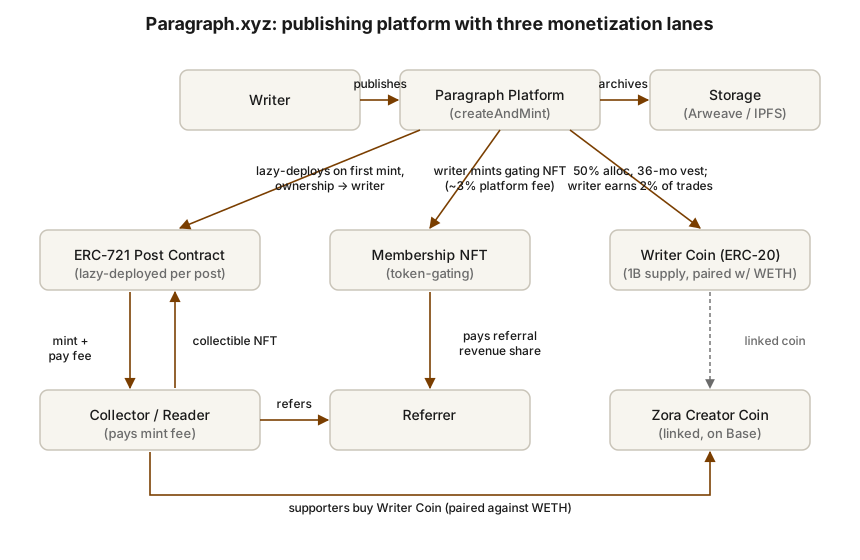
Paragraph's design is a stack of composable monetization primitives bolted onto a familiar web2 newsletter UX:
- Collectible posts and highlights (ERC-721). Readers can mint a post — or even a highlighted sentence — as an NFT. Paragraph calls
createAndMintmethods that lazily deploy a new ERC-721 contract on first mint, mint to the collector, and transfer contract ownership to the writer. Writers set price, supply, and chain (early options included Ethereum and Polygon; activity later concentrated on Base and Optimism). Collecting is free for creators; collectors pay a fee split between creator and platform. - Token-gating and NFT memberships. Writers can gate content with NFTs/ERC-20s they already have, or mint membership NFTs directly on Paragraph (historically with a ~3% platform fee), turning subscriptions into transferable onchain assets.
- Censorship-resistant storage + open distribution. Content is archived to Arweave/IPFS; distribution leans on open social graphs, especially Farcaster — posts render as frames/embeds and subscriber growth is wired into Farcaster identity.
- Referral rewards. Readers who refer paying subscribers earn a revenue share, making distribution itself an incentivized mechanism.
- Coins (2025). "Post coins" (introduced ~July 2025) let readers "support" a post via three preset tiers — deliberately framed as support, not speculation — and the most-supported posts rank an Explore feed, tying discovery to money at stake. "Writer Coins" (announced November 20, 2025) attach a 1-billion-supply token to a writer: 50% allocated to the creator vesting monthly over 36 months, ~5% pre-allocated to past supporters (Paragraph/Mirror readers, Zora/Base author-token holders, subscribers, Farcaster followers, weighted by contribution), creator earns 2% of every transaction in their coin. Coins pair against WETH by default and can be linked to a Zora creator coin (both live on Base).
- Agent payments (2026). An API/SDK (December 2025) plus per-article payments purchasable by AI agents ("Your work, paid for by agents," April 2026) — machine-payable content as a new demand side.
Outcome
Ongoing and arguably the survivor of the onchain-publishing category. Milestones: $1.7M pre-seed (Lemniscap, with Binance Labs, FTX Ventures, Seed Club, others, Oct 2022); claimed 5,000+ creators by ~2023 (founder podcast appearances); $5M from USV and Coinbase Ventures plus the takeover of Mirror's product, brand, and users (May 2024); Mirror content fully merged into Paragraph by September 2025. The coins experiments shipped in 2025 with a public "what we're learning" retrospective after the first month, and in 2026 the platform repositioned as AI-native (custom agents for editing/SEO/distribution, agent-paid content) while retaining Writer Coins. No token for the platform itself; no known exploit or shutdown. Specific revenue/mint volume figures: Unknown / not found. Verified contract addresses: not published in a central registry (contracts are lazily deployed per-post/per-writer).
Why it worked
- Web2 UX first, crypto underneath. Email delivery, editor, and analytics matched Substack expectations; onchain features were opt-in additive monetization rather than a prerequisite — the opposite of Mirror's wallet-first posture.
- It outlasted its rival and then absorbed it. Acquiring Mirror handed Paragraph the category's brand, archive, and user base in one move, with blue-chip backers (USV, Coinbase Ventures) validating the consolidation.
- Aligned distribution. Farcaster-native embeds and referral revenue-share made readers and the social graph do the distribution work, cheaply acquiring exactly the crypto-native users likeliest to mint.
- Mechanism iteration. The team kept shipping new monetization primitives (collectibles → gating → coins → agent payments) instead of betting everything on one, and published candid learnings.
Limitations and criticisms
- Collectible-post economics are thin on their own. One-off NFT mints of essays largely tracked the 2021–22 speculative wave; Mirror itself — the category creator — could not sustain a standalone business on it, which is part of why it merged in. Paragraph's own sequence of pivots (subscriptions → collectibles → coins → AI/agents) suggests no single mechanism alone monetizes writing well, forcing continuous product iteration.
- Coins import speculation risk. Writer Coins carry the reflexivity problems of all creator tokens: illiquidity (docs warn gains require active buyers), a creator-heavy allocation (50%), and price charts attached to individual reputations.
- Niche ceiling. The paying audience remains crypto-native; mainstream writers have stayed on Substack/beehiiv, and the 2026 AI-native repositioning reads partly as a search for a larger market beyond that niche.
Lessons
- In creator tools, distribution and UX beat ideological purity. The wallet-optional platform absorbed the wallet-first one.
- Collectibles are a monetization feature, not a business model. One-shot mint revenue decays with the speculative cycle; durable creator income needs recurring or fee-bearing mechanisms layered on top.
- Consolidation is a viable endgame for onchain verticals. When a category's TAM shrinks, acquiring the rival's users and brand can be cheaper than out-competing them.
- If you attach tokens to people, design for the downside. Vesting (36 months), preset "support" tiers, and pre-allocations to past supporters are deliberate dampeners on pump-and-dump dynamics — worth copying.
Redesign (EDITORIAL — hypothesis, not fact)
This section is editorial speculation, not a factual account. A redesign would decouple speculation from patronage more aggressively: replace tradeable Writer Coins with non-transferable "supporter points" that vest into a share of the writer's future onchain revenue (mints, agent payments, subscriptions) — patronage with upside but no order book against a person's name. Second, make the agent-payment rail the centerpiece: a standardized per-article micropayment endpoint (x402-style) with onchain receipts could position Paragraph as the paywall layer for the machine-readable web, a much larger market than crypto newsletters. Third, publish a canonical contract registry and subgraph so third parties can build readers, aggregators, and royalty tooling — the composability story Mirror promised but never institutionalized.
Sources
- Paragraph raises $1.7m (official blog) — primary (retrospective)
- Introducing Coins on Paragraph (official blog) — primary (docs)
- Writer coins — Paragraph docs — primary (docs)
- Collectibles on Paragraph (official blog) — primary (docs)
- Paragraph blog index (Mirror merger, AI-native, agent payments posts) — primary (docs)
- The Block: Paragraph raises $5 million from USV and Coinbase Ventures, takes over Mirror (news)
- PRNewswire: Paragraph Raises $1.7M Pre-Seed (news)
- Into the Bytecode #37: Colin Armstrong — Paragraph, writing onchain (analysis)
Related experiments
Last verified: 2026-07-26 · Spot an error? Suggest a correction