Fedimint
Open-source protocol for federated Chaumian e-cash mints that let a community of "guardians" custody Bitcoin collectively and issue private, Lightning-compatible e-cash to members.
▶ Run interactive simulation animated mechanism with editable parameters
How it works onchain
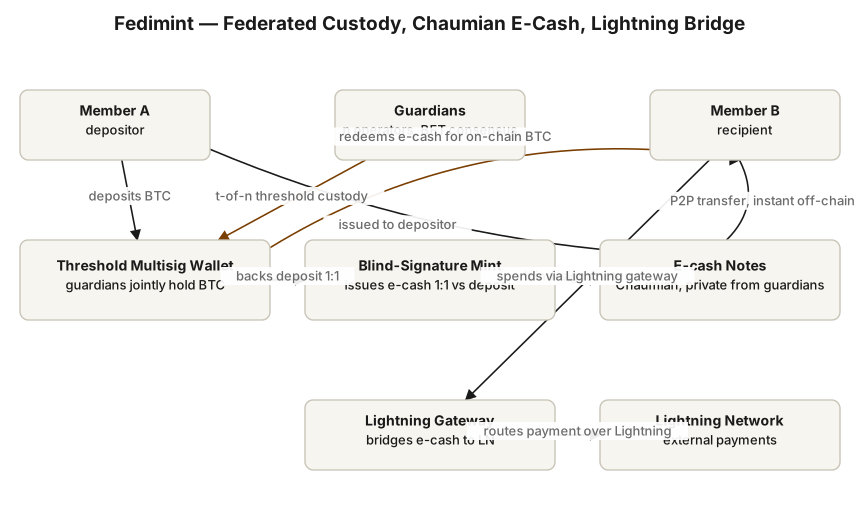 Open full-size diagram
Summary
Fedimint (short for "Federated Mint") is an open-source protocol that lets a group of trusted-but-verifiable operators — called "guardians" — jointly custody Bitcoin on behalf of a community and issue Chaumian e-cash notes against those deposits. Members deposit BTC into a federation-controlled multisig wallet and receive privacy-preserving e-cash tokens they can spend instantly among each other, over the Lightning Network via a gateway, or redeem back to on-chain Bitcoin. The idea, credited to developer Eric Sirion, was conceived and first implemented in mid-2021 with sponsorship from Blockstream, and later became the base layer for Fedi, a mobile wallet company co-founded by Sirion, Justin Moon, and Obi Nwosu. Fedimint is positioned as a middle ground between fully custodial exchanges and fully self-custodial (but UX-heavy) Bitcoin wallets, aimed particularly at communities, families, and users in regions with unreliable banking or high censorship risk.
Design (Mechanism)
Fedimint combines three older ideas — David Chaum's blind-signature e-cash, threshold/federated multisig custody, and Byzantine fault-tolerant consensus (derived from HoneyBadgerBFT) — into a modular protocol:
- Guardians: A federation is run by n operators (commonly 4+), each running a
fedimintdnode. Guardians jointly hold Bitcoin in a threshold multisig wallet and reach consensus on the federation's ledger state. - E-cash issuance: When a user deposits BTC, the federation blind-signs e-cash notes redeemable 1:1 for the deposited value. Because signatures are blinded, guardians cannot link a specific note back to the depositor's spending activity — giving users privacy from the very custodians holding their funds, a property normal custodial wallets don't offer.
- Spending: E-cash notes can be transferred peer-to-peer instantly within the federation (client-side, no on-chain settlement), or bridged out via a Lightning "gateway" module that lets users pay/receive over the wider Lightning Network.
- Threshold trust model: Security relies on an honest-majority (or similar threshold) assumption among guardians rather than a single custodian — funds are safe as long as fewer than the threshold of guardians collude or are compromised, but a majority-collusion or coordinated guardian failure can still result in loss of funds, unlike fully trustless L1 Bitcoin custody.
- Modularity: The core protocol is built as a set of pluggable "modules" (mint, wallet/Bitcoin peg, Lightning gateway, and community-built extensions), letting federations add functionality without a base protocol fork.
Outcome
Fedimint is live and under active development as of 2026, with a maturing modular architecture (v0.6/v0.7+ releases), a growing set of self-hosted and hosted federations, and Fedi's consumer mobile app as the most visible production deployment, targeting community and emerging-market use cases (including deployments referenced in humanitarian/censorship-resistance contexts, with backers such as the Human Rights Foundation). The protocol has not achieved mainstream or exchange-scale adoption, and exact figures on total value custodied, number of live federations, and active users were not found in available public sources as of this research. Outcome is best classified as ongoing: a technically functioning, incrementally improving protocol with real but still niche/early-stage deployment rather than a clear success or failure.
Why it worked
- Solved a genuine gap: no other widely-used protocol combines Chaumian e-cash privacy, federated (rather than single-party) custody, and native Lightning interoperability.
- Backed by credible Bitcoin-native sponsors (Blockstream) and builders (Fedi) with deep protocol-engineering credibility, which helped it get taken seriously rather than dismissed as another "custodial wrapper."
- Modular architecture allowed the ecosystem (wallets like Fedi, gateway operators, community federations) to build on top without waiting for a monolithic v1.
- Clear, differentiated use case (family/community/NGO custody, censorship resistance) rather than trying to compete head-on with self-custody wallets or exchanges.
Limitations and criticisms
- Federated trust model is a hard sell to security-maximalist Bitcoiners: it reintroduces collusion/majority-compromise risk that pure self-custody avoids, limiting adoption among the most security-conscious segment of the Bitcoin community.
- Running a federation requires real operational commitment (guardians must run infrastructure and coordinate), which slows organic growth compared to permissionless, infrastructure-light alternatives.
- Ecosystem is still early: liquidity, UX polish, and interoperability with the broader Lightning/Bitcoin app ecosystem (exchanges, wallets, merchants) lag behind more established custodial and non-custodial options.
- Public, verifiable adoption metrics (TVL, active federations, user counts) are scarce, making it hard to independently confirm growth claims beyond project-published blog posts.
Lessons
- Federated/threshold custody protocols face a fundamental tension: they trade the UX and recovery benefits of trusted intermediaries against the collusion risk of any threshold-of-n trust assumption, and adoption depends heavily on which side of that tradeoff a given user segment cares about most.
- Chaumian blind-signature e-cash remains one of the few practical ways to give users privacy from their own custodians, not just from outside observers — a distinct and underused design pattern.
- Modular protocol design (pluggable modules for mint, wallet peg, Lightning gateway) lets an ecosystem of independent builders extend a base protocol without requiring central coordination or hard forks, accelerating experimentation.
- Backing by credible, technically rigorous sponsors (e.g., Blockstream) can substitute for early user traction in building protocol credibility, but eventually needs to convert into measurable real-world usage to prove the model works at scale.
Redesign (EDITORIAL)
EDITORIAL — hypothesis, not fact. A version of Fedimint optimized for faster mainstream adoption might separate "custody trust" from "privacy" as opt-in layers: default federations could offer simple, non-anonymous multisig custody with easy guardian onboarding (closer to a "Bitcoin credit union" UX), while privacy-maximizing e-cash issuance is offered as an advanced, opt-in module for users who explicitly want it. This could lower the trust/complexity bar for first-time community federations (churches, co-ops, remittance circles) while still preserving the core innovation — federated, non-custodial-adjacent Bitcoin banking — for users who need censorship resistance or true holder privacy. Pairing this with standardized, publicly auditable guardian reputation/insurance mechanisms (e.g., bonded guardians, transparent proof-of-reserves) could also address the collusion-risk objection that likely limits adoption among security-conscious Bitcoin users today.
Sources
- Fedimint official site — primary (official)
- Fedimint GitHub organization — primary (code)
- What is Fedimint and second-party custody for Bitcoin? — Protos (news)
- Bitcoin Fedimints — Coinbase Institutional Market Intelligence (research)
- Fedi to Build Privacy-Focused Bitcoin Mobile App on Fedimint Protocol (news)
- Fedimint's Ecosystem: A Look Back at 2025's First Half — primary (official blog)
Related experiments
Last verified: 2026-07-27 · Spot an error? Suggest a correction