Fluid Protocol
Instadapp's unified DeFi liquidity layer merging lending, high-LTV vault borrowing, and a DEX with 'smart collateral/debt' around one shared pool of capital.
▶ Run interactive simulation animated mechanism with editable parameters
How it works onchain
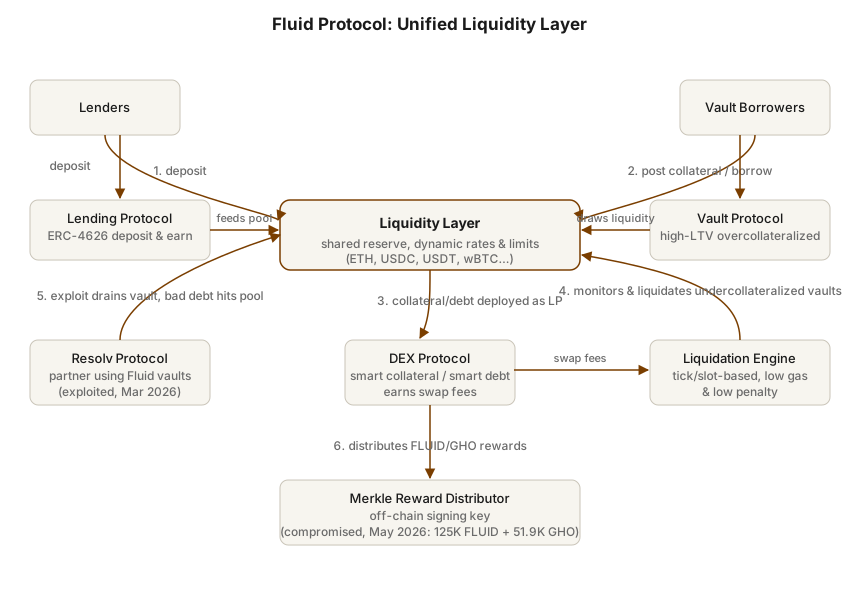 Open full-size diagram
Summary
Fluid is a DeFi protocol built by the Instadapp team that unifies lending, collateralized borrowing (vaults), and decentralized exchange trading around a single shared pool of on-chain liquidity. Rather than fragmenting capital across separate lending markets and AMM pools the way Aave, Compound, and Uniswap do independently, Fluid routes deposits into one "Liquidity Layer" that simultaneously services lenders, borrowers, and swappers, aiming to push capital efficiency and yields higher than siloed protocols can achieve. It was announced in October 2023, shipped its Lending and Vault protocols in January 2024, and added its DEX (with "smart collateral" and "smart debt") in October 2024, quickly becoming one of the largest lending/DEX hybrids in DeFi by TVL.
Design (Mechanism)
At the base sits the Liquidity Layer, a single shared reserve of assets (ETH, USDC, USDT, wBTC, etc.) that every downstream Fluid product draws from and repays into. Utilization, interest-rate curves, and supply/borrow limits are computed centrally and dynamically for this shared pool rather than per isolated market, which Fluid's team argues produces tighter rate spreads and deeper liquidity than protocols where each asset pair has its own bespoke pool.
On top of the Liquidity Layer, the Vault protocol offers overcollateralized borrowing with unusually high loan-to-value ratios (up to roughly 95% LTV for correlated pairs like ETH/wstETH) and a liquidation engine modeled conceptually on Uniswap v3's concentrated-liquidity "ticks": positions are liquidated in narrow slots/ranges rather than all-or-nothing, which the team says lowers liquidation gas costs (~150k gas, several times cheaper than incumbents) and liquidation penalties (as low as 0.1% in some markets), reducing cascading liquidation risk during volatility.
The Lending protocol is a simple ERC-4626-compliant deposit-and-earn layer feeding the same Liquidity Layer, so lenders' capital is simultaneously available to vault borrowers and DEX liquidity, rather than sitting idle waiting for matched borrow demand.
The DEX protocol, added in late 2024, introduces "smart collateral" and "smart debt": collateral posted against a vault, or even the debt itself, can simultaneously be deployed as concentrated liquidity in Fluid's DEX pools, earning swap fees on top of (or offsetting) interest costs. This effectively turns idle collateral/debt positions into fee-generating LP positions, a distinguishing feature versus most lending markets where collateral is inert.
Outcome
Fluid grew rapidly through 2024–2026, reporting TVL in the range of $1.6–1.8B+ and tens of billions in monthly DEX volume by late 2025, with deployments across Ethereum, Arbitrum, Base, and Polygon and its own FLUID governance token/DAO. It is one of the more prominent "second generation" lending-and-DEX hybrid protocols to emerge from the Aave/Compound/Uniswap era. The protocol has also weathered stress events: in March 2026 it absorbed roughly $70M in bad debt stemming from a Resolv Protocol exploit that had used Fluid vaults, covering the shortfall via a split between Resolv, Fluid's governance treasury ($8.2M), and future team revenue. In May 2026, an off-chain key-compromise attack on Fluid's Merkle reward-distributor infrastructure drained roughly 125,000 FLUID tokens and 51,900 GHO — a breach of privileged operational keys rather than the core smart contracts.
Why it worked
Unifying lending, borrowing, and trading liquidity into one shared pool is a genuinely differentiated capital-efficiency pitch versus siloed incumbents, and the high-LTV, low-liquidation-penalty vault design attracted leverage-seeking users and integrators looking for tighter borrowing terms. Building on Instadapp's multi-year DeFi infrastructure experience (aggregating Aave, Compound, Maker, Uniswap, Curve flows) gave the team credibility and existing user relationships to bootstrap adoption quickly.
Limitations and criticisms
The shared-liquidity design that produces Fluid's efficiency gains also concentrates systemic risk: the Resolv bad-debt episode shows that when a partner protocol's exploit propagates through Fluid vaults, the shared Liquidity Layer means losses can be socialized across the whole pool rather than contained to one isolated market. The May 2026 Merkle-distributor breach also underscores that off-chain operational/key-management infrastructure (rewards distribution) remains a weak link even when core contracts are well-audited — a recurring pattern across DeFi generally, not unique to Fluid's mechanism design.
Lessons
- Shared, protocol-wide liquidity layers improve capital efficiency but create tighter coupling between products (lending, vaults, DEX) — a shock to one surface (e.g., a partner-protocol exploit routed through vaults) can propagate treasury-wide rather than staying isolated to a single market.
- Range/slot-based liquidation (borrowing from AMM tick design) can meaningfully cut liquidation gas costs and penalties versus legacy all-or-nothing liquidation, showing DEX mechanism ideas can transfer productively into lending markets.
- Off-chain and semi-off-chain infrastructure (Merkle reward distributors, privileged signing keys) is frequently the weakest link in otherwise well-audited DeFi systems — security review scope needs to extend beyond on-chain contracts.
- Absorbing bad debt transparently and splitting the cost across counterparties, treasury, and future revenue (as Fluid did after the Resolv exploit) is a governance pattern worth studying for how protocols manage contagion without insolvency.
Redesign (EDITORIAL)
EDITORIAL — hypothesis, not fact. A more resilient version of Fluid's shared-liquidity design might introduce explicit risk compartmentalization within the Liquidity Layer itself — e.g., tiered or ring-fenced sub-pools by counterparty-risk class, so that a partner-protocol exploit (like Resolv's) can only draw down a bounded, pre-committed insurance slice rather than the general pool. Separately, since the Merkle-distributor exploit was a key-compromise rather than a contract bug, a redesign could move all reward-distribution claims on-chain with multisig/threshold-signature or timelocked publication of Merkle roots, removing single-key trust from the claims pipeline entirely.
Sources
- Introducing Fluid (protocol blog) — primary (official)
- Introducing Fluid! (Instadapp blog) — primary (official)
- Instadapp introduces lending protocol Fluid in testing phase, aiming for January release (news)
- Understanding Fluid: A Comprehensive Overview (research)
- Fluid TVL, Fees, Revenue & Volume - DefiLlama (data)
- Fluid Paid the Bad-Debt Bill First, Asked the DAO Second: Inside the $8.2M Treasury Cleanup (news)
- Fluid Protocol Loses 125K FLUID & 51.9K GHO in Key Compromise Attack (news)
Related experiments
Last verified: 2026-07-27 · Spot an error? Suggest a correction