MakerDAO / DAI
The first widely adopted decentralized, crypto-collateralized stablecoin, minted against on-chain collateral via overcollateralized debt positions and governed by MKR holders.
▶ Run interactive simulation animated mechanism with editable parameters
How it works onchain
 Open full-size diagram
Summary
MakerDAO is the Ethereum protocol that issues DAI, the first crypto-collateralized decentralized stablecoin to achieve durable, large-scale adoption. Rather than backing a dollar-pegged token with fiat held in a bank (the model of USDT/USDC), DAI is minted by users who lock volatile crypto collateral into smart contracts and borrow DAI against it, always keeping the position overcollateralized. A second token, MKR, governs the system's risk parameters and acts as a backstop of last resort: MKR is diluted (minted and sold) to recapitalize the system if bad debt accrues, and is burned when the protocol earns surplus. Single-Collateral Dai (originally "Sai", backed only by ETH) went live on 18 December 2017; Multi-Collateral Dai (MCD), accepting many approved collateral types, launched on 18 November 2019. DAI became a foundational money-lego of DeFi, integrated across lending markets, DEXes, and yield protocols. In August 2024 MakerDAO rebranded to Sky, introducing an upgraded stablecoin (USDS, 1:1 upgradeable from DAI) and a new governance token (SKY, convertible from MKR at 1:24,000) as the first product of its "Endgame" restructuring — though DAI itself continues to exist.
Design (Mechanism)
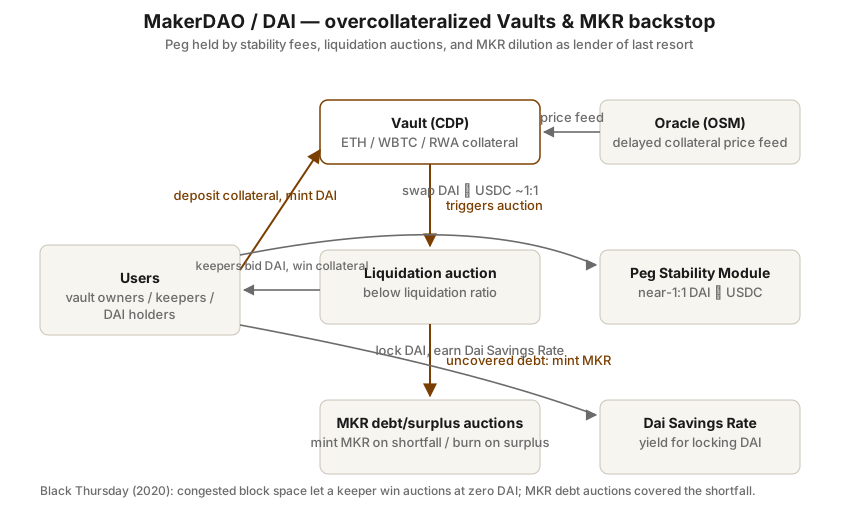
The core primitive is the Collateralized Debt Position (CDP), later renamed the Vault. A user deposits collateral (originally ETH; later WBTC, USDC, LP tokens, real-world assets, and more) and mints DAI up to a collateral-specific ceiling defined by a liquidation ratio (e.g., requiring 150% collateralization). Each collateral type carries governance-set risk parameters: debt ceiling, stability fee (an interest-like accrual on generated DAI), and liquidation penalty.
Peg maintenance relies on several coupled feedback loops:
- Stability fee — a continuously accruing borrowing rate paid in DAI; raising it discourages new DAI supply, nudging the price up toward $1.
- Liquidation auctions — if a Vault falls below its liquidation ratio, keepers trigger an auction that sells collateral for DAI to cover the debt plus penalty; "keeper" bots compete to bid.
- MKR as backstop — if auctions fail to cover debt, the system runs a debt auction minting new MKR to raise DAI, diluting holders. Conversely, surplus revenue triggers surplus auctions that buy and burn MKR.
- Oracles — a decentralized set of price feeds with an Oracle Security Module delay feeds collateral prices; a governance Emergency Shutdown can freeze and unwind the system to redeem collateral at last-known prices.
Later additions strengthened the peg materially. The Dai Savings Rate (DSR) lets holders earn yield by locking DAI, absorbing supply. The Peg Stability Module (PSM) allows near-1:1 swaps between DAI and fiat-backed stablecoins (notably USDC), which tightened the peg dramatically but introduced heavy centralized-collateral dependence. Governance is on-chain: MKR holders vote on parameters and executive spells.
Outcome
DAI is a canonical success by adoption. It grew from an experimental ETH-only system into one of the largest and most integrated stablecoins in crypto, deeply embedded across DeFi. The protocol survived multiple stress events, most notably Black Thursday (12 March 2020), when a ~43% ETH crash plus Ethereum gas congestion left keeper bots unable to bid; a single bot won collateral auctions with effectively zero-DAI bids, netting roughly $8.32M in ETH and leaving the system with several million in bad debt. Maker covered the shortfall via an MKR debt auction — the recapitalization mechanism working as designed, if painfully. The protocol later generated substantial protocol revenue, funding MKR burns, and pioneered real-world-asset collateral. In August 2024 it executed the Sky rebrand, launching USDS and SKY under the Endgame plan; USDS supply scaled into the billions within months. Outcome status: major_success — DAI proved decentralized stablecoins viable at scale, though with meaningful compromises.
Why it worked
- Overcollateralization + a credible backstop. Requiring collateral in excess of debt, combined with MKR dilution as lender-of-last-resort, made the peg robust to normal volatility and gave the system a way to survive insolvency events.
- Composability and neutrality. As a permissionless, on-chain dollar with no issuer KYC gate, DAI became the default building block for DeFi lending, AMMs, and yield strategies — network effects compounded.
- Adaptive governance. MKR governance repeatedly re-tuned parameters and added mechanisms (DSR, PSM, OSM, multi-collateral, RWAs) in response to crises, letting the system evolve rather than ossify.
- First-mover credibility. Launching in 2017 and surviving Black Thursday established a multi-year track record that later competitors could not easily replicate.
Limitations and criticisms
DAI falls short of its original ideal of a fully decentralized, crypto-backed dollar:
- Centralized-collateral dependence. The PSM made USDC (and other fiat-backed stablecoins) a dominant slice of backing at times, meaning DAI's peg and censorship-resistance became partly hostage to centralized issuers — undermining the founding thesis.
- Black Thursday design gap. The liquidation-auction mechanism assumed competitive keepers and functioning block space; under congestion those assumptions broke, producing zero-bid auctions and bad debt (later addressed by Liquidations 2.0).
- Governance centralization. MKR ownership concentration and low voter turnout left effective control of parameter changes and major restructurings (the 2019 "Purple Pill" governance dispute, the Endgame plan) in a small set of holders and delegates, with no structural check requiring broader participation for high-impact decisions.
- Rebrand disruption. The 2024 Sky transition split the brand and token surface across two pairs (DAI/USDS, MKR/SKY), and the lapsed "MakerDAO" X handle was claimed by an unrelated account, fragmenting the project's public identity across platforms.
Lessons
- A stablecoin is only as decentralized as its worst collateral. Reaching for a tight peg via fiat-backed stablecoins (PSM/USDC) trades away the censorship-resistance that justified building a crypto-backed dollar in the first place; the peg mechanism and the collateral mix must be evaluated together.
- Liquidation mechanisms must assume adversarial block space. Systems that depend on competitive keepers can fail catastrophically under congestion and gas spikes; auction design needs congestion-resilient parameters (delays, batch/collateral floors, or fallback pricing), a lesson Black Thursday taught the whole industry.
- A dilutable governance token as backstop is powerful but not free. MKR-as-lender-of-last-resort genuinely recapitalized the system, but only works if the token retains value and holders accept dilution — tying peg stability to a reflexive, market-priced asset.
- On-chain governance needs both agility and legitimacy. The ability to ship fixes fast was a strength, but a governance structure that let major pivots proceed from a concentrated set of holders, without a broader legitimacy check, repeatedly generated community friction.
Redesign (EDITORIAL — hypothesis, not fact)
The following is the researcher's editorial hypothesis, not established fact.
A from-scratch redesign would treat collateral quality as a first-class, transparently-bounded constraint rather than a governance dial that quietly drifted toward USDC. One approach: hard-cap the share of centralized/fiat-backed collateral at a publicly enforced ceiling (e.g., via a protocol invariant), accepting a slightly looser peg band in exchange for a guaranteed floor of censorship-resistant backing — and market DAI honestly as a decentralization-weighted dollar rather than a perfect 1:1 clone. On liquidations, the redesign would replace pure competitive keeper auctions with congestion-robust mechanisms: Dutch auctions with time-based price decay (which Maker's later Liquidations 2.0 partly adopted), collateral-value floors that pause auctions during oracle-price free-falls, and a protocol-owned backstop bidder funded by surplus so the system is never dependent on third-party bots showing up. Governance would move toward credibly time-locked, scope-limited delegation with a constitutional layer that makes certain properties (max centralized collateral, minimum collateralization) hard to change quickly, reducing both governance-attack surface and founder-pivot risk. Finally, a cleaner single canonical token with in-place upgrades (rather than parallel DAI/USDS and MKR/SKY pairs) would preserve brand and liquidity network effects that the Sky rebrand partially fractured. The central bet: users will accept a modestly imperfect peg in return for a stablecoin whose decentralization guarantees are enforced by code, not by a governance vote that can be captured.
Sources
- The Dai Stablecoin System Whitepaper (Dec 2017) — primary (docs)
- Maker Protocol Technical Docs — primary (docs)
- Dai Stablecoin (DAI) ERC-20 contract — Etherscan (labelled 'Sky: Dai Stablecoin') — primary (contract)
- Black Thursday for MakerDAO: $8.32M was liquidated for 0 DAI (whiterabbit) (analysis)
- Mempool Manipulation Enabled Theft of $8M in MakerDAO Collateral on Black Thursday (CoinDesk) (news)
- MakerDAO rebrands as Sky, unveils USDS and SKY (CryptoSlate) (news)
- MakerDAO Is Now 'Sky' as $7B Crypto Lender Rolls Out New Stablecoin (CoinDesk) (news)
- Welcoming Rune Christensen as a Venture Partner (Dragonfly Research) (analysis)
Related experiments
Last verified: 2026-07-26 · Spot an error? Suggest a correction