Cabalcoin
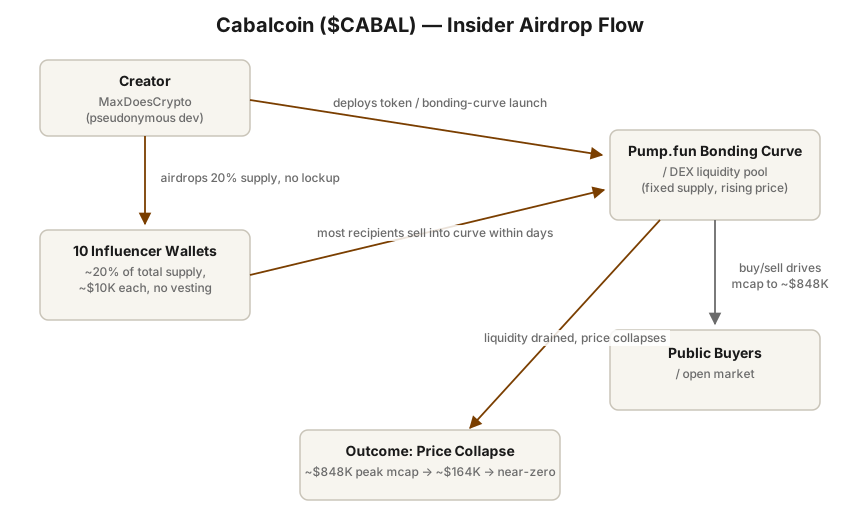
A Solana meme coin that airdropped 20% of supply (~$10K each) to ten crypto influencers to deliberately manufacture a promotional 'cabal' — most recipients dumped within days.
▶ Run interactive simulation animated mechanism with editable parameters
How it works onchain
 Open full-size diagram
Summary
Cabalcoin ($CABAL) was a Solana meme coin launched on Pump.fun around 26 August 2024 by a pseudonymous creator known as MaxDoesCrypto (@maxdoescrypt0). It billed itself as "the biggest social experiment on Solana." Rather than seed a community organically, the project attempted to engineer a promotional insider group — a "cabal" — by airdropping roughly 20% of total supply, worth about $10,000 per recipient, directly to ten well-known crypto Twitter influencers. In crypto slang, a "cabal" is a coordinated cluster of insiders who quietly accumulate and then loudly promote a token. Cabalcoin's thesis was that if you give influencers a meaningful bag for free, they will become financially motivated to shill it to their followers, bootstrapping the exact reflexive hype loop that normally forms in secret.
The experiment tested this thesis in public — and largely falsified it. Within a couple of days most recipients sold their allocation, several immediately. The token spiked to a peak market cap of roughly $848,000 (per DEX Screener figures cited by Decrypt) before collapsing to about $164,000 at the time of reporting, and to trivial value thereafter. Only about three of the ten recipients were still holding when Decrypt covered it. The creator conceded the influencer route had failed and pivoted the framing toward "building our own cabal: the community."
Design (Mechanism)
- Launchpad / bonding curve: Standard Pump.fun launch on Solana. Supply and initial liquidity followed Pump.fun's bonding-curve template (fixed max supply, price rising along the curve as buyers enter, graduating to a DEX pool once the curve fills). The novelty was not the token mechanics but the distribution.
- Targeted insider airdrop: ~20% of supply was split across ten hand-picked crypto influencers, roughly $10,000 of value each at the moment of the drop. Recipients named in reporting include Ansem (@blknoiz06), Joji (@metaversejoji), Meechie (@973Meech), Beaver (@midasmulligann), Yelo (@yelotree), Mr. Frog (@TheMisterFrog), and others. (Some allocations reportedly went to wrong addresses.)
- Reflexive-promotion assumption: The design's load-bearing hypothesis was that an unsolicited, liquid, sizable bag creates an incentive to promote — because promotion raises the price of the tokens the recipient now holds. The "gift" was meant to convert neutral or unaware influencers into aligned promoters.
- No lockups, no vesting, no strings: Critically, recipients received freely transferable tokens with no vesting, no claim conditions, and no reciprocal obligation. Nothing prevented an immediate sale into the very liquidity the launch hype had created.
- Public framing as an "experiment": The project openly narrated itself as a social experiment via @thesolanacabal, which itself was part of the marketing — turning the meta-question ("will the cabal form?") into the content hook.
Outcome
The airdrop generated a short, sharp attention spike — the market cap ran to ~$848K — but the incentive did not produce loyal promoters. Most influencers treated the drop as found money. Mr. Frog publicly summarized the dynamic: "I woke up to a $10,000 airdrop, nuked it and swapped for wrapped ETH." Some (e.g., Beaver) sold, rebought, then bled out; a minority (reportedly Ansem, Joji, Meechie) held. By reporting time the market cap had fallen to ~$164K, and later quotes show the token trading near zero. The creator acknowledged "some of the dumpings were pretty funny" and redirected toward organic community-building. Outcome status: failed as a mechanism (it did not manufacture a durable cabal or sustained price), though it succeeded as a piece of viral commentary/marketing.
Why it worked
- Attention capture: Framing distribution as a live "will insiders defect?" experiment was genuinely novel and drew coverage (including Decrypt), giving a nano-cap token outsized reach.
- Real short-term volume: The $10K-per-influencer drops and the spectacle drove real buying into the launch, briefly pushing the market cap toward seven figures.
- Honest instrumentation: Because everything happened on a transparent chain and via a public account, observers could watch each recipient's wallet, making the "experiment" legible and shareable in real time.
Where the design broke
- Wrong incentive object: A liquid, no-strings gift maximizes the incentive to sell, not to promote. The rational move for a recipient with no cost basis is to realize the free value immediately, especially into hype-driven liquidity.
- No skin in the game / no vesting: Without lockups or claim conditions, the design had no way to align holding horizons. The "gift" was pure downside pressure the moment it hit wallets.
- Cabals form on trust and coordination, not coupons: Real insider clusters are self-selected, pre-committed, and often pre-accumulated at low prices; you cannot instantiate that social structure by mailing tokens to strangers who owe you nothing.
- Adverse selection of promoters: Influencers who accept unsolicited drops are precisely those most comfortable dumping them; being publicly "handed" a coin can also be reputationally costly, discouraging endorsement.
- Meme-coin base rate: As a Pump.fun launch with no product, it faced the ordinary near-total mortality of the category regardless of the clever distribution.
Lessons
- Incentives must be aligned to the behavior you want, not merely correlated with it. Free tokens incentivize selling; promotion requires either lockups, milestone-gated unlocks, or upside that dominates the immediate liquidation value.
- You cannot buy a social structure. Coordination, trust, and shared conviction — the actual substance of a "cabal" or community — are emergent and cannot be conjured by transferring assets to unaligned parties.
- Transparency is a double-edged sword for hype mechanisms. On-chain visibility that makes an experiment shareable also makes betrayal instantly observable, accelerating the collapse of confidence once the first recipients sell.
- "Novel distribution" is not "novel value." Cleverness in how tokens are handed out does not substitute for a reason to hold; distribution mechanics amplify demand at best, never manufacture it.
Redesign (EDITORIAL — hypothesis, not fact)
The following is the researcher's editorial hypothesis, not established fact.
If the goal were genuinely to test whether an insider promotion group can be engineered, the redesign should convert the free "gift" into a conditional, vesting, promotion-linked position:
- Vest, don't gift. Deliver influencer allocations as time-locked or linearly-vesting tokens (e.g., 6–12 months) that only stream while the recipient opts in, so the value of holding depends on the token surviving — realigning the incentive from dump-now to build-now.
- Milestone/attestation unlocks. Gate portions of the allocation on verifiable promotional actions or holding thresholds (on-chain attestations, signed endorsements, minimum retained balance), turning the airdrop into a performance contract rather than a no-strings coupon.
- Opt-in claim with a stake. Require recipients to actively claim and post a small matching buy, giving them real cost basis and skin in the game; passive recipients simply never activate the allocation, removing the guaranteed dump.
- Slower, quieter accumulation before the reveal. Real cabals pre-accumulate before publicity; a redesign might distribute privately at low prices to a self-selected set who apply to join, then reveal the group, inverting the "surprise gift to strangers" flaw.
- Reframe the experiment as retention, not acquisition. Instrument and publish holder-retention curves rather than price, so the mechanism is judged on whether alignment was actually created — the metric the original design implicitly cared about but never engineered for.
The core editorial claim: Cabalcoin failed not because incentive-designed communities are impossible, but because it gave away the asset while withholding the alignment. Value transfer without commitment mechanisms reliably produces the opposite of loyalty.
Sources
- Meme Coin Airdrops $10,000 Worth of Tokens to Crypto Influencers—Most Instantly Sell — primary (news)
- CABAL Project Airdrop Campaign to Crypto Influencers Falls Flat (Decrypt News Explorer) (news)
- CABAL Meme Coin Baru di Solana (Pintu News, secondary coverage) (news)
Related experiments
Last verified: 2026-07-26 · Spot an error? Suggest a correction