PoWH3D
A self-described 'legitimate pyramid scheme' on Ethereum whose bonding-curve token taxed every buy and sell 10% and streamed the fees to holders as ETH dividends.
▶ Run interactive simulation animated mechanism with editable parameters
How it works onchain
 Open full-size diagram
Summary
PoWH3D ("Proof of Weak Hands 3D," token ticker P3D) was an openly self-described pyramid-scheme token launched on Ethereum on February 26, 2018 by the pseudonymous Team JUST. It grew out of 4chan's /biz/ board as satire of ICO-era token culture: the token had no utility by design, and the pitch was radical honesty about that fact. The contract acted as its own exchange — users bought and sold P3D directly against the contract on a bonding curve — and every buy and sell was taxed 10%, with the fee redistributed pro-rata to existing holders as claimable ETH "dividends." Its immediate predecessor, the original PoWH Coin, had been drained (866 ETH, roughly $800k) on February 1, 2018 via an integer-underflow bug in its sell()/transferTokens() path; Team JUST's lead developer Mantso rewrote the system from scratch, and the resulting PoWH3D contract was never exploited despite holding, at its reported peak, on the order of 16,000 ETH. It became the direct ancestor of Fomo3D (July 2018) and of thousands of "dividend token" forks. The contract remains live and autonomous; the project's cultural and financial peak passed with the 2018 cycle.
Design (Mechanism)
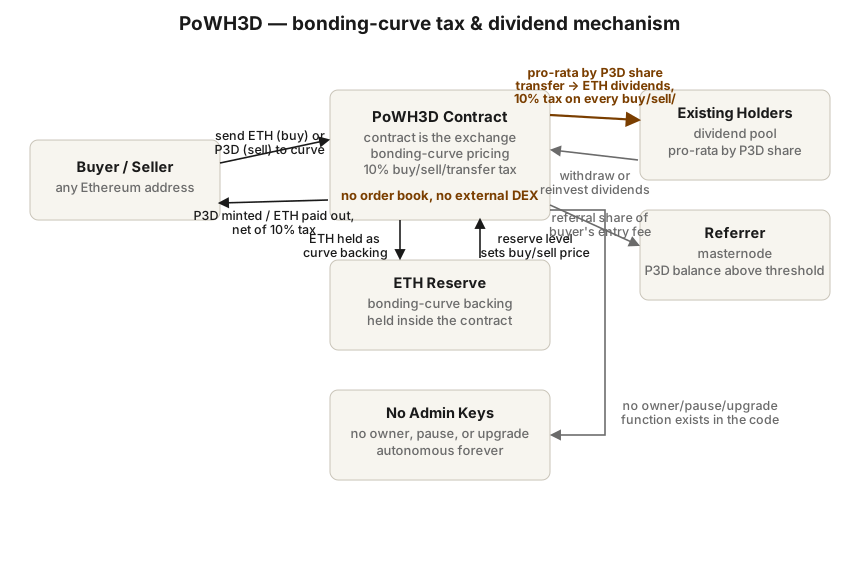
- Contract-as-exchange with a bonding curve. There was no order book or external DEX dependency. Users sent ETH to the contract to mint P3D and burned P3D back to the contract for ETH. Price rose deterministically as supply grew and fell as supply shrank, so the contract always held the ETH backing the curve.
- 10% transfer tax, paid to incumbents. Every buy, sell, and transfer levied a 10% fee, split among all existing holders proportional to their share of supply. Dividends accrued in ETH and could be withdrawn or "reinvested" (compounded into more P3D).
- Masternode referral system. Holders above a small P3D threshold got referral links; a portion of the entry fee of anyone buying through the link went to the referrer. This turned the holder base into a distributed marketing force — a parody of "masternodes" that functioned as a genuine growth loop.
- No admin keys, no exit. The contract was autonomous: no owner withdrawal function, no upgradability, no pause. The team could not rug even if it wanted to, which was central to the pitch ("the only honest Ponzi").
- Round-trip friction with no external revenue. A round-trip cost ~19% in fees, funded entirely by other participants' fees rather than any outside revenue source. The design bet was that transparency about this mechanism, plus continuous fee flow to holders (dividends arrive from any volume, not only inflows), would sustain participation longer than hidden-scam competitors.
Outcome
PoWH3D briefly became one of the highest-balance and most-used contracts on Ethereum in 2018, reportedly holding around 16,000 ETH (~$6.4M at the time) at peak, with contemporaneous coverage describing "smart Ponzis" attracting millions. Its security record is its most notable outcome: after the predecessor's 866 ETH exploit, the rewritten contract withstood years of adversarial attention while holding large sums, and Team JUST gained a (grudging) reputation for strong Solidity engineering. In July 2018 the team launched Fomo3D, which routed part of its fee flow to P3D holders, temporarily supercharging dividends. As the 2018 bubble deflated, buy volume collapsed; the bonding curve unwound as holders exited, and P3D's value fell with it. The contract still runs autonomously today — community trackers show thousands of ETH in unclaimed dividends left behind by departed holders — but activity is a small fraction of its peak. It was never hacked, never rugged, and never economically sustainable, which is exactly what it said on the tin. Later community revivals (e.g., P3D-inspired deployments promoted via powh3d.global) are separate efforts not covered by this entry.
Why it worked
- Honesty as a differentiator. In a market saturated with disguised Ponzis, an undisguised one was novel, funny, and — because expectations were set correctly — oddly trustworthy.
- Real yield mechanics. Dividends flowed from all volume (buys and sells), so holders earned even during exits, softening panic dynamics relative to pure inflow-dependent schemes.
- Provable non-ruggability. No admin functions plus a battle-tested contract removed counterparty risk, leaving only the (disclosed) economic risk.
- The referral/masternode loop converted holders into recruiters, generating growth without a marketing budget.
Where the design broke
- No exogenous revenue source. With ~19% round-trip friction and no external revenue, the fee pool distributed to holders came entirely from other holders' fees, so aggregate holder P&L summed to a loss net of that friction, and the size of any individual's share depended on how much volume traded after their entry. Once new inflows slowed, the bonding curve could only grind down.
- Dependence on attention cycles. Volume — the dividend engine — tracked crypto-mania. The 2018 bear market removed the fuel, and Fomo3D cannibalized much of the remaining degen attention.
- No terminal value. By design the token had no utility, so there was no floor beyond the curve's remaining reserve and no reason to return after the meme faded.
Lessons
- Contract security and economic soundness are orthogonal. PoWH3D was an exemplary piece of Solidity engineering wrapped around an unsound economy — auditing the code tells you nothing about whether participants can win.
- Transparency changes behavior but not arithmetic. Disclosing the fee structure and its lack of external revenue sustained participation longer, but did not change the underlying accounting: the fee pool paid out could not exceed what was paid in.
- Fee-on-transfer dividends and bonding-curve treasuries were genuinely influential primitives. Reflection tokens, tax tokens, and protocol-owned-liquidity designs of 2020–2021 recognizably descend from P3D mechanics.
- Removing admin keys is a powerful trust primitive — and a double-edged one: the contract can never rug, but it also can never be fixed, upgraded, or wound down; stranded unclaimed ETH sits in it permanently.
- The predecessor's exploit shows the cost of copy-paste finance: the original PoWH Coin died from a basic integer underflow in hand-rolled ERC-20 logic, a bug class that safe-math libraries had already solved.
Redesign (EDITORIAL — hypothesis, not fact)
This section is editorial speculation, not a description of the project. A modern redesign that kept the honesty but improved the economics could route the 10% tax partly into productive yield (e.g., staked ETH) so dividends had a revenue source beyond other participants' fees; publish a live dashboard of realized aggregate P&L by entry cohort, making the fee flow's cohort-by-cohort accounting legible in real time as the actual product ("a live behavioral-economics exhibit"); add a sunset mechanism — if volume falls below a threshold for N months, the curve enters an orderly unwind that returns reserves pro-rata and sweeps unclaimed dividends to claimants via a Merkle drop, avoiding permanently stranded funds; and cap referral rewards, since uncapped per-signup payouts reward recruitment volume independent of what the recruited buyer knows about the fee structure. The honest framing was the innovation worth preserving; the redesign should make honesty measurable rather than merely stated.
Sources
- PowH3D (P3D) Token contract — Etherscan/Ethplorer — primary (contract)
- How $800k Evaporated from the PoWH Coin Ponzi Scheme Overnight (Eric Banisadr) (analysis)
- PoWH3D & FOMO3D: Flawed Behavioral Economics Wrapped in Highly Secure Smart Contracts (Bitrates) (analysis)
- Ethereum 'smart Ponzis' attracting millions in investment (Brave New Coin) (news)
- Proof of Weak Hands (PoWH) Coin hacked, 866 eth stolen (Steemit, contemporaneous) (archive)
- PoWH3D community charts and dividend tracker (powh.trade) (archive)
- PoWH3D timeline (community wiki, powh3d.global) (archive)
Related experiments
Last verified: 2026-07-27 · Spot an error? Suggest a correction