Griffain
Solana 'Agent Engine' that let users command a network of AI agents (minted as soulbound NFTs) to trade, mint, and transact via natural language, whose accidentally-live 'test' pump.fun token became the flagship of the DeFAI mania of late 2024–early 2025.
▶ Run interactive simulation animated mechanism with editable parameters
How it works onchain
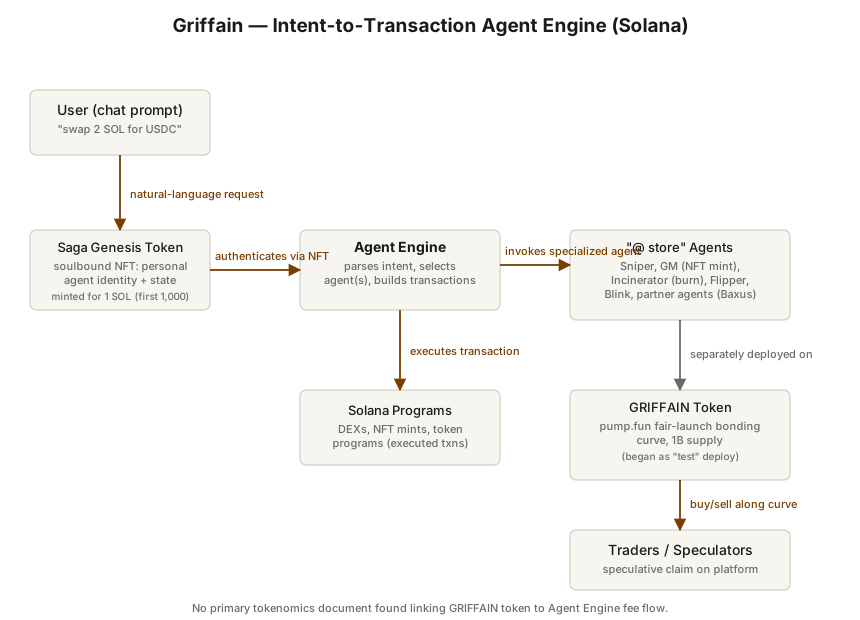 Open full-size diagram
Summary
Griffain, self-described as "The Agent Engine," is a Solana platform that translates natural-language chat into executed on-chain actions — swaps, token launches, NFT mints, wallet management, token burns — by routing user intent through a network of specialized AI agents. It launched in November 2024, at the exact moment the "AI agent" narrative (ai16z, Virtuals, Zerebro) collided with Solana's consumer-crypto push, and became the flagship of the "DeFAI" (DeFi + AI) sub-sector. Its GRIFFAIN token began life as a token literally named "test griffain.com," deployed on pump.fun (mint KENJSUYLASHUMfHyy5o4Hp2FdNqZg1AsUPhfH2kYvEP); traders bought the test deployment anyway, and the team adopted it as the canonical token. Boosted by visible enthusiasm from Solana co-founder Anatoly Yakovenko and Solana ecosystem accounts, GRIFFAIN's market cap ran to roughly $600M by late January 2025, then fell ~55% within a week as the DeFAI trade unwound. The product itself kept shipping (Agent Studio, mobile app, performance upgrades) and reportedly processed over one million automated transactions, but the token never reclaimed its mania-era valuation. Founder Tony Plasencia (@tonyplasencia3) had previously worked on Underdog Protocol and a Blinks-ecosystem launch platform.
Design (Mechanism)
- Intent-to-transaction engine. The core loop: a user types a request in plain English ("swap 2 SOL for USDC," "snipe this token at launch," "burn my dust tokens"); the Agent Engine parses intent, selects the appropriate agent(s), constructs Solana transactions, and executes them from agent-managed wallets. This abstracts away contract interaction entirely — the chat window is the interface.
- Soulbound agent identity. Users mint a personal AI agent whose identity and configuration live in a soulbound (non-transferable) NFT — the "Saga Genesis token," introduced December 2024. The NFT is both access pass and persistent state container for the agent, an early example of putting agent identity/config on-chain rather than in a company database.
- Scarcity-gated early access. The first 1,000 agents were sold for 1 SOL each (announced November 11, 2024; live November 23), creating an access market and an initial revenue/legitimacy signal before open access. Later access was gated by invites and Saga Genesis holdings.
- Agent marketplace ("@ store"). Specialized agents are invoked by tagging them (e.g.,
@+ agent) inside chat: Agent Sniper (automated token buying), Agent GM (NFT creation), Agent Incinerator (token burning), Agent Flipper, Agent Blink, and partner agents like Agent Baxus (whiskey marketplace transactions). This made the platform a launchpad/directory for third-party agents, not just a single assistant. Agent Studio (2025) added no-code creation of price-target trading agents. - Token. GRIFFAIN (1B supply) launched via pump.fun's fair-launch bonding curve — famously as a test deployment the market refused to treat as a test. The token functioned primarily as the speculative claim on the ecosystem; documented utility remained thin relative to its valuation. Reported distribution figures (40% community / 30% development / 20% team / 10% partners) come from third-party summaries; a primary tokenomics document was not found.
Outcome
Explosive rise, sharp deflation, surviving product. Between November 2024 and January 22, 2025, GRIFFAIN reached a peak market cap of roughly $600M and became the largest "DeFAI" token; it was listed on Bitget (December 18, 2024) and other exchanges. In early February 2025 the AI-agent complex broke: GRIFFAIN fell ~30% in a day and ~55% in a week, tracking a >27% sector-wide DeFAI drawdown, and continued to bleed with the broader agent-token collapse through 2025. The platform, however, kept operating and shipping — over 1M automated transactions processed, a mobile app previewed (January 2025), face-login and "3x faster" engine upgrades (2025), and continued agent-store expansion — making Griffain one of the relatively few agent-mania projects with a real, functioning product after the hype cycle. Verdict: partial_success — genuine working automation and durable product cadence, but a token that behaved like (and traded like) a memecoin.
Why it worked
- Perfect narrative timing. It shipped a usable chat-to-transaction product in the exact weeks the market wanted "AI agents that do on-chain things," and on the chain (Solana) where that narrative was hottest.
- Credible ecosystem halo. Public attention from Anatoly Yakovenko and Solana ecosystem figures gave it legitimacy no competing agent launchpad had; the founder was visible and did live interviews (e.g., Threadguy stream), countering anon-rug fears.
- The "test token" origin was accidental marketing genius. A token named "test griffain.com" mooning became its own story — proof of organic demand — and the team's decision to embrace it avoided the community-splitting relaunch that killed other projects.
- Real UX abstraction. Non-technical users could genuinely execute multi-step Solana operations by chatting, and the @-store made specialized capabilities composable in one interface.
Where the design broke
- Token value was narrative, not cash flow. GRIFFAIN's valuation priced a platform monopoly on agentic DeFi; when the sector's aggregate attention collapsed (Feb 2025), there was no fee-capture or burn mechanism strong enough to set a floor. It fell with FARTCOIN and ai16z regardless of product progress.
- Capability lagged rhetoric sector-wide. 2024–25 "AI agents" were largely LLM wrappers around transaction templates; the gap between "autonomous on-chain economy" narratives and "chatbot that swaps tokens" implementations became undeniable, deflating every token in the category.
- Custody and safety surface. Delegating live wallets to LLM-driven agents concentrates risk (prompt injection, misparsed intent, sniping losses); mainstream users had little reason to keep capital under agent control after novelty faded.
- Opaque tokenomics and roadmap. No authoritative published tokenomics/roadmap made it hard for anyone to underwrite the token as anything but momentum.
Lessons
- A token that launches as a joke trades like a joke. Adopting the "test" pump.fun deployment bought instant fair-launch credibility, but permanently welded the token to memecoin market structure — the product's steady progress could not decouple the price from sector beta.
- Soulbound NFTs are a clean primitive for agent identity. Storing agent identity/configuration in a non-transferable on-chain token (Saga Genesis) is one of Griffain's most reusable design contributions: portable, verifiable agent state without account databases.
- Scarcity-priced early access works as both funding and QA. Selling the first 1,000 agents for 1 SOL filtered for committed users and created demand theater without a VC round or presale allocation fight.
- Narrative sectors crash as one asset. Being the best product in DeFAI provided nearly zero protection when DeFAI itself repriced; mechanism designers should assume category-wide correlation ≈ 1 in a drawdown and build token sinks that don't depend on attention.
- Founder visibility is a mechanism. Live-streamed, doxxed founder appearances measurably differentiated Griffain in a category dominated by anonymous teams and rugs.
Redesign (EDITORIAL — hypothesis, not fact)
This section is editorial speculation, not a factual account. A redesigned Griffain would tie the token to the engine's actual throughput: route a protocol fee (in SOL or USDC) on every agent-executed transaction into buybacks or staker revenue-share, so the 1M+ automated transactions become measurable token demand rather than a marketing stat. Agent access would be priced in burned GRIFFAIN rather than one-off SOL mints, making platform growth deflationary. On safety, agent wallets should sit behind on-chain policy guards — per-agent spend limits, allowlisted programs, and a session-key architecture — so a misfired LLM intent or prompt injection cannot drain a user; publishing those constraints as verifiable on-chain policy would convert the platform's biggest liability (delegated custody) into its moat. Finally, publish canonical tokenomics and treasury reporting on day one: the absence of a primary tokenomics document forced the market to price GRIFFAIN as pure momentum, and transparency is nearly free.
Sources
- Griffain official site (Agent Engine) — primary (docs)
- test griffain.com (GRIFFAIN) token page on pump.fun — primary (contract)
- GRIFFAIN token mint on Solana Explorer — primary (contract)
- Threadguy livestream announcement with founder @tonyplasencia3 — primary (archive)
- Griffain project review — Solana Compass (analysis)
- Griffain: Your Personal AI Agent on Solana — Bybit Learn (analysis)
- AI crypto crash: GRIFFAIN, FARTCOIN down 30% — crypto.news (news)
- Griffain Unveils Saga Genesis Token for AI Agents — Altcoin Buzz (news)
- OKX Ventures Research: AI Agent Landscape (Part 2) — PANews (analysis)
- Bitget Lists GRIFFAIN in Innovation, MEME and AI Zone — GlobeNewswire (news)
- Tony Plasencia — IQ.wiki (caution: contains contested biographical details) (analysis)
Related experiments
Last verified: 2026-07-26 · Spot an error? Suggest a correction