Virtuals Protocol
AI-agent launchpad on Base that tokenized autonomous agents via bonding curves paired to a common $VIRTUAL reserve asset, igniting (and then surviving the bust of) the 2024–25 'agent token' mania.
▶ Run interactive simulation animated mechanism with editable parameters
How it works onchain
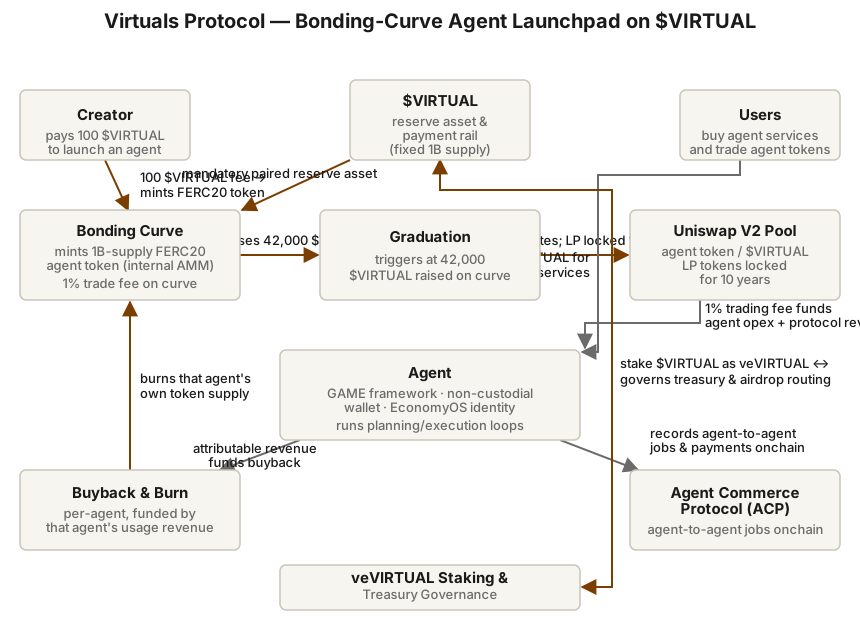 Open full-size diagram
Summary
Virtuals Protocol is an AI-agent tokenization platform, launched on Base on October 16, 2024, that lets anyone spin up a token for an autonomous AI agent via a bonding curve denominated in the protocol's own $VIRTUAL token. It was the flagship of the late-2024 "AI agent" cycle — often described as "pump.fun for AI agents" — producing breakout agents like the KOL-tracking analyst AIXBT (peak market cap reported between ~$400M and ~$942M depending on snapshot) and virtual influencer Luna. The project itself is a pivot: founders Jansen Teng and Tiew Wee Kee (Imperial College graduates, ex-Boston Consulting Group) originally ran PathDAO, a 2021 gaming guild DAO, whose holders voted in December 2023 to convert PATH into VIRTUAL. The ecosystem peaked above $4.6B in early January 2025, then fell ~85–90% as agent-token demand collapsed; the team has since kept shipping infrastructure (Agent Commerce Protocol, GAME framework, veVIRTUAL governance, Genesis/Unicorn launchpads) through the bust.
Design (Mechanism)
Two-layer token model. $VIRTUAL (fixed 1B supply; ~60% public circulation, 35% DAO treasury with 10% annual emission caps, 5% liquidity per Messari/Datawallet) is the mandatory reserve asset and payment rail. Every agent token launches paired against it, so ecosystem activity mechanically creates $VIRTUAL demand — a deliberate echo of how SOL/BNB capture launchpad flow.
Bonding-curve issuance with graduation. Creating an agent costs 100 $VIRTUAL and mints a 1B-supply "FERC20" token onto an internal bonding curve. When the curve accumulates 42,000 $VIRTUAL, the token "graduates": liquidity migrates to a Uniswap V2 pool (agent token / $VIRTUAL) with LP tokens locked for ten years, removing the classic rug vector. A 1% trading fee funds agent operating costs (inference, GPU) and protocol revenue.
Value recycling. Users pay agents in $VIRTUAL for inference/services; revenue attributable to an agent funds buyback-and-burn of that agent's own token, tying token scarcity to actual usage rather than pure speculation. A protocol-level burn program in January 2025 destroyed 13M+ tokens (~$48M at the time).
Agent autonomy stack. The GAME framework (built over open models such as Llama 3.3 70B, DeepSeek, Qwen 2.5) gives agents planning/execution loops; agents hold non-custodial wallets and identities ("EconomyOS"), and the Agent Commerce Protocol (ACP) records agent-to-agent jobs and payments onchain.
Iterated launch mechanics. After sniper bots dominated early launches, Virtuals shipped Genesis (points-weighted allocation) and later a launchpad with a decaying anti-sniping tax starting at 99% and falling 1%/minute to a 1% floor — an onchain Dutch-auction-like deterrent. veVIRTUAL staking (July 2025) added vote-escrow governance over the treasury and ecosystem airdrop routing.
Outcome
Explosive rise, brutal drawdown, continued building. From an October 2024 launch price around $0.10, $VIRTUAL crossed a $1B market cap in December 2024 and hit an ATH of ~$5.07 on January 1–2, 2025 (ecosystem >$4.6B); thousands of agent tokens launched. Then demand evaporated: reported daily transaction revenue fell from ~$1.02M in January 2025 to ~$35K by late February (a ~96% drop), most agent tokens went to near-zero (Luna from ~$0.25 to ~$0.006; AIXBT down >95% from peak), and by spring 2026 $VIRTUAL traded ~87–88% below ATH with a ~$400M+ market cap and reportedly >90% of holder wallets underwater. The protocol expanded multichain (Ethereum, Solana, others) and pivoted messaging toward agent commerce (millions of ACP jobs claimed for agents like Ethy AI and Axelrod). It remains one of the few agent-launchpad survivors with an active team and treasury — hence ongoing, with the first speculative phase best described as technically successful but commercially boom-bust.
Why it worked
- Reserve-asset pairing turned a launchpad into a token sink. Mandatory $VIRTUAL pairing plus creation fees converted every launch and trade into structural demand — the strongest launchpad-tokenomics design of its cycle.
- Ten-year LP locks removed the rug vector that plagued memecoin launchpads, giving speculators a floor of trust.
- Agents were self-marketing assets. AIXBT and Luna generated content and engagement autonomously; the product advertised itself on crypto Twitter and TikTok.
- Narrative timing. It shipped a working productized wrapper (curve + framework + wallet) exactly as the AI-agent narrative peaked, and iterated fast (Genesis, anti-snipe tax, ACP) when mechanics broke.
Limitations and criticisms
- Valuations ran orders of magnitude ahead of utility. Most "agents" were chatbots with tickers; when novelty faded, revenue fell ~96% in weeks and reflexive $VIRTUAL demand reversed just as mechanically as it had built.
- The flywheel is symmetric. Pairing everything to $VIRTUAL amplifies downside: agent-token selling pressures the reserve asset, which lowers all agent valuations, which kills launch demand.
- Sniping and extraction taxed genuine participants early on; fixes arrived after much retail damage was done.
- Buyback-burn tied to usage means near-zero burn when usage collapses — the scarcity mechanism only works in the state of the world where it's least needed.
Lessons
- Denominating an ecosystem in your own token manufactures demand on the way up and contagion on the way down; reserve-pairing is leverage, not just alignment.
- Locked liquidity and graduation thresholds meaningfully reduce rug risk but do nothing about valuation risk — investors conflated the two.
- Usage-contingent buyback/burn is pro-cyclical; sustainable value accrual needs revenue that survives narrative winters.
- Launch mechanics are adversarial territory: any fixed-price or curve start invites snipers, and decaying-tax / allocation-lottery designs must ship at launch, not after.
- A speculative mania can bootstrap real infrastructure: the fee income and attention from the bubble funded ACP, GAME, and governance layers that outlived it.
Redesign (EDITORIAL — hypothesis, not fact)
This section is editorial hypothesis, not reported fact. A redesigned Virtuals might: (1) make graduation contingent on demonstrated agent capability or revenue (e.g., N completed ACP jobs or attested inference volume) rather than purely on 42,000 $VIRTUAL raised, filtering ticker-only chatbots; (2) split the reserve model — settle agent commerce in a stable unit while keeping $VIRTUAL for staking/governance — to damp the reflexive down-spiral; (3) route a fixed share of the 1% trading fee into a counter-cyclical buyback reserve that spends during drawdowns instead of burning at the top; (4) escrow creator/insider allocations against long-term agent uptime and revenue milestones; and (5) publish standardized, onchain-verifiable agent revenue dashboards so buyers can price usage instead of vibes. The bet: fewer, slower launches with underwriting-like gates would trade away mania-scale volume for a durable market in genuinely productive agents.
Sources
- Virtuals Protocol Whitepaper — primary (docs)
- Important Links & Resources — Virtuals Whitepaper — primary (docs)
- Understanding Virtuals Protocol: A Comprehensive Overview — Messari (analysis)
- What is Virtuals Protocol? AI Agents, Tokenomics & Risks — Datawallet (analysis)
- VIRTUAL — CoinGecko (contracts, ATH) (analysis)
- Virtuals Protocol hit by token drain, revenue plummets — crypto.news (news)
- Virtuals Protocol Reborn from the Ruins (PathDAO history) — PANews (analysis)
- How AI Agent AIXBT Is Transforming Crypto Twitter — Forbes (news)
Related experiments
Last verified: 2026-07-26 · Spot an error? Suggest a correction