Bonsai (MadFi)
MadFi's BONSAI began as a DN404 'memecoin with utility' airdropped to Lens Protocol power users, briefly became the dominant currency for paid mints on Lens, then pivoted into an AI 'smart media' protocol as its token value collapsed.
▶ Run interactive simulation animated mechanism with editable parameters
How it works onchain
 Open full-size diagram
Summary
BONSAI was launched on 2024-03-04 by MadFi, a small crypto-social startup (founded ~2022, New York) building monetization tools on Lens Protocol. Rather than a pure memecoin, BONSAI was framed as a "community token" for the Lens ecosystem: a DN404 (divisible-NFT hybrid, an unofficial ERC experiment) on Polygon, airdropped to Lens power users and pushed as the default currency for paid content mints, tips, and creator rewards. It briefly worked remarkably well — capturing 75–90% of monetized publications on Lens in spring 2024 and reaching an ~$80–100M fully diluted valuation after a $1M angel round led by Palm Tree Crew Crypto (with Avara Ventures, Social Graph Ventures, Friends With Benefits, and Polygon's Sandeep Nailwal). The team then chased the market through successive pivots: cross-chain expansion to Base and zkSync Era, a 2025 relaunch as an AI "Smart Media" protocol on the new Lens Chain, and by 2026 a further pivot toward "Imagine" (AI-video content coins via Zora infrastructure). The token's market value collapsed to negligible levels (aggregators show onchain market caps in the low tens of thousands of dollars by early 2026), even as the underlying mechanisms mostly did what they were designed to do.
Design (Mechanism)
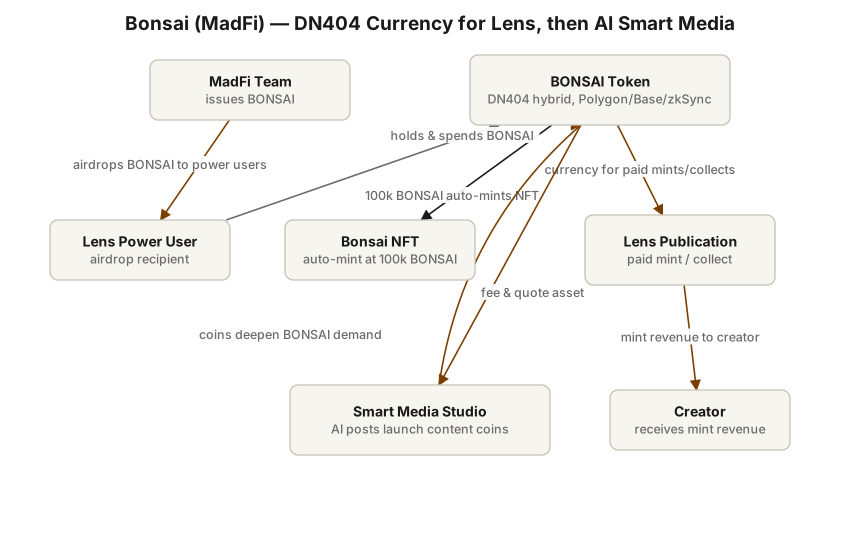
- Token standard: BONSAI was a DN404 — an experimental ERC20/ERC721 hybrid ("Divisible NFT"). For every 100,000 BONSAI a wallet accrued, the holder automatically received 1 Bonsai NFT. Carlos Beltran explicitly described it as "a new experiment" that had not gone through a full EIP process.
- Distribution: Airdropped to power users of Lens Protocol rather than sold, seeding the token with the exact user base whose behavior it needed to shape.
- Utility loop: BONSAI was positioned as the currency for paid mints/collects of Lens publications, tipping, and creator rewards across Lens-native apps (and later mint incentives on Pods and Zora). The bet: a social network's economy standardizes on whichever token is easiest to earn and spend in-feed.
- Cross-chain phase (late 2024): Expansion to Base and zkSync Era as "Phase One" of a cross-chain strategy, following Lens's own migration trajectory.
- Smart Media phase (April 2025): With Lens Chain's mainnet, Bonsai relaunched as a "Smart Media Protocol" and no-code studio (app.onbons.ai) built on ElizaOS: templates ("Evolving Post," "Evolving Art," "Campfire") define memory/logic/behavior of AI-driven posts that update from user interactions. Individual posts could launch content coins on bonding curves (Lens Chain or Base) that graduate to Uniswap; $BONSAI was the collection-fee and value-accrual asset.
Outcome
Short-term: a genuine hit. Within weeks of launch BONSAI was up several hundred percent, creators had earned $240,000+ in tokens, and it accounted for ~75% of monetized Lens publications in March 2024 (peaking near 90%), with investors citing ~80% of paid mints. FDV touched ~$80–100M around the April 2024 angel round. Long-term: the Lens ecosystem itself remained small; BONSAI's dominance of a tiny economy did not translate into durable demand. Through 2025–2026 the token bled out; by early 2026 aggregators showed prices near zero and onchain market caps around $6k–18k, and CoinGecko's API had delisted the token profile. The team kept shipping — the Smart Media studio launched April 2025, and by 2026 the docs redirect to "Imagine," a product turning AI (Sora) videos into tradable content coins on Zora infrastructure — but each pivot moved further from the original BONSAI holders. Outcome: technically successful mechanisms, commercially unsuccessful token.
Why it worked
- Airdrop-to-actual-users targeting: distributing to verified Lens power users (a small, high-context population) produced immediate, measurable usage rather than farm-and-dump.
- Real in-protocol sink: paid mints denominated in BONSAI gave the token a native job on day one; 75–90% share of monetized publications proves a social token can standardize inside a walled ecosystem.
- Meme + utility framing rode the early-2024 memecoin wave while offering creators tangible earnings ($240k+ in the first month), and credible backers (Avara — the Lens/Aave parent's venture arm) signaled ecosystem endorsement.
Where the design broke
- Captive-market ceiling: BONSAI's demand was a derivative of Lens activity, and Lens never reached mainstream scale. Winning 90% of a very small economy is still a very small economy.
- Pivot churn: memecoin → cross-chain social currency → AI smart media → AI-video content coins in ~2 years. Each pivot reset the narrative and diluted holder conviction; liquidity and attention did not follow.
- DN404 novelty without durable value: the divisible-NFT gimmick drove launch buzz but created no lasting reason to hold once the meme cooled; the unofficial standard also added integration friction.
- Chain migrations as taxes: following Lens from Polygon to zkSync-based Lens Chain (plus Base/zkSync legs) fragmented liquidity repeatedly at exactly the moments the token needed depth.
Lessons
- A token that becomes the "default currency" of a niche protocol inherits that protocol's growth ceiling; mechanism dominance is not a substitute for underlying network growth.
- Airdrops to authenticated, high-context users (Lens profiles) are far more effective at bootstrapping real usage than open claims — this part of the design is worth copying even though the token failed.
- Serial pivots that keep the ticker but change the thesis tend to destroy holder trust faster than a clean shutdown-and-relaunch; each narrative reset is a sell event.
- Experimental token standards (DN404) generate launch attention but add long-tail costs: exchange/indexer support, audits, and integrations all lag unofficial standards.
- Ecosystem-native currencies are fragile to platform migrations; every chain move by the host protocol forces a liquidity migration the token team doesn't control.
Redesign (EDITORIAL — hypothesis, not fact)
This section is editorial speculation. A stronger design would have decoupled BONSAI's value from raw Lens throughput: (1) route a protocol-level fee share — e.g., a fixed percentage of all paid-mint volume in any currency — into BONSAI buybacks or staking yield, so the token captures ecosystem revenue rather than merely denominating it; (2) commit at launch to a canonical home chain with burn-and-mint bridging, avoiding liquidity fragmentation across Polygon/Base/zkSync/Lens Chain; (3) replace the DN404 gimmick with a standard ERC-20 plus a separate, earned NFT membership tier tied to creator milestones; and (4) when pivoting to Smart Media, make legacy BONSAI the mandatory quote asset and fee token for all content-coin bonding curves from day one (with a portion burned on graduation), converting each new speculative wave into structural demand for existing holders instead of launching value into new assets. Whether Lens itself could ever supply enough volume to sustain this remains the unresolved dependency.
Sources
- BONSAI Memecoin Aims to Become De Facto Currency On Lens After $1M Angel Round (news)
- MadFi x $BONSAI – the Memecoin on Lens Protocol Closes $1 Million (Mirror announcement) — primary (governance)
- Bonsai Token (BONSAI) token page, PolygonScan — primary (contract)
- Bonsai Token (BONSAI) token page, BaseScan — primary (contract)
- Lens Protocol-based memecoin BONSAI hits $100 million valuation after latest funding round (news)
- Expanding the Bonsai Token Network (t2.world) (analysis)
- Lens's Living Media: The Bonsai Smart Media Studio (Bankless) (analysis)
- Bonsai Docs (now redirects to Imagine docs) — primary (docs)
- Bonsai Token price page, CoinGecko (analysis)
Related experiments
Last verified: 2026-07-26 · Spot an error? Suggest a correction