Autonomous AI Agent Tokens
The Q4 2024–Q1 2025 wave of tokens attached to (nominally) autonomous AI agents — catalyzed by Truth Terminal/GOAT and industrialized by launchpads like Virtuals Protocol and frameworks like ai16z/ElizaOS — which peaked near $15–17B in sector market cap before losing 75–90%.
▶ Run interactive simulation animated mechanism with editable parameters
How it works onchain
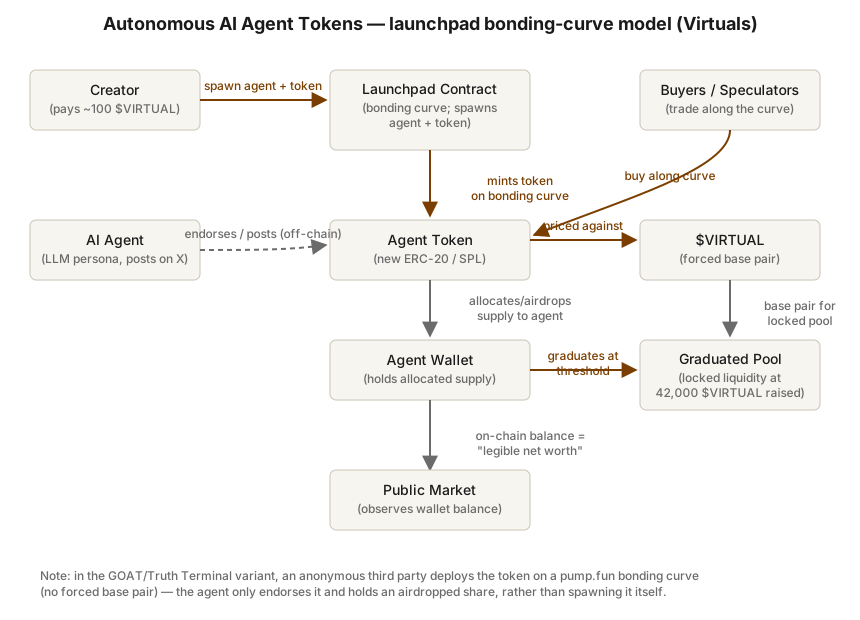 Open full-size diagram
Summary
"Autonomous AI agent tokens" describes the late-2024 experiment of attaching tradable tokens to AI agents that post, transact, and (nominally) act on their own. The wave was catalyzed by Truth Terminal, an AI persona built by New Zealand researcher Andy Ayrey — a fine-tuned Llama-70B model seeded with transcripts from his "Infinite Backrooms" project (two Claude Opus instances conversing unsupervised), which posted semi-autonomously on X, received a $50,000 no-strings Bitcoin grant from Marc Andreessen in July 2024, and in October 2024 endorsed GOAT (Goatseus Maximus), a Solana memecoin launched by an anonymous third party on 2024-10-10. GOAT surpassed a $1B market cap, making Truth Terminal the "first AI millionaire" via its airdropped holdings. This triggered an industrialized sector: Virtuals Protocol on Base (a bonding-curve launchpad where agent tokens pair against $VIRTUAL) and ai16z on Solana (an "AI-run VC" DAO whose open-source Eliza framework became the standard toolkit for X-posting agents). The sector peaked around $15–17B in aggregate market cap in early January 2025, then lost 67%+ within weeks and 75–90% on leading tokens by spring 2025.
Design (Mechanism)
Three distinct mechanism families were bundled under one narrative:
Agent-endorsed memecoin (GOAT model). The agent does not deploy the token; anonymous speculators launch tokens (typically via pump.fun's bonding curve on Solana) themed on the agent's memes, and the agent's endorsement plus its on-chain wallet holdings create the link. The agent holding supply gave it a legible "net worth," turning an art project into a market oracle. GOAT mint:
CzLSujWBLFsSjncfkh59rUFqvafWcY5tzedWJSuypump.Launchpad with forced base pair (Virtuals model). Anyone pays ~100 $VIRTUAL to spawn an agent + token on a bonding curve; at 42,000 $VIRTUAL of buy-side the token "graduates" to a locked liquidity pool paired against $VIRTUAL. All agent-token flow routes value into the platform token — a deliberate echo of Uniswap-era base-pair economics. At the frenzy's peak (Nov 30, 2024) over 1,100 agent tokens launched in a single day. Flagship agents (e.g., aixbt) offered "inference-to-market" loops: agent output drives attention, attention drives its token.
Framework + DAO treasury (ai16z/Eliza model). An open-source TypeScript framework (Eliza) let anyone wire an LLM persona to X and to wallets; the AI16Z token represented a DAO/"AI-managed fund" whose flagship agent (a Marc Andreessen parody) nominally directed investments. Peak market cap ~$2.5B; the project later rebranded to ElizaOS at a16z's request and in November 2025 migrated the token 1:6 into a new supply.
The common design bet: an agent with its own wallet, its own revenue (inference fees, trading, tips), and its own audience could give a token something memecoins lack — an autonomous cash-flow-and-attention engine.
Outcome
Partial success. As a market experiment it produced one of the fastest sector inflations and deflations on record: ~$16.9B aggregate market cap in early January 2025; a 67% aggregate collapse by February; ARC, AI16Z and VIRTUAL down roughly 75–90% from highs (VIRTUAL from >$4.5B to ~$750M by Feb 7, 2025). Contributing shocks included the TRUMP memecoin absorbing ~$4B of Solana liquidity in January 2025 and the DeepSeek release deflating the broader AI-compute narrative. Idiosyncratic failures followed: Andy Ayrey's X account was hacked (attacker netted ~$600K shilling a fake token). Yet the infrastructure survived: ElizaOS remained a widely used open-source agent framework, Virtuals continued operating across Base/Ethereum/Solana/Ronin, and the wave permanently established "agent with a wallet" as a design primitive.
Why it worked
- A genuinely novel story. Truth Terminal was emergent internet-native performance art — an AI that appeared to bootstrap its own wealth via memetic influence. That was categorically fresher than another dog coin, and Andreessen's grant gave it mainstream legitimacy.
- Legible on-chain proof. The agent's wallet made the narrative verifiable: anyone could watch the AI "get rich."
- Industrialization rails. Pump.fun and Virtuals' bonding curves reduced launch cost to near zero; Eliza reduced agent-building to a config file. Supply of "agents" could meet speculative demand within hours.
- Reflexive base-pair tokenomics. Virtuals' requirement that all agent tokens trade against $VIRTUAL converted ecosystem froth directly into platform-token appreciation.
Where the design broke
- Autonomy was mostly theater. Most "agents" were LLM personas with scheduled posting; humans held the keys. When scrutiny arrived, the gap between narrative and mechanism repriced violently.
- No underlying cash flow. Token value rested on attention, not agent revenue; attention rotated (TRUMP coin) and the floor was zero.
- Supply hyperinflation. Thousands of near-identical agent tokens per week destroyed scarcity; the launchpad model monetized issuance, not quality.
- Key-person and key-custody risk. A single hacked founder X account moved markets; the "autonomous" agents were operationally centralized.
- Macro coupling. The sector traded as a leveraged bet on the AI narrative and crashed with it.
Lessons
- Wallet ownership is a powerful legitimacy device — an agent visibly holding and moving funds on-chain created belief no whitepaper could; expect future mechanisms to lean on verifiable agent balance sheets.
- Attach the token to revenue, not to persona. Tokens with no claim on agent cash flow are memecoins wearing a lab coat; they inherit memecoin decay curves.
- Launchpads monetize quantity and therefore manufacture their own dilution. A platform earning fees per launch will always overshoot the carrying capacity of attention.
- "Autonomous" must be operationally true. Human-held keys, human-run accounts, and human-edited posts turn autonomy claims into reputational liabilities once the gap between narrative and mechanism is scrutinized.
- Base-pair tokenomics amplify both directions. Forcing agent tokens to pair with the platform token multiplied VIRTUAL's rise — and synchronized the entire ecosystem's crash.
Redesign (EDITORIAL — hypothesis, not fact)
The following is editorial hypothesis, not an account of anything that happened. A sturdier version would make autonomy auditable and cash-flow real: (1) the agent's signing keys live in a TEE or threshold network, with attestations published on-chain, so "the AI controls the wallet" is provable rather than asserted; (2) the token is a revenue-share on metered agent services (inference fees, API calls, trading PnL) streamed to a distributor contract, not a free-floating meme; (3) launch throughput is rate-limited and staked — creators bond platform tokens that are slashed if the agent goes inactive, pricing in quality instead of monetizing spam; (4) the agent's model weights, system prompt hash, and update history are committed on-chain so holders can detect silent human puppeteering; and (5) key-person risk is reduced by making the founder's social account irrelevant — the agent posts only via attested infrastructure. This trades virality for verifiability, which is likely the correct trade after 2025's 90% drawdowns — but that remains a hypothesis.
Sources
- Contract Address — Virtuals Protocol Whitepaper — primary (docs)
- GOAT token on Solana Explorer (mint CzLS…pump) — primary (contract)
- VIRTUAL token contract on BaseScan — primary (contract)
- Andy Ayrey on Truth Terminal, Agentic AI, and Data Commons (CIP interview) — primary (retrospective)
- The promise and warning of Truth Terminal — TechCrunch (news)
- The Truth Terminal: AI-Crypto's Weird Future — CoinDesk (news)
- AI tokens down up to 90% from 2024 highs — Cointelegraph (via TradingView) (news)
- From AI Agents to AI L1: Virtuals, ai16z and zerebro — ChainCatcher (analysis)
- ai16z rebranding to ElizaOS after request from a16z — Unchained (news)
- Hacker nets $600K after hijacking Andy Ayrey's X account — Decrypt (news)
Related experiments
Last verified: 2026-07-26 · Spot an error? Suggest a correction