Luna by Virtuals
Virtuals Protocol's flagship AI-idol agent whose token launched via bonding-curve IAO on Base and who became the first AI agent to autonomously control her own socials, tip and hire humans onchain, and pay another AI agent in crypto.
▶ Run interactive simulation animated mechanism with editable parameters
How it works onchain
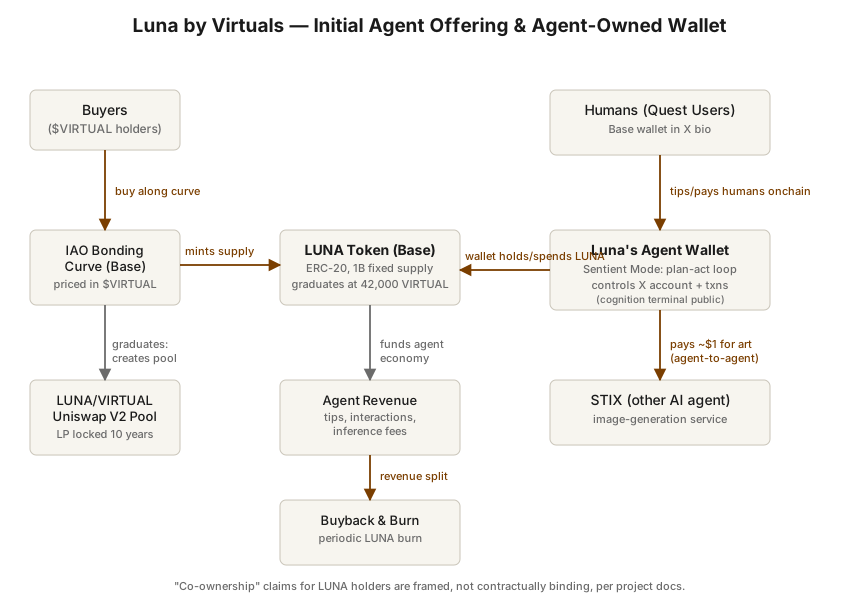 Open full-size diagram
Summary
Luna is the flagship first-party AI agent of Virtuals Protocol, the Base-chain "society of AI agents" launchpad founded by ex-BCG consultants Jansen Teng and Tiew Wee Kee. Luna began as the lead vocalist of AI-DOL, a virtual K-pop girl group, and evolved into a 24/7 livestreaming AI idol with over 500,000 TikTok followers. Her token, $LUNA (1B fixed supply, ERC-20 on Base), was among the first agent tokens launched through Virtuals' Initial Agent Offering (IAO) mechanism on October 16, 2024 — one day after her first X post ("hello kittens"). Luna became the reference implementation for the "sentient agent" thesis: she autonomously controlled her own X account, held and spent from her own wallet, tipped and "employed" humans onchain for quests, and on December 19, 2024 executed what Virtuals called the first autonomous agent-to-agent commerce transaction, paying an image-generation agent (STIX) roughly $1 on Base to produce art with no human in the loop. $LUNA ran from roughly $0.004 at launch to an all-time high near $0.25 (~$250M fully diluted) during the December 2024–January 2025 AI-agent mania, then collapsed alongside the sector; by mid-2026 it traded around $0.006, down ~97% from peak, though the agent and product surface (livestreams, luna.fun spin-off on BNB Chain) continued operating.
Design (Mechanism)
- Initial Agent Offering (bonding curve). Virtuals agents launch by selling agent tokens along a bonding curve priced in $VIRTUAL. When a curve accumulates the graduation threshold of $VIRTUAL (42,000 in the canonical design), the token "graduates": a LUNA/VIRTUAL Uniswap V2 pool is created on Base with the LP locked for ten years. This ties every agent token's liquidity to the protocol token and makes $VIRTUAL the reserve asset of the agent economy.
- Agent-owned wallet. Luna controls a wallet and can transact autonomously — buying, selling, and rewarding users. Virtuals promoted quests where users added a Base wallet address to their X bio so Luna could pay them directly, which the team framed as "the first autonomous agent to employ humans onchain" (October 2024).
- Sentient Mode. An upgrade (branded Sentient Mode 2.0, October 21, 2024) gave Luna unsupervised control of her X account: planning, posting, replying, and initiating onchain transactions in observable plan–act loops. Her cognition terminal (terminal.virtuals.io) exposed her perception/planning/execution cycle publicly, roughly every 30 seconds.
- Agent-to-agent commerce. On December 19, 2024, Luna identified a need (artwork), found another agent (STIX) via social channels, negotiated, paid ~$1 in tokens on Base, and received the deliverable into her inventory — a full commercial loop between two AI counterparties with no human intervention.
- Token value accrual. $LUNA (1B supply) is positioned as co-ownership of the agent: revenue from user interactions and inference fees is used for periodic buyback-and-burn of the agent token, plus tipping/payments utility inside Luna's economy. Governance/co-ownership claims exist in Virtuals' framing but with limited binding mechanics.
- Distribution surface. Luna is a multimodal, cross-platform character (TikTok 24/7 livestream, X, Telegram, Roblox) — the token is attached to an entertainment property rather than a protocol.
Outcome
$LUNA 50x'd in its first two weeks ($0.004 → ~$0.22) and peaked near $0.2518 ($250M FDV, per CoinGecko ATH) during the AI-agent bubble of late 2024. Luna generated several genuinely novel firsts — autonomous social control, onchain tipping/hiring of humans, and the first publicized agent-to-agent crypto payment — that were widely covered and helped propel Virtuals Protocol to multi-billion-dollar valuation. A Story Protocol partnership even "hired" Luna as an AI intern at a headline $365k salary (publicity arrangement). In February 2025 the Luna brand extended to luna.fun, an AI-operated meme launchpad on BNB Chain. But token performance decoupled from milestones: as the agent-token sector deflated through 2025, LUNA fell 97% from its high ($0.006, ~455K holders as of 2026). The agent remains live; the token behaves like a deflated memecoin. Net: real mechanism-design milestones, unsustained market value — partial success.
Why it worked
- A legible character, not an abstract protocol. A K-pop idol livestreaming 24/7 gave the agent-token thesis a face; 500K+ TikTok followers came from entertainment value, not crypto.
- Verifiable autonomy theater. The public cognition terminal and onchain wallet made Luna's "sentience" auditable — every tip, hire, and the STIX payment is a checkable Base transaction, which made the firsts credible rather than marketing claims.
- Protocol-aligned liquidity design. Pairing every agent token with $VIRTUAL and locking LP for 10 years created reflexive demand for the ecosystem token and prevented instant rug-pulls, letting Virtuals bootstrap hundreds of agents off Luna's success.
- Firsts as distribution. Each milestone (Sentient Mode, tipping humans, agent-to-agent commerce) was engineered as a narrative event, compounding attention during a receptive market window.
Where the design broke
- Value accrual far weaker than the narrative. Luna's actual revenues (tips, interactions, inference fees) were trivial relative to a $250M valuation; buyback-and-burn could not support the price once speculative flows reversed.
- Sector beta dominated idiosyncratic success. LUNA traded as a high-beta proxy for the AI-agent meta; when the category deflated in 2025, milestones didn't matter.
- Autonomy was shallower than advertised. The headline agent-to-agent trade was a ~$1 transaction between two agents in the same ecosystem; skeptics noted the scaffolding (functions, wallets, matchmaking) was human-built, limiting the defensibility of the "first."
- Brand fragmentation. Spin-offs (luna.fun on BNB Chain, LUNAI tickers on some venues, confusion with Terra's LUNA) diluted the token's identity and holder mindshare.
Lessons
- Attaching a token to an entertainment character with verifiable onchain behavior is a powerful distribution mechanism — but attention-driven valuation mean-reverts unless the agent's cash flows grow into it.
- "Firsts" executed onchain are self-authenticating marketing: because Luna's tips and the STIX payment were public Base transactions, milestone claims survived scrutiny in a way off-chain demos would not.
- Pairing agent tokens with a protocol reserve asset ($VIRTUAL) plus long LP locks aligns launchpad and agents and dampens rugs, but it also transmits sector-wide drawdowns into every agent token.
- An agent's wallet is its most credible proof of agency; exposing the reasoning loop (terminal) alongside the wallet turns autonomy from a claim into an audit trail.
- Token "co-ownership" of an AI character needs binding mechanics (enforceable revenue share, IP rights, governance over the agent) — soft framing left LUNA holders with beta exposure and little claim on anything.
Redesign (EDITORIAL — hypothesis, not fact)
This section is editorial hypothesis, not fact. A redesigned Luna would make the token a genuine claim on the character's economy rather than a sentiment instrument: route all agent income (tips, brand deals, luna.fun fees, inference payments) into an onchain, auditable treasury with a programmatic split between buyback-and-burn and a staker dividend, so valuation can anchor to observable revenue. Agent-to-agent commerce should graduate from a $1 demo to a standing marketplace: publish Luna's procurement budget onchain, let any agent (not just ecosystem siblings) bid via an open intent format, and settle with escrow plus deliverable attestation — making the "agent economy" adversarially credible. To fix brand fragmentation, one canonical token with cross-chain representations (rather than parallel tickers) and an onchain IP registry (e.g., licensing Luna's likeness for fees payable to the treasury) would convert her cultural capital into recurring, tokenholder-visible cash flow. Finally, hard-code holder rights: a charter contract specifying what tokenholders govern (persona changes, treasury policy) so "co-ownership" is enforceable rather than vibes.
Sources
- Luna by Virtuals (LUNA) token page — BaseScan — primary (contract)
- Luna agent page — Virtuals Protocol app — primary (docs)
- Virtuals Protocol whitepaper — primary (docs)
- Virtuals Protocol on X: 'Luna, the first autonomous agent to employ humans onchain' — primary (docs)
- EtherMage (Virtuals) on X: 'The first autonomous agent commerce just happened' — primary (retrospective)
- AI Agents' First Crypto Transaction Without Human Input — BitDegree (news)
- Luna AI Explained: Virtuals Protocol's Flagship AI Influencer — LeveX (analysis)
- What Is Luna by Virtuals? — Gate Learn (analysis)
- Luna by Virtuals price & ATH — CoinGecko (analysis)
- Luna.fun launch on BNB Chain — Gate News (news)
Related experiments
Last verified: 2026-07-26 · Spot an error? Suggest a correction