Sablier
The first Ethereum token-streaming protocol, releasing ERC-20 tokens second-by-second for vesting, payroll, airdrops, and grants.
▶ Run interactive simulation animated mechanism with editable parameters
How it works onchain
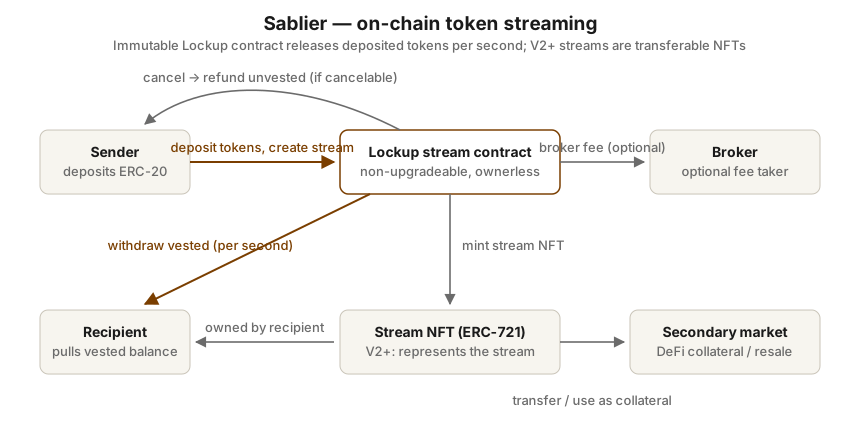 Open full-size diagram
Summary
Sablier is widely recognized as the first token-streaming protocol on Ethereum. Instead of paying someone a lump sum, a sender locks ERC-20 tokens into a Sablier contract, and the recipient can withdraw a continuously accruing balance that increases every second until the stream completes. The idea traces to Andreas Antonopoulos's 2016 "streaming money" keynote and was formalized by co-founder Paul Razvan Berg in ERC-1620 (published November 2018), a proposed standard for on-chain payment streams. Berg built a proof-of-concept in June 2019, and the first production version of the Sablier protocol was deployed to Ethereum Mainnet in December 2019 together with co-founder Gabriel Apostu.
Over its life Sablier became core infrastructure for token vesting, payroll, grants, and airdrops, expanding from a single-chain V1 into a multi-system V2/V3 stack across 20+ EVM chains. In July 2026, Sablier Labs announced it was winding down active development and entering maintenance mode — a technically durable protocol that never found a venture-scale business.
Design (Mechanism)
V1 (2019). A stream is a digital agreement defined by a deposit amount, a token, a start time, and a stop time. The contract computes a per-second release rate; at any moment the recipient can call withdraw to pull the amount vested so far (elapsed_time × rate), while the sender retains the not-yet-streamed remainder and can cancel. The V1 contracts are non-upgradeable and ownerless, so no admin can seize or freeze funds. V1.0 lives at 0xA4fc358455Febe425536fd1878bE67FfDBDEC59a and V1.1 at 0xCD18eAa163733Da39c232722cBC4E8940b1D8888 on Ethereum Mainnet.
V2 (July 13, 2023). V2 was a ground-up redesign. Every stream became an ERC-721 NFT owned by the recipient, making streams transferable and usable as DeFi collateral, and each NFT renders a dynamically generated on-chain hourglass SVG that reflects stream progress. V2 split into two products:
- Lockup Linear — a refined V1-style constant-rate stream with optional cliff.
- Lockup Dynamic — non-linear release using segments of
(amount, exponent, milestone)tuples evaluated by on-chain power functions, enabling exponential, logarithmic, step, or custom curves.
V2 also added batch stream creation, on-chain hooks, cancelable/non-cancelable configurations, and broker-fee support. It was audited by Cantina and additional independent firms, with a bug bounty.
V3 / current stack. By 2026 the protocol had grown into four systems documented as Lockup (vesting/streams), Merkle Airdrops (claimable distributions), Flow (open-ended recurring payments like payroll/subscriptions), and Bob (price-locked token releases). The permissionless, immutable contract design carried throughout — organizations configure distributions once and tokens stream automatically without further intervention.
Outcome
Status: technically_successful_commercially_unsuccessful.
By adoption and security, Sablier was a clear success. According to the team's own retrospective, TVL grew from roughly $100k in its early months to millions, then tens of millions, then hundreds of millions, peaking around $1.5B in 2021; the protocol ran on Mainnet for nearly four years without a hack. It became a standard building block for DAO vesting and grants and integrated with tools like The Graph. The team's trajectory was intertwined with Hifi Finance (which acquired Sablier in summer 2020, with Berg as Technical Lead) before Sablier spun out as UK-based Sablier Labs in early 2022.
Commercially, it did not last. On July 13, 2026, Sablier Labs announced it was halting active product development. Co-founder Paul Razvan Berg said there was "no longer venture-scale business to be found in onchain streamed payments," citing Q1 market weakness that pushed customers to postpone token launches, and AI-assisted coding that made the products cheap to replicate. Crucially, because the contracts are permissionless and non-upgradeable, existing streams, vesting plans, and airdrops keep working independently of the company. The license was flipped from BUSL to GPL immediately (ahead of schedule), frontend support was guaranteed through June 2028, after which the frontend passes to community governance.
Why it worked
- Genuine primitive. Streaming solved real pain in vesting, payroll, and grants — trustless, continuous release without a payroll intermediary or manual multisig disbursements.
- Credible neutrality. Non-upgradeable, ownerless contracts meant users didn't have to trust the team not to rug or freeze funds — a strong fit for DAO treasuries.
- Standards-first credibility. Publishing ERC-1620 and being "the first" gave Sablier durable mindshare and made it a reference implementation others cited.
- V2's NFT abstraction turned illiquid vesting positions into transferable, composable assets, widening the design space.
Where the design broke
- Weak monetization. The core value — immutable, permissionless streaming — is hard to charge for; the very neutrality that made it trusted also made fee capture awkward.
- Commoditization. Streaming is conceptually simple and, by 2026, cheap to fork; AI-assisted coding compressed the moat further. Competitors (Superfluid, LlamaPay, and others) fragmented the market.
- Cyclicality. Demand was tied to token launches and airdrops; a soft market directly starved the customer pipeline.
- Primitive, not a business. A durable public good does not automatically translate into venture-scale revenue — the reason cited for winding down.
Lessons
- Immutability is a double-edged sword: ownerless contracts earn trust and outlive the company, but they also make it structurally hard to install a fee switch or defend a business model.
- Being first and being a standard buys mindshare, not margin. ERC-1620 leadership gave Sablier durability and recognition, yet did not prevent commoditization or guarantee revenue.
- Match funding model to value type. Streaming is a public-good-shaped primitive; pursuing venture-scale returns on top of an easily-forkable, low-fee utility was a mismatch that eventually forced maintenance mode.
- Graceful shutdowns are possible in DeFi: flipping to GPL early, guaranteeing frontend runway, and handing off to community governance shows how a permissionless protocol can outlive its operator without stranding users.
Redesign (EDITORIAL — hypothesis, not fact)
The following is the researcher's analysis, not established fact.
If rebuilding Sablier to be both a durable public good and a viable business, the core streaming math should stay immutable and free, but value capture should move to the edges where users already pay for convenience. A thin, optional protocol fee router — off by default, opt-in per deployment or per broker — could let integrators and the frontend capture basis points without compromising the neutral core, avoiding the "immutable therefore unmonetizable" trap.
Second, lean harder into the stream-as-collateral thesis that V2's NFTs opened: a first-party lending/discounting market where recipients borrow against or sell future stream value would generate fee-bearing volume and defensible network effects that a fork of the base contracts cannot easily replicate. Third, given the cyclicality of token launches, diversify demand toward counter-cyclical, recurring flows — DAO payroll, subscriptions, and real-world payroll rails — via the Flow system, priced as SaaS-like tooling rather than TVL-dependent infrastructure. Finally, since Sablier ultimately succeeds as shared infrastructure, an earlier transition to a community/foundation-stewarded model (endowment-funded maintenance, GPL from day one, integrator revenue-share) might have preserved the protocol's public-good value while removing the venture pressure that made "maintenance mode" feel like failure rather than a healthy steady state.
Sources
- Sablier's Past And Future (retrospective) — primary (retrospective)
- Introducing Sablier V2 (blog) — primary (docs)
- What Is Sablier? (official docs) — primary (docs)
- Sablier v1.0 contract on Etherscan — primary (contract)
- Sablier SDK — contract addresses & deployments — primary (contract)
- Sablier Is Winding Down Development of Its Token Streaming Protocol (news)
- Streaming Payments with Sablier (The Graph) (analysis)
Related experiments
Last verified: 2026-07-26 · Spot an error? Suggest a correction