UMA KPI Options
Fully-collateralized synthetic-token options that pay out more as a project hits predefined KPI targets, resolved by UMA's optimistic oracle.
▶ Run interactive simulation animated mechanism with editable parameters
How it works onchain
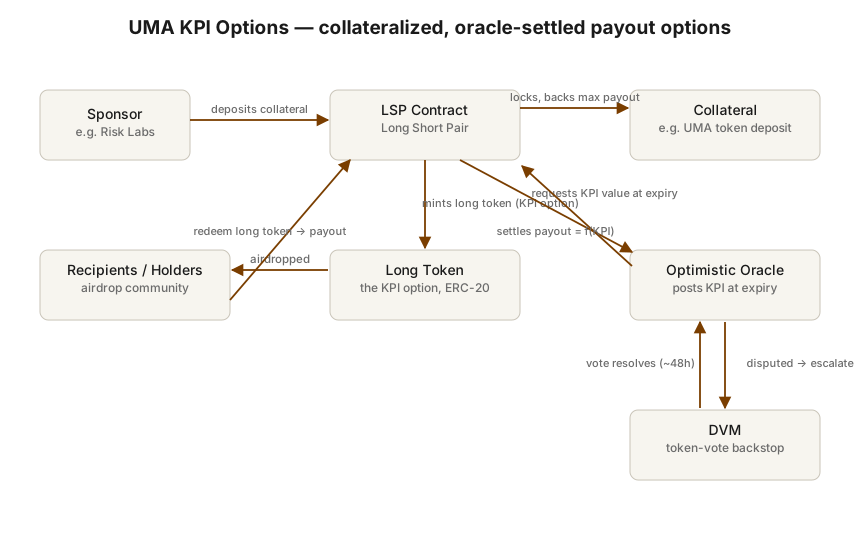 Open full-size diagram
Summary
UMA KPI Options are fully-collateralized ERC-20 synthetic tokens that pay out a variable amount of a reward asset depending on whether a project hits a pre-defined Key Performance Indicator (e.g., total value locked, number of DAO migrations, number of token rebases) before an expiry date. Introduced by UMA (Universal Market Access) co-founder Hart Lambur on February 11, 2021, they were pitched as a smarter alternative to conventional liquid-token airdrops: instead of handing out tokens that recipients can dump immediately, KPI options give every holder a direct financial incentive to grow the metric the project actually cares about, because the option becomes worth more only if the KPI improves.
The inaugural instance was UMA's own "uTVL" option. Risk Labs committed 2,000,000 UMA (roughly $60M at the time) as collateral to mint 1,000,000 uTVL options, which were airdropped to UMA supporters and the broader DeFi community. Each option would redeem for between 0.1 UMA (if protocol TVL was ≤ $100M) and 2 UMA (if TVL was ≥ $2B) at expiry on June 30, 2021, scaling linearly. Payout resolution was handled by UMA's optimistic oracle via the price identifier uTVL_KPI_UMA (ratified in UMIP-65). The mechanism required no bespoke price feed and, for the deployer, "no lines of code."
Design (Mechanism)
KPI Options are built on UMA's Long Short Pair (LSP) financial-contract template and settled through the optimistic oracle:
- Collateralization. A sponsor deposits collateral (for uTVL, UMA tokens) into an LSP contract, which mints paired long/short synthetic tokens. For the KPI-option airdrop only the "long" side is distributed; the payout is bounded so the contract is always fully collateralized against the maximum payout.
- Payout function. At expiry the redemption value per option is a deterministic function of the KPI. For uTVL:
payout = clamp(TVL / 1e9, floor=0.1, ceiling=2.0)UMA per option, so $1B TVL ⇒ 1 UMA, $2B+ ⇒ 2 UMA, ≤$100M ⇒ 0.1 UMA. - Oracle resolution. At expiry, a proposer posts the KPI value on-chain via the optimistic oracle. If nobody disputes within the challenge window, it settles as truth. A disputer can post an equal bond to escalate to UMA's Data Verification Mechanism (DVM), where UMA token-holders vote over ~48 hours; the loser forfeits their bond. UMIP-65 specified exactly how TVL was to be computed (dollar value of collateral across approved EMP/Perpetual contract types, priced off Kraken/Coinbase/Binance etc., excluding certain contracts).
- Event-based expiry (later evolution). In November 2021, Chandler introduced "milestone" / event-based KPI options: the LSP was upgraded so a contract could expire early the moment the KPI condition (e.g., "$1B TVL reached") is satisfied, rather than only at a fixed date, enabling milestone rewards, pre-market tokens, and insurance-style products.
The design's elegance is that any publicly verifiable, off-chain metric can become a payout parameter without a dedicated price feed — the optimistic oracle acts as a generalized "truth machine" invoked only at settlement.
Outcome
The uTVL option settled on June 30, 2021. Amid the mid-2021 market downturn, UMA's TVL was low, and each option redeemed for approximately 0.11 UMA — just above the 0.1 floor and far below the 2.0 ceiling that a $2B TVL would have required. So in raw payout terms the flagship experiment landed near its minimum.
However, the mechanism was adopted repeatedly and became a recognizable UMA product line. KPI options were subsequently built for other protocols and metrics, including Badger's DIGG (number of positive rebases), Aragon (number of DAO migrations), and a GYSR integration that let projects stream KPI options as ongoing liquidity-mining rewards. This mix — a headline instance that paid near the floor, but a reusable primitive that saw genuine third-party adoption — is why the outcome is best described as a partial success rather than a clean win or failure.
Why it worked
- Incentive alignment. By making the airdrop's value a function of the metric recipients could influence, it converted passive recipients into stakeholders motivated to grow TVL / usage, rather than sellers of a free token.
- Full collateralization and trustlessness. Because payouts were capped and pre-funded in the LSP, holders never faced counterparty risk; settlement was enforced by the optimistic oracle rather than a promise.
- Generality with low deployment cost. The optimistic oracle meant almost any measurable KPI could be used with no custom price feed and minimal code, making the primitive easy for other DAOs to reuse.
- Anti-mercenary framing. It directly addressed the well-known "airdrop dump" problem, giving UMA a differentiated distribution narrative.
Where the design broke
- KPIs are largely exogenous. TVL is driven by macro conditions, yields, and market cycles far more than by the marginal effort of a few thousand option holders; the 2021 downturn crushed the payout regardless of community enthusiasm. The incentive-alignment thesis is weaker when holders cannot meaningfully move the metric.
- Weak coordination leverage. A retail option holder has almost no ability to increase a protocol's TVL, so the "everyone rows together" story is more rhetorical than mechanical for diffuse airdrop recipients.
- Gameability / measurement risk. TVL-style metrics can be inflated via mercenary capital or recursive strategies, meaning a KPI can be "hit" without the real growth it was meant to proxy.
- Modest headline result. Settling near the 0.1 floor blunted the marketing narrative and gave recipients a token worth far less than the ~$60M collateral headline implied.
Lessons
- Choose KPIs the incentivized group can actually influence. Options tied to exogenous, macro-driven metrics (like TVL) give holders little real agency; milestone metrics closer to a team's or community's direct control align incentives far better.
- A reusable primitive can outlast a disappointing flagship. Even though uTVL paid near its floor, the LSP-plus-optimistic-oracle pattern became a durable, composable product other DAOs adopted — the infrastructure was the real product.
- Optimistic oracles make arbitrary payout functions cheap. The experiment demonstrated that generalized off-chain data resolution lets you attach financial payoffs to almost any verifiable metric without bespoke feeds — a pattern later central to prediction markets and insurance.
- Guard against KPI gaming. Metric selection must anticipate that any incentivized target invites Goodhart-style manipulation; define measurement rigorously (as UMIP-65 attempted) and prefer metrics that are hard to inflate.
Redesign (EDITORIAL — hypothesis, not fact)
The following is the researcher's analysis and speculation, not established fact.
A redesign would start by attacking the agency problem. Rather than tying a broad community airdrop to a macro metric like TVL, I would target KPIs that recipients can plausibly move: number of unique integrating protocols, governance participation, verified referrals, or usage from the specific cohort being incentivized — ideally with sybil-resistant attribution so the payout tracks their contribution, not the market's. Second, I'd replace the single linear TVL curve with a basket of KPIs (a weighted index of adoption, retention, and integrations) to reduce the chance that one exogenous shock zeroes out the reward and to make gaming any single metric less profitable. Third, I would lean into the event-based / milestone variant with vesting-on-achievement and clawback if a milestone is later reversed (e.g., TVL that evaporates within N days), discouraging mercenary spikes. Finally, given how much of the payoff depended on the correctness of an off-chain, manually-specified metric, a modern version should pair the optimistic oracle with tamper-evident, on-chain-derived KPI data wherever possible (native protocol counters rather than externally aggregated dollar TVL), shrinking both dispute surface and manipulation surface. The core insight — collateralized, oracle-settled options as incentive tokens — remains strong; the leverage comes almost entirely from picking endogenous, manipulation-resistant KPIs.
Sources
- UMA KPI Options and Airdrop (Hart Lambur) — primary (retrospective)
- UMIP-65: Add uTVL_KPI_UMA as a Price Identifier — primary (governance)
- Introducing Event-Based Expiry (Milestone) KPI Options (Chandler) — primary (docs)
- UMA Airdrop Recipient Addresses (Sean Brown) — primary (retrospective)
- GYSR Integrates UMA KPI Options (Chandler) — primary (docs)
- UMA Optimistic Oracle / How does UMA's oracle work — primary (docs)
- UMA Links (official social handles) — primary (docs)
- UMA KPI Options Explained (Everything Blockchain) (analysis)
Related experiments
Last verified: 2026-07-26 · Spot an error? Suggest a correction