Indigo Protocol
A CDP-based synthetic assets protocol on Cardano that lets users mint iAssets (like iUSD, iBTC, iETH) by collateralizing ADA, governed by staked INDY holders.
▶ Run interactive simulation animated mechanism with editable parameters
How it works onchain
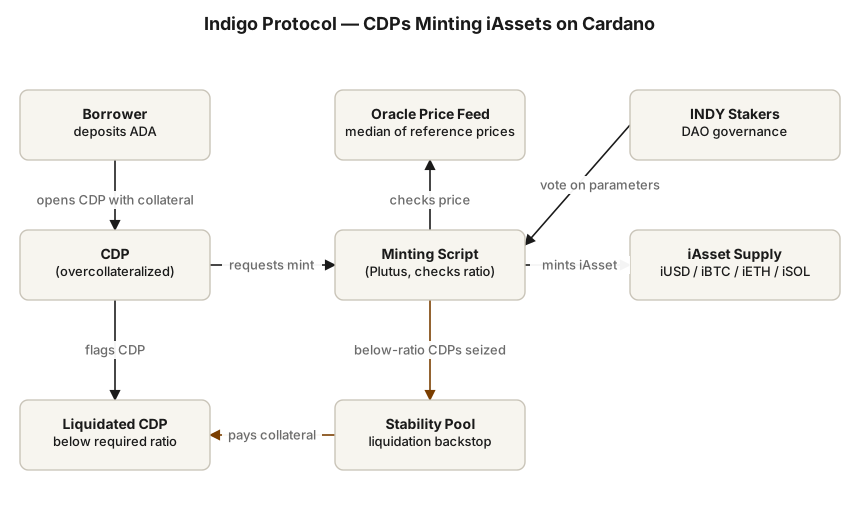 Open full-size diagram
Summary
Indigo Protocol is a decentralized synthetics platform built on Cardano that lets users mint "iAssets" — synthetic tokens tracking the price of real-world assets such as the US dollar (iUSD), Bitcoin (iBTC), Ethereum (iETH), and Solana (iSOL) — by locking ADA or other supported assets as collateral in a collateralized debt position (CDP). The protocol deployed to Cardano mainnet on November 20, 2022, with the public web app following a day later, making it one of the first CDP-style synthetic asset systems built with Plutus smart contracts. Its native token, INDY, launched via a "fair" distribution (no presale) with a fixed supply of 35 million, used for governance and fee-sharing among stakers.
Design (Mechanism)
Indigo follows the same broad model pioneered by MakerDAO/Synthetix-style CDP systems, adapted to Cardano's UTXO-based Extended UTXO (eUTXO) model and Plutus scripting:
- Minting iAssets: A user deposits collateral (primarily ADA) into a CDP and mints iAssets against it at a required collateralization ratio, with the position remaining overcollateralized to absorb price volatility.
- Price tracking via oracles: iAssets mirror the price of the referenced real-world asset using oracle price feeds, giving holders synthetic exposure without owning the underlying asset.
- iUSD stability design: iUSD, described by the team as Cardano's first fault-tolerant, fully collateralized native stablecoin, pegs to the median of USDC, TUSD, and USDT reference prices — intended to let it hold its peg even if one of those three underlying stablecoins depegs.
- Stability pools: Community members deposit iAssets into stability pools that act as a liquidation backstop, absorbing undercollateralized positions in exchange for a share of liquidated collateral (a Liquity-style mechanism).
- Governance: INDY token holders stake to vote on Indigo DAO proposals, including the addition of new iAssets, parameter changes, and protocol fee direction. Over 60% of circulating INDY has reportedly remained staked by the community.
- Funding origin: The project was incubated through Cardano's Project Catalyst community-funding rounds ("Indigo: Synthetic Assets on Cardano," Fund 6), reflecting Cardano's ecosystem-funded development model rather than VC-led seed rounds.
Outcome
Indigo launched successfully on mainnet in November 2022 and became one of the flagship DeFi protocols in the Cardano ecosystem, growing TVL to a reported ~125 million ADA by July 2023 (roughly $24.75M in April 2023 per some trackers). It established iUSD as a widely referenced native Cardano stablecoin and iBTC/iETH/iSOL as means of synthetic cross-chain asset exposure without bridging. The protocol continues to operate as of the most recent data available, with active governance, an open-source GitHub repository, and continued protocol iteration (e.g., publicized work on optimizing Plutus smart contract throughput). However, it remains a niche player relative to synthetic-asset and stablecoin protocols on Ethereum or Solana, constrained by Cardano's overall DeFi liquidity and user base, and current-cycle (2025-2026) TVL and usage figures were not found in available sources, making a full assessment of its present scale difficult.
Why it worked
- First-mover native stablecoin/synthetic infra on Cardano: Indigo filled an infrastructure gap — Cardano lacked a native CDP-based stablecoin and synthetic asset system — giving it a natural niche audience among Cardano-native DeFi users.
- Community-funded, fair-launch model: Using Project Catalyst funding and a no-presale INDY distribution aligned with Cardano's community-governance culture, likely helping it earn trust and ecosystem support (e.g., staking participation reportedly over 60% of supply).
- Battle-tested mechanism design: Borrowing the CDP + stability pool pattern from proven systems (Maker, Liquity, Synthetix) reduced novel mechanism-design risk while adapting it to Cardano's UTXO architecture.
Where the design broke
- Constrained by Cardano's smaller DeFi ecosystem: Even with strong execution, Indigo's growth ceiling is capped by Cardano's comparatively small DeFi TVL and liquidity relative to Ethereum, Solana, or Arbitrum-based synthetic/stablecoin protocols.
- eUTXO development complexity: Cardano's Extended UTXO model and Plutus require materially different (and historically slower/harder) smart contract engineering than the EVM, which the team's own public writing about "optimizing throughput" suggests was an ongoing technical challenge rather than a solved problem at launch.
- Limited public verifiability of current metrics: Unlike many EVM-based protocols with mature dashboards (DefiLlama, Dune), up-to-date TVL/usage figures for Indigo were not readily available in this research pass, making it hard to independently confirm sustained traction into 2025-2026.
Lessons
- Ecosystem-specific infrastructure gaps (e.g., "no native CDP stablecoin on Cardano") can be a viable wedge even without novel mechanism design — importing a proven model (Maker/Liquity-style CDPs + stability pools) into an underserved chain can succeed on execution and timing alone.
- Community/grant-funded development (Project Catalyst) plus a no-presale "fair launch" can be an effective alternative to VC funding for earning trust in tight-knit ecosystem communities, though it may also cap the capital available for growth versus VC-backed competitors.
- Pegging a stablecoin to the median of multiple external stablecoin oracles (rather than a single reference) is a pragmatic hedge against single-point depegs, but it inherits composite risk if multiple reference assets stress simultaneously — a design worth studying by other stablecoin builders.
Redesign (EDITORIAL — hypothesis, not fact)
EDITORIAL: If rebuilding Indigo today, one hypothesis worth testing is deeper cross-chain interoperability from day one — rather than confining iAssets to Cardano's relatively thin liquidity, a version of Indigo built with native bridge-free settlement (e.g., via a shared liquidity layer or intent-based cross-chain routing) could let iAssets be minted on Cardano but traded/settled against liquidity on larger chains. A second hypothesis: publishing a public, protocol-maintained real-time dashboard (TVL, collateralization ratios, stability pool depth, iAsset peg health) as a first-class product feature, not an afterthought, would materially improve external trust and analyst coverage — the difficulty encountered in this research pass in finding current TVL/health data is itself a governance and transparency lesson for niche-chain protocols competing for attention against EVM incumbents with mature analytics tooling.
Sources
- Indigo Protocol — official site — primary (official)
- Indigo Protocol Tokenomics and Fair Launch — primary (official)
- Indigo Token Generation Event (TGE) and Airdrop Update — primary (official)
- Indigo: Synthetic Assets on Cardano — Project Catalyst — primary (primary source)
- Indigo Protocol, An Introduction — Altcoin Buzz (secondary)
- Indigo Protocol · GitHub (official)
Related experiments
Last verified: 2026-07-27 · Spot an error? Suggest a correction