Alchemix
A DeFi protocol pioneering self-repaying, liquidation-free loans by minting synthetic tokens against yield-bearing collateral whose future yield amortizes the debt.
▶ Run interactive simulation animated mechanism with editable parameters
How it works onchain
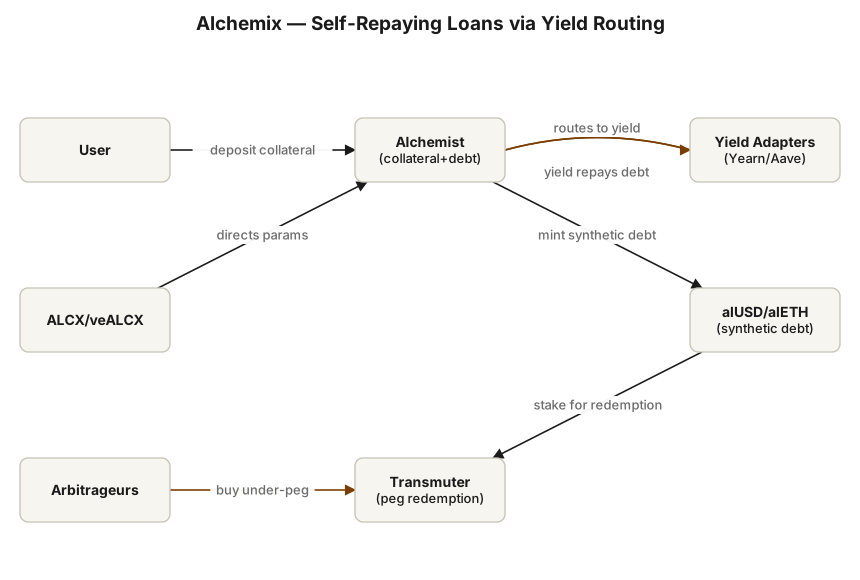 Open full-size diagram
Summary
Alchemix is an Ethereum DeFi protocol, launched in February 2021 by a pseudonymous team led by "Scoopy Trooples," that introduced the concept of the self-repaying loan. A user deposits a yield-bearing or yield-routable asset (originally DAI, later ETH and others) as collateral, and can borrow a synthetic representation of that asset (alUSD or alETH) up to a fraction of the deposit. Crucially, the deposit is put to work in external yield strategies (initially Yearn vaults), and the yield it generates is streamed back to pay down the borrower's debt over time — so the loan repays itself with no fixed schedule, no interest beyond forgone yield, and, most distinctively, no liquidation risk. Because debt is denominated in a synthetic clone of the collateral rather than in an unrelated volatile asset, price movements never trigger a margin call. Alchemix became one of the canonical "DeFi 2.0"-era mechanism-design experiments and demonstrated that future yield could be tokenized and advanced to users as spendable liquidity.
Design (Mechanism)
The core contract family is the Alchemist (AlchemistV2, e.g. alUSD Alchemist V2 at 0x5c6374a2...1add94dd). Its pieces:
- Collateral + yield routing. Deposited assets are deployed to whitelisted yield adapters (Yearn, later Aave, and other strategies). The generated yield accrues to the deposit position and is credited against outstanding debt.
- Synthetic debt tokens (alAssets). Borrowing mints alUSD (
0xbc6da0fe...653660e9) or alETH (0x0100546f...65ff7ee6), synthetic tokens soft-pegged 1:1 to their underlying (USD/ETH). The debt is denominated in the same unit as the collateral, so collateral and liability move together — the source of the no-liquidation property. Loan-to-value was historically capped near 50% (raising to a targeted 90% in the v3 design). - The Transmuter. This is the peg-stabilization engine. Holders can stake alAssets in the Transmuter, which converts them 1:1 into the underlying over time as the protocol's collateral yields real returns. This creates a redemption/arbitrage floor: if alUSD trades below $1, arbitrageurs buy it cheap and transmute it for $1 of value, pushing the price back toward peg. The Transmuter effectively recycles system yield into peg defense.
- Self-liquidation / repayment. Users can repay with the underlying, or "self-liquidate" by burning part of their own collateral against debt; otherwise yield simply erodes the debt to zero.
- Governance. The ALCX token (
0xdbdb4d16...90c8df) governs the DAO, directs incentives, and was later coupled to a vote-escrow (veALCX) model. Emissions funded liquidity and staking.
Later iterations extended the protocol to Optimism and Arbitrum and, as of 2025–2026, an announced v3 redesign introducing Meta-Yield Tokens (MYT), fixed-duration redemptions, and higher (up to 90%) LTV.
Outcome
Status: partial_success. Alchemix successfully proved the self-repaying-loan primitive, attracted meaningful TVL, and remained live and iterating for over five years — a rare survival horizon in DeFi. It spawned imitators and cemented "future yield as collateral" in the DeFi vocabulary.
However, its trajectory was uneven. The July 30, 2023 Curve/Vyper reentrancy exploit damaged the alETH-ETH liquidity pool: attackers drained roughly 4,821 alETH and 7,258 ETH (with an arbitrage bot removing another ~3,856 alETH), amounting to a partial loss of alETH backing of about ~5,000 ETH. The root cause was not Alchemix's own code but a compiler bug in Vyper versions 0.2.15/0.2.16/0.3.0 used by the affected Curve pools. In an unusual positive turn, the exploiter returned all stolen alETH and ETH on August 4–5, 2023, and Alchemix's team had proactively removed ~8,027 alETH before the pool fully drained. The protocol paused affected transmuters/yield tokens and moved to safe compiler versions. ALCX and TVL declined heavily through the 2022–2023 bear market; the project has pursued a multi-year v3 rebuild rather than achieving breakout mainstream scale.
Why it worked
- A genuinely novel, legible primitive. "A loan that pays itself off and can never be liquidated" is intuitively compelling and technically real, giving Alchemix strong narrative and product-market fit during the 2021 yield-farming boom.
- Peg engineering via the Transmuter. Denominating debt in a synthetic clone of the collateral, plus a yield-funded redemption mechanism, gave alAssets a structural peg-defense that many algorithmic stablecoins lacked.
- No-liquidation UX. Removing liquidation eliminated the single most stressful risk of collateralized borrowing, widening the addressable user base.
- Resilience and stewardship. Surviving multiple market cycles and handling the 2023 incident transparently (post-mortem, pausing, compensation planning) preserved credibility.
Where the design broke
- Capital inefficiency. A ~50% LTV meant users locked large deposits for modest borrowing power, limiting appeal versus rival lending markets — a core problem v3 explicitly targets.
- Yield dependency and composability risk. Self-repayment only works when underlying strategies (Yearn, Curve, Aave) produce yield; the 2023 Curve/Vyper exploit showed the protocol inherits the risk of every venue it integrates, even without a flaw in its own contracts.
- Peg and liquidity fragility. alUSD/alETH periodically traded off peg, and thin/exploitable LP liquidity created attack surface and eroded confidence.
- Bear-market mindshare loss. Founder statements acknowledge Alchemix faded from DeFi's front of mind after 2021–2022; token value and TVL contracted, and momentum depended heavily on a long-delayed v3.
Lessons
- Denominating debt in a clone of the collateral neutralizes liquidation risk — an elegant, exportable design idea, but it shifts risk from price volatility to yield-strategy solvency and peg maintenance.
- A protocol that composes on top of others inherits their vulnerabilities. Alchemix lost backing to a Curve/Vyper compiler bug it did not write; integration surface is attack surface, and diversifying/limiting external dependencies matters.
- Peg-stabilizing redemption mechanisms (the Transmuter) are powerful but yield-rate-sensitive. When underlying yields fall, the self-repayment thesis and the peg both weaken simultaneously.
- Transparency and voluntary-return dynamics can salvage an incident, but relying on an attacker's goodwill is not a control; proactive pausing and pre-emptive fund removal were the real risk mitigants.
- Capital efficiency is destiny in lending. A conservative LTV that felt safe in 2021 became a competitive liability, forcing a multi-year redesign.
Redesign (EDITORIAL — hypothesis, not fact)
The following is the researcher's editorial hypothesis, not established fact.
If rebuilding Alchemix from scratch, the highest-leverage changes would target the twin weaknesses of capital inefficiency and inherited composability risk. First, decouple peg defense from any single external venue: rather than concentrating alAsset liquidity in one Curve pool (as in 2023), a redesigned protocol could maintain a protocol-owned, multi-venue redemption backstop with per-venue exposure caps and a circuit-breaker that auto-pauses a strategy when its TVL or oracle deviates beyond tolerance — turning the manual multisig pause of 2023 into an autonomous, on-chain guardrail. Second, replace a static LTV with a dynamic, risk-priced LTV that scales with the realized volatility and audited maturity of each underlying yield strategy, so blue-chip strategies unlock high (v3-style ~90%) borrowing while newer adapters stay conservative — capturing capital efficiency without socializing tail risk. Third, make the self-repayment schedule legible and hedgeable: expose an on-chain "expected time-to-repay" oracle derived from current strategy APYs, and let users optionally fix a redemption duration (the v3 direction) so the peg floor is time-bounded and arbitrageable with certainty. Finally, to address mindshare decay, the token model could tie veALCX emissions directly to protocol-owned-liquidity depth and real yield distributed, aligning incentives with peg strength rather than mercenary farming. The bet: Alchemix's primitive was always sound; its underperformance was an engineering and risk-management problem, not a conceptual one.
Sources
- Alchemix User Docs — primary (docs)
- Alchemix official website — primary (docs)
- Alchemix GitHub (alchemix-finance, v2-foundry) — primary (contract)
- alUSD Alchemist V2 contract (Etherscan) — primary (contract)
- Curve Exploit Post-Mortem (Alchemix Finance, Medium) — primary (retrospective)
- SlowMist: Alchemix Hack Analysis (audit)
- Curve suffers $70M exploit, but damage contained (Blockworks) (news)
- Alchemix profile (Messari) (analysis)
- Alchemix — Decentralized Finance (IQ.wiki) (analysis)
- Alchemix Bug Bounties (Immunefi) (audit)
Related experiments
Last verified: 2026-07-26 · Spot an error? Suggest a correction