Curve Vote Escrow
Curve's vote-escrow (veCRV) model made governance power a function of how long holders lock CRV, coupling emissions control, fee sharing, and LP reward boosts into a single non-transferable, time-decaying token.
▶ Run interactive simulation animated mechanism with editable parameters
How it works onchain
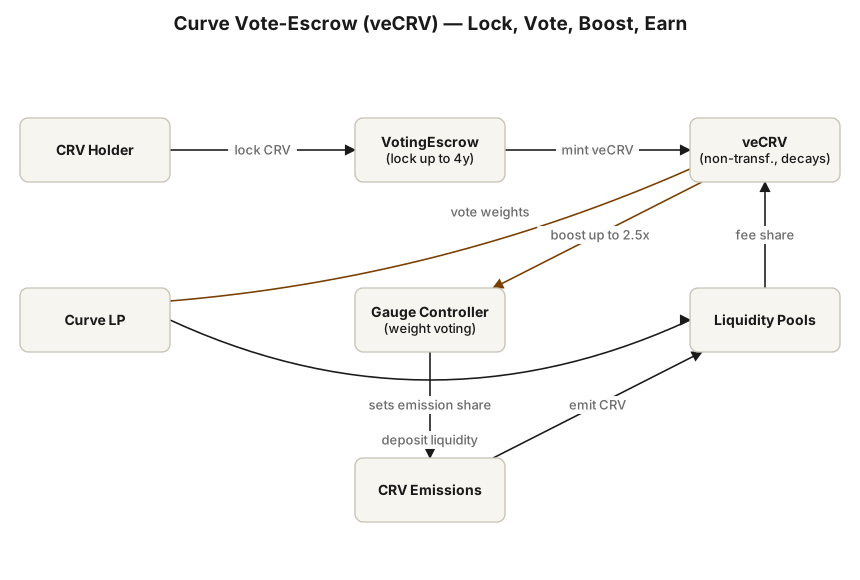 Open full-size diagram
Summary
Curve Vote Escrow (veCRV) is the governance and incentive core of Curve Finance, a stablecoin-focused AMM DEX on Ethereum. Rather than granting one-token-one-vote power, Curve requires holders to lock their CRV in the VotingEscrow contract for a chosen period (a minimum of one week up to a maximum of four years) to receive non-transferable veCRV. The longer the lock, the more veCRV received: one CRV locked for four years yields one veCRV, while the same CRV locked for one year yields only 0.25. This time-weighting, combined with a linear decay toward zero as the lock nears expiry, aligned voting power with long-term commitment and became the archetypal "ve" model copied across DeFi.
CRV itself launched unusually: the token and DAO code were public on GitHub, and on August 13, 2020 an anonymous developer deployed the contracts before the Curve team intended to. The team ratified the launch on August 14, 2020. veCRV was designed into the tokenomics from the start as the mechanism binding governance, emissions, fees, and LP boosts together.
Design (Mechanism)
veCRV combines several tightly coupled subsystems:
- Time-locked, non-transferable escrow. CRV is locked in
VotingEscrow(0x5f3b5DfEb7B28CDbD7FAba78963EE202a494e2A2). Lock durations round down to whole weeks, capped at four years. veCRV cannot be transferred; the only way to obtain it is to lock CRV. Voting weight isveCRV = CRV_locked × (years_remaining / 4). - Linear decay. "User voting power is linearly decreasing since the moment of lock." The contract stores per-user slopes and biases in
user_point_history, so decay is computed without users needing to check in. Holders can extend the lock, add CRV, or withdraw after expiry. - Gauge-weight voting (emissions direction). CRV inflation is distributed to liquidity pools via "gauges." veCRV holders vote to set each gauge's weight, and those weights determine each pool's share of ongoing CRV emissions. This is the highest-value power in the system: whoever controls veCRV controls where new liquidity incentives flow.
- LP reward boost. Providing liquidity while holding veCRV boosts an LP's CRV rewards by up to 2.5x, giving large lockers both global influence (gauge votes) and individual yield advantages.
- Fee sharing. veCRV holders receive a share of protocol trading fees and, later, a portion of interest from Curve's stablecoin (crvUSD) markets, giving the locked token a cash-flow claim rather than only voting rights.
The elegance is that these four levers — lock, vote, boost, earn — reinforce one another: to maximize yield and influence, participants are pushed to lock the maximum four years, reducing sell pressure and concentrating governance among long-term aligned holders.
Outcome
veCRV is one of the most influential and durable mechanism designs in DeFi. It successfully bootstrapped and retained deep stablecoin liquidity and spawned an entire ecosystem — the "Curve Wars" — in which external protocols competed to accumulate veCRV (directly or indirectly) to steer emissions toward their own pools. Convex Finance, launched in May 2021, abstracted veCRV locking behind its own liquid wrapper and captured roughly half of all veCRV within a year, a position it still held as of mid-2026. Vote-bribe marketplaces such as Votium and Hidden Hand emerged to let protocols pay veCRV/vlCVX voters for gauge support, and these markets were still paying voters every round as of June 2026.
The ve model was subsequently forked or adapted by numerous protocols (Balancer's veBAL, Frax's veFXS, and many others), making it a canonical primitive. Curve itself remained a top DeFi venue by liquidity for years. On these grounds the outcome is a major success as a mechanism-design experiment, even though it also produced side effects (governance capture, mercenary "bribe" dynamics) that its designers did not fully anticipate.
Why it worked
- Commitment as sybil-resistant signal. Requiring illiquid, time-locked capital made governance power expensive to acquire and hard to fake, aligning voters with the protocol's long horizon.
- Reduced circulating supply / sell pressure. Rational actors locked for four years to maximize boost and fees, sinking a large share of CRV and dampening emission-driven dumping.
- Composable value flywheel. Gauge votes controlled real economic flow (emissions → liquidity → volume → fees back to lockers), so acquiring veCRV had measurable ROI, which drew sophisticated capital and, ultimately, entire meta-protocols.
- Right problem, right tool. For a stablecoin DEX where liquidity depth is the product, a mechanism that directs incentives to the most useful pools fit the business precisely.
Limitations and criticisms
Several structural weaknesses emerged alongside veCRV's success:
- Governance capture and liquidity abstraction. Convex's liquid wrapper let users get veCRV-like boosts without locking themselves, concentrating voting power in a single third party (vlCVX) and undermining the "everyone locks" ideal.
- Bribe/mercenary dynamics. Vote markets turned gauge voting into a pay-for-emissions auction, arguably optimizing for who pays the most bribe rather than which pool best serves the protocol.
- Illiquidity friction. Four-year non-transferable locks are a hard sell for many holders; much of the "solution" (liquid wrappers) reintroduced the very transferability the design tried to remove.
- Token concentration risk. A large share of circulating CRV was concentrated in a few large holders and used as loan collateral elsewhere in DeFi; a 2024 liquidation cascade tied to those positions stressed the CRV market and highlighted how concentrated the underlying token remained.
Lessons
- Locking capital is a powerful alignment tool, but it invites liquid wrappers. Any non-transferable, benefit-bearing lock creates demand for a tradable derivative; designers should assume a "Convex" will appear and plan governance accordingly.
- Whoever controls the emissions dial becomes the prize. Making gauge voting the lever over real cash flows guarantees a meta-game (the "Curve Wars") forms on top; this can be a feature (deep liquidity) and a bug (bribe-driven capture) simultaneously.
- Coupling cash flow to governance strengthens the token but concentrates power. Fee-sharing plus boost incentivizes maximum locking, which is good for supply dynamics but tends to concentrate influence in the largest, most sophisticated players.
- Time-decay must be paired with clear accounting. Curve's slope/bias storage let power decay trustlessly without user check-ins — a reusable pattern for any time-weighted voting system.
Redesign (EDITORIAL — hypothesis, not fact)
The following is the researcher's opinion, not established fact.
If redesigning veCRV today, I would target the two failure modes — capture via liquid wrappers and bribe-dominated gauge voting — while preserving the commitment flywheel:
- Native liquid ve position with protocol-owned wrapper. Rather than ceding the wrapper market to a third party like Convex, ship an official, transparent liquid-lock product so the value and governance stay inside the protocol's control surface, reducing single-point capture.
- Quadratic or convex-capped gauge influence. Cap or dampen the marginal gauge power of any single voting entity (e.g., convex weighting above a threshold) to blunt majority capture, while keeping linear rewards for honest lockers.
- Legitimize and internalize bribes. Since vote-buying is inevitable when votes control cash flow, route "incentives" through a protocol-native, auditable auction that skims a fee back to all lockers, converting a leakage into protocol revenue and improving transparency.
- Shorter max lock with renewal boosts. Four-year locks deter participation; a 1–2 year max with escalating loyalty multipliers for continuous re-locking could capture most alignment benefit with far less illiquidity friction.
- Emissions guardrails. Add a minimum baseline emission to core stablecoin pools that cannot be voted to zero, preventing bribe wars from starving the protocol's foundational liquidity.
These changes aim to keep veCRV's proven strength — expensive, aligned, cash-flow-bearing governance — while defending against the concentration and mercenary dynamics that history showed it invites.
Sources
- VotingEscrow (veCRV) - Curve Technical Docs — primary (docs)
- Curve DAO: Vote-Escrowed CRV — Curve 1.0.0 documentation (readthedocs) — primary (docs)
- What is veCRV? | Curve Knowledge Hub — primary (docs)
- VotingEscrow contract on Etherscan — primary (contract)
- curve-dao-contracts (GitHub) — primary (contract)
- How Curve Finance's CRV Token Launched Without Anyone Knowing (Crypto Briefing) (news)
- Overview & Implementation (liquidity gauges / minting CRV) - Curve Technical Docs — primary (docs)
- veTokenomics & Bribe Markets: Gauge Voting, Incentives, and Curve Wars Mechanics (Mitosis University) (analysis)
- Voting and Gauge Weights | Convex Finance Docs (docs)
Related experiments
Last verified: 2026-07-26 · Spot an error? Suggest a correction