Jito
Solana's dominant MEV infrastructure and liquid staking network, which turned validator MEV capture into an auditable tip auction shared with stakers via JitoSOL — and famously shut down its own mempool to stop sandwich attacks.
▶ Run interactive simulation animated mechanism with editable parameters
How it works onchain
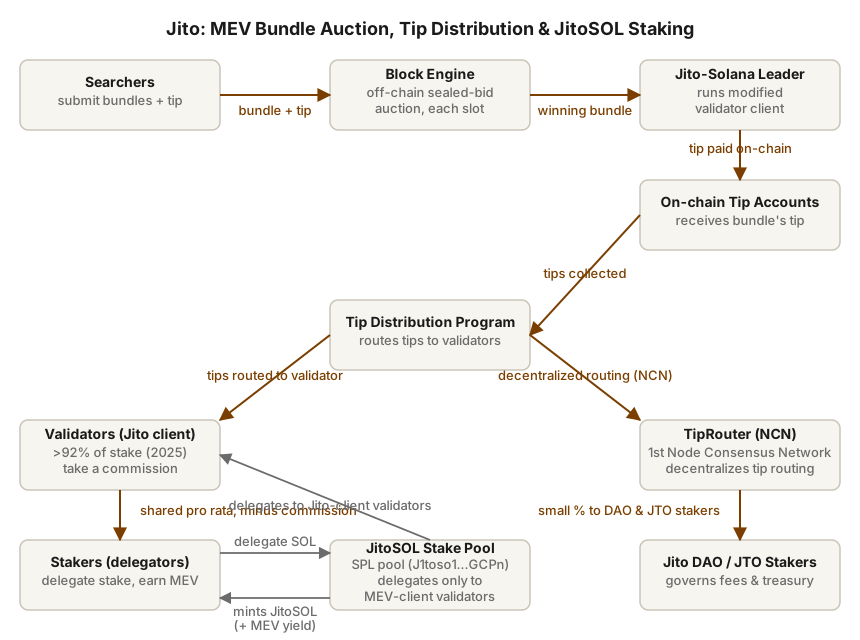 Open full-size diagram
Summary
Jito is the experiment that answered a question Ethereum spent years agonizing over — who should capture MEV, and how — on a chain that officially had no mempool at all. Founded in 2021 by Lucas Bruder (CEO) and Zano Sherwani (CTO), Jito Labs built a modified Solana validator client (Jito-Solana) that runs an off-chain, sealed-bid auction for transaction "bundles," collects searcher tips, and routes that revenue back to validators and their stakers. On top of this sits JitoSOL, launched on mainnet in late 2022 (officially announced November 2022) as Solana's first MEV-boosted liquid staking token: stakers earn base staking yield plus a share of MEV tips. The stack was progressively decentralized via the JTO governance token (airdropped December 7, 2023 to 9,852 addresses), the Jito DAO on Realms, a restaking system with Node Consensus Networks (TipRouter being the first), and in July 2025 the Block Assembly Marketplace (BAM), which opened block-building into a transparent, verifiable marketplace. By early 2025, over 92% of Solana stake ran the Jito client, making it arguably the most successful MEV-infrastructure capture-and-redistribute experiment on any chain.
Design (Mechanism)
The core mechanism is a three-sided market between searchers, validators, and stakers:
- Bundle auction (Block Engine): Searchers submit atomic bundles of transactions with an attached tip to Jito's block engine, which runs a sealed-bid, off-chain auction each slot. Winning bundles are forwarded to the current Jito-Solana leader for inclusion. Because bundles execute atomically or not at all, searchers can express arbitrage and liquidation strategies without spamming — Solana's pre-Jito MEV meta was brute-force transaction spam that congested the network.
- Tip distribution: Tips are paid to on-chain tip accounts and distributed via a tip-distribution program to validators, who share them pro rata with delegated stakers (validators take a commission). This converts MEV from a validator-private income stream into protocol-legible yield.
- JitoSOL stake pool: Built on the SPL stake pool standard (pool mint
J1toso1...GCPn), it delegates only to validators running the MEV client and meeting performance criteria, so JitoSOL holders receive staking rewards plus MEV tips in one appreciating LST. - Token and DAO: JTO (1B supply) launched with ~10% airdropped based on retroactive "Jito Points" (JitoSOL holding, DeFi usage, validator and searcher activity), 24.3% to a DAO-controlled treasury, 25% to the Jito Foundation, and the remainder to team/investors on 3-year vests with a 1-year cliff. The DAO governs pool fees and treasury.
- Restaking and TipRouter: Jito (Re)staking introduced Node Consensus Networks (NCNs) secured by staked SPL assets. TipRouter, the first NCN, decentralized the calculation and routing of tip distributions and directs a small percentage of MEV tips to the DAO, JitoSOL holders, and JTO stakers — turning governance into a cash-flow claim.
- BAM (2025): Replaces the trusted block engine with scheduler nodes running in TEEs, making transaction sequencing transparent, verifiable, and programmable via "plugins," with early mainnet and open-sourcing announced September 2025.
Outcome
Overwhelming success on adoption: the Jito-Solana client went from roughly 48% of Solana stake at the start of 2024 to over 92% by early 2025 (Helius), and Jito bundles generated about 3.75 million SOL in tips over 2024 alone. JitoSOL became the leading Solana LST, and the JTO airdrop (December 2023) was one of the defining airdrops of the cycle, with even small users receiving thousands of dollars — widely credited with reigniting Solana DeFi activity. The most consequential governance-adjacent moment came in March 2024, when Jito Labs unilaterally suspended its mempool service because it had become the primary enabler of sandwich attacks against Solana retail users — deliberately destroying a revenue stream for ecosystem health. Sandwiching migrated to private infrastructure rather than disappearing, which in turn motivated BAM's verifiable sequencing. A reported $50M strategic investment from a16z crypto and the DAO's move to route real MEV revenue to token stakers via TipRouter cemented Jito as core Solana infrastructure. The experiment is still evolving (BAM is young), but on its own terms it is a major success.
Why it worked
- It monetized an externality that already existed. MEV was being extracted via spam; Jito offered a strictly better channel (atomic bundles, auctions) and paid validators and stakers to adopt it. Adoption was individually rational at every node.
- Aligned LST flywheel: JitoSOL's extra MEV yield attracted stake; more Jito-delegated stake made the auction more valuable to searchers; higher tips raised JitoSOL yield.
- Credible retroactive airdrop rewarded real usage (points snapshot before announcement), seeding a DAO with genuine users.
- Willingness to self-cannibalize: killing the mempool in March 2024 bought enormous legitimacy with the Solana community and its core developers.
Limitations and criticisms
- The mempool episode showed the mechanism's dark side: Jito's infrastructure briefly created a de facto mempool where none existed, giving searchers visibility into pending order flow that enabled sandwich attacks on user transactions; suspension pushed sandwiching into private deals between operators and validators rather than eliminating it.
- Centralization critique: for years a single company's block engine sat in the critical path of >90% of Solana's stake — a trusted chokepoint BAM is explicitly designed to unwind, but which persisted through the period of fastest growth.
- JTO governance value depended on later retrofits (TipRouter fee routing); at launch the token had voting rights over fees but no direct cash flow.
Lessons
- MEV redistribution beats MEV prohibition: channeling extraction through an auction and paying it to stakers converted a negative-sum spam war into ordered, legible yield — the mechanism won by making every participant richer than the status quo.
- Infrastructure operators can and sometimes must act as regulators: Jito's mempool shutdown is the canonical example of a profit-making protocol pruning a profitable product line because its externalities threatened the host ecosystem's social license.
- Retroactive points-based airdrops to verified users remain the strongest cold-start tool for DAO legitimacy — but governance tokens need an eventual cash-flow or control hook (here, TipRouter tip routing) to stay relevant.
- A trusted intermediary is an acceptable bootstrap but not an end state: the block-engine-to-BAM arc mirrors Flashbots' relay-to-SUAVE arc — centralize to prove the market exists, then decentralize the chokepoint.
Redesign (EDITORIAL — hypothesis, not fact)
This section is editorial hypothesis, not established fact. A redesigned Jito might have launched with verifiable sequencing from day one — even a simple commit-reveal or TEE-attested ordering log for the block engine would have blunted both the centralization critique and the sandwich-attack window, since the mempool's harms stemmed from privileged, unaccountable visibility into pending flow. Second, the tip split could be set by an on-chain market rather than governance: let validators bid the staker-share of tips they'll pass through, with the stake pool auto-delegating toward the best risk-adjusted pass-through, making commission competition continuous instead of curated. Third, JTO could have vested airdrop claims into staked (TipRouter-earning) positions by default, converting mercenary claimants into aligned fee recipients at genesis rather than eighteen months later.
Sources
- Introducing JitoSOL: Solana's 1st MEV-Powered Liquid Staking Token — primary (docs)
- Announcing JTO: The Jito Governance Token — primary (docs)
- Deployed Programs — Jito Foundation docs — primary (contract)
- What Is Jito TipRouter? — primary (docs)
- Jito: Past, Present, and Future — Lucas Bruder — primary (retrospective)
- Jito Labs ends mempool functionality citing impact on Solana users (news)
- Solana MEV Report: Trends, Insights, and Challenges — Helius (analysis)
- Jito Launches BAM to Reshape Solana's Blockspace Economy — CoinDesk (news)
- JitoSOL mint on Solana Explorer — primary (contract)
Related experiments
Last verified: 2026-07-27 · Spot an error? Suggest a correction