GHO
Aave's DAO-governed, overcollateralized stablecoin minted by whitelisted 'facilitators' against Aave V3 collateral, whose fixed governance-set borrow rate caused a months-long depeg before rate hikes and a stability module restored the dollar peg.
▶ Run interactive simulation animated mechanism with editable parameters
How it works onchain
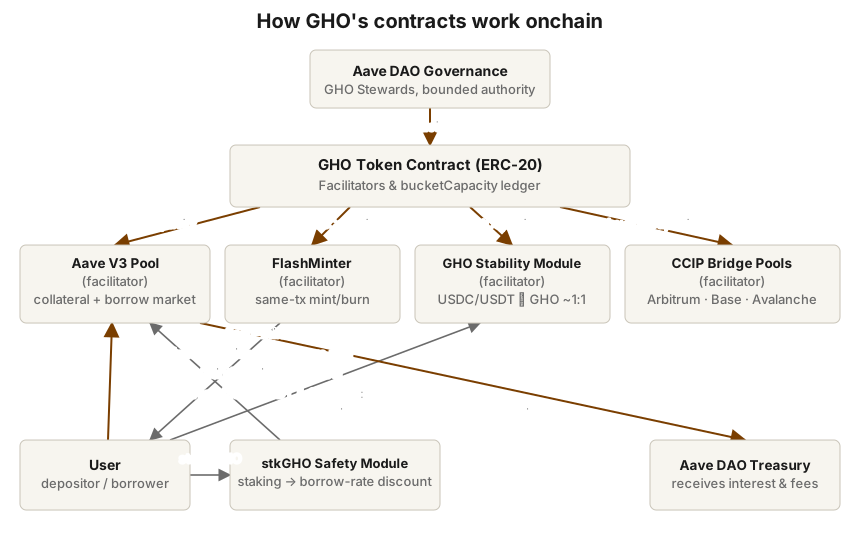 Open full-size diagram
Summary
GHO is the Aave DAO's native, overcollateralized US-dollar stablecoin, proposed by Aave Companies in a July 2022 governance post, approved by an overwhelming DAO vote, and launched on Ethereum mainnet on July 15, 2023 as an ERC-20 at 0x40D16FC0246aD3160Ccc09B8D0D3A2cD28aE6C2f. Unlike MakerDAO's DAI, which grew its own collateral system, GHO piggybacks on an existing money market: users borrow (mint) GHO against their Aave V3 deposits, and all interest paid flows directly to the DAO treasury rather than to depositors. Its defining experiment is the facilitator model — a whitelist of contracts, each with a governance-set "bucket capacity," that may mint and burn GHO — and a governance-set interest rate instead of a utilization-curve rate. The early result was a textbook mechanism-design lesson: a cheap fixed borrow rate with no hard redemption path produced a months-long depeg to roughly the mid-$0.90s in late 2023, corrected only after repeated rate hikes, a dedicated liquidity committee, staking incentives, and a Peg-Stability-Module-style GSM. Since re-pegging in early 2024, GHO has expanded cross-chain via Chainlink CCIP and grown to a mid-sized stablecoin (roughly $580M supply by early 2026), tightly pegged and central to Aave's V4 roadmap.
Design (Mechanism)
- Facilitators and buckets. GHO's token contract does not mint against collateral itself. The Aave DAO whitelists facilitators — contracts trusted to mint/burn GHO up to a per-facilitator
bucketCapacity, withbucketLeveltracking outstanding mints. Total supply is the sum of bucket caps, giving governance a supply dial per minting mechanism. Launch facilitators were the Aave V3 Ethereum pool and a FlashMinter. - Overcollateralized borrowing. In the primary facilitator (Aave V3 Ethereum), users supply collateral and borrow GHO like any other asset, except GHO is minted on demand rather than lent from depositors. Repayment burns the principal; accrued interest is transferred to the Aave DAO treasury, making GHO a direct revenue engine.
- Governance-set rate. GHO's borrow rate is fixed by governance (later delegated to "GHO Stewards" within bounds, adjustable when price leaves the $0.995–$1.005 band) rather than by utilization. Launch rate was very low (~1.5%), with a discount (up to 30%) for stkAAVE stakers — deliberately coupling stablecoin demand to AAVE staking.
- FlashMinter. A second facilitator flash-mints GHO (fee to treasury), supporting liquidations and arbitrage without pre-existing liquidity.
- GHO Stability Module (GSM). Proposed on the governance forum in 2023 and activated after the depeg period, the GSM lets users swap USDC/USDT for GHO near 1:1 (with fees and exposure caps), creating an arbitrage-enforced soft redemption path analogous to Maker's PSM.
- Peg-support add-ons. A GHO Liquidity Committee (from late 2023) managed DEX liquidity; stkGHO staking in the Aave Safety Module (January 2024) and the Merit incentive program created native demand sinks; later sGHO/Aave Savings Rate products extended this. Cross-chain deployments (Arbitrum July 2024, then Avalanche, Base and others) use Chainlink CCIP token pools as burn-and-mint facilitators.
Outcome
GHO launched smoothly but slid below peg almost immediately and stayed there for roughly half a year, bottoming around the mid-$0.90s in autumn 2023. The cause was structural: borrowing GHO at ~1.5% (or ~1% with the stkAAVE discount) was far cheaper than other stablecoin credit, so rational users minted GHO and sold it for other assets, while no redemption mechanism guaranteed $1 on the way out. Governance responded iteratively — multiple rate increases, the Liquidity Committee (whose first-month report documents targeted DEX liquidity operations), stkGHO staking, and Merit rewards — and the peg was substantially restored by early 2024, with the GSM subsequently hardening it. Growth after re-pegging was deliberate and cap-constrained: CCIP expansion to Arbitrum (2024) and later Base and Avalanche, supply passing ~$580M by March 2026 with the peg holding within basis points. GHO became a core pillar of Aave's economics (100% of GHO revenue accrues to the DAO/AAVE per the "Aave Will Win" framework) and of the V4 hub-and-spoke design. Outcome status: ongoing — a clear recovery story, though still an order of magnitude smaller than DAI/USDS and dependent on Aave's broader ecosystem.
Why it worked
- Facilitator abstraction proved genuinely extensible. The same interface admitted a lending pool, a flash minter, a PSM-style GSM, and CCIP bridge pools — supply control stayed legible to governance as one list of buckets.
- Distribution was inherited, not bootstrapped. Minting through Aave V3 gave GHO instant access to billions in existing collateral and a battle-tested liquidation engine at zero incremental protocol risk surface.
- Governance iterated fast and publicly. The depeg was diagnosed and corrected through forum proposals — rate hikes, GLC, stkGHO, GSM — within roughly six months, a credible demonstration that a DAO can do monetary policy.
- Aligned revenue. Routing all interest to the treasury made GHO the DAO's highest-margin product, sustaining long-term political will to defend the peg.
Limitations and criticisms
- The launch rate was mispriced. A fixed ~1.5% borrow rate with no redemption arb made "mint and dump" the dominant strategy; the peg broke within weeks of launch and took roughly six months to fully restore, a costly early lesson.
- No day-one redemption path. The GSM existed as a forum proposal before launch but shipped only after the depeg; soft pegs without a $1 exit rely purely on demand, which hadn't yet materialized.
- stkAAVE discount worsened the loop. The discount concentrated the cheapest minting capacity in the largest stakers, and nothing in the design limited how much of that discounted mint could be converted straight into sell pressure during the depeg period.
- Scale remains modest. Even by 2026, GHO's few hundred million supply trails centralized stablecoins and DAI/USDS by orders of magnitude; growth is throttled by conservative bucket caps and competition from yield-bearing fiat-backed coins.
Lessons
- A stablecoin needs a credible $1 exit before it needs cheap minting. Redemption/arbitrage mechanisms (GSM-style) should ship at genesis; demand-side incentives cannot substitute for them.
- Fixed governance-set rates are a peg lever, not a growth subsidy. Below-market borrow rates on a freely-sold asset are a standing invitation to short your own peg; rates must float with peg deviation (Aave eventually bounded this via Stewards).
- Modular mint permissioning (facilitators + bucket caps) is a strong pattern. It turned one token contract into a policy framework spanning lending, flash loans, PSMs, and bridges, with per-mechanism blast-radius limits.
- DAOs can run monetary policy, but slowly. Every corrective step required forum + vote latency; delegating bounded authority to stewards/committees was the workable compromise between decentralization and responsiveness.
- Attaching a stablecoin to an existing money market inverts the cold-start problem — collateral and liquidation infrastructure come free; what must be bootstrapped is demand to hold, not supply.
Redesign (EDITORIAL — hypothesis, not fact)
This section is editorial hypothesis, not a factual record. A redesigned GHO would launch the GSM and the borrow market in the same transaction, with the borrow rate algorithmically floored at (benchmark stablecoin borrow rate − small spread) and automatically ratcheted by an on-chain peg controller reading a TWAP oracle, leaving governance only the parameter bounds. The stkAAVE discount would be replaced by a discount that vests only while the peg holds within band, aligning insiders with peg defense instead of cheap leverage. Facilitator buckets could carry per-facilitator peg-risk pricing: mint fees that scale with each bucket's historical net sell pressure, making the facilitator list a self-tuning risk market. Finally, a portion of GHO interest revenue would be committed to a transparent, on-chain buffer earmarked for GSM backstop liquidity, converting the DAO's profit motive into a visible peg guarantee.
Sources
- GHO — Aave Protocol Documentation (developer docs, facilitators, GSM, flashminter) — primary (docs)
- GHO Token (GHO) ERC-20 contract on Etherscan — primary (contract)
- [TEMP CHECK] GHO Stability Module — Aave Governance forum — primary (governance)
- GHO Stability Module Update — Aave Governance forum — primary (governance)
- GHO Liquidity Committee: First month report — DeFi Collective (retrospective)
- Aave's GHO Stablecoin Nears Elusive Dollar Peg — CoinDesk (Nov 2023) (news)
- Aave's GHO Stablecoin Now Live on Arbitrum Powered by Chainlink CCIP (PR, July 2024) (news)
- Aave Explainer Series — The GHO Stablecoin (LlamaRisk) (analysis)
- Aave in 2025: The Three Horsemen of GHO (stkGHO, anti-GHO, sGHO) — OAK Research (analysis)
Related experiments
Last verified: 2026-07-27 · Spot an error? Suggest a correction