Mars Protocol Rover Credit Accounts
NFT-represented, cross-collateralized 'credit accounts' on Mars Protocol let Cosmos users lend, borrow, spot trade, margin trade, and leverage-farm from a single composable position instead of siloed money-market deposits.
▶ Run interactive simulation animated mechanism with editable parameters
How it works onchain
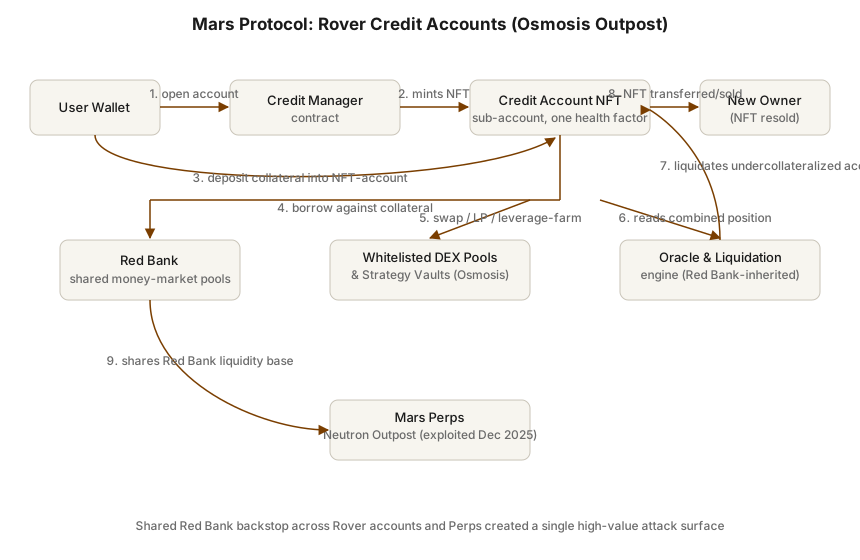 Open full-size diagram
Summary
Mars Protocol is a Cosmos-native money market that originally launched (as "Red Bank") on Terra in 2022, offering standard isolated lending/borrowing pools. After Terra's collapse gutted its TVL, the team (backed by Delphi Labs, with the protocol later run by an independent Mars Protocol Foundation) rebuilt Mars as its own Cosmos SDK appchain, "Mars Hub," and redeployed money markets to partner chains via IBC as "Outposts." On October 10, 2023, Mars shipped "Rover" credit accounts on its Osmosis Outpost — the centerpiece of its "v2" architecture. A credit account is a smart-contract sub-account represented by an NFT that a user mints and funds; instead of one deposit doing one thing (like a normal Aave-style position), the account can simultaneously hold multiple collateral assets, borrow against them, swap, provide liquidity, and deploy into whitelisted leveraged-yield strategies, all cross-collateralized under one health factor.
Design (Mechanism)
A user opens a Rover by calling the chain's Credit Manager contract, which mints them an NFT representing an empty account. They deposit any supported asset(s) into that NFT-account and can then, in a single transaction bundle: borrow additional assets from Mars' Red Bank against the deposited collateral, swap between assets, add liquidity to whitelisted AMM pools, stake LP tokens into vaults, or open margin/spot positions — all inside the same account. Because every asset and position in the account is netted into one collateralization ratio, users get capital efficiency similar to a centralized-exchange cross-margin account: adding any asset (even an LP or vault token) increases total borrowing power, and a single liquidation engine monitors the whole account rather than each position separately. Ownership of the underlying NFT can be transferred, sold, or used elsewhere, since credit accounts are fungible/tradable objects rather than an address-bound balance. The system relies on a whitelist of vetted assets, DEX pools, and strategy vaults (so risk parameters can be tuned per integration) and on Mars' oracle and liquidation infrastructure, inherited from the Red Bank, to keep undercollateralized accounts from becoming bad debt. Later iterations extended the same Outpost model to Neutron and added a perpetuals ("Mars Perps") product built on top of the credit-account/Red-Bank liquidity base.
Outcome
Rover credit accounts shipped and have operated continuously on Osmosis since October 2023, later expanding toward Neutron, and became the flagship differentiator of Mars v2 versus plain isolated-pool lenders. The broader protocol's history is turbulent, however: Mars (as Red Bank on Terra) peaked around $350M TVL before Terra/UST's May 2022 collapse crushed it roughly 99% to about $2.6M, prompting Delphi Labs to initially propose winding the protocol down and refunding depositors before the team instead relaunched on its own Cosmos Hub. Mars survived that near-death event and rebuilt around the credit-account architecture, but the protocol never recovered anything close to Terra-era scale, operating instead as a mid-tier Cosmos-ecosystem money market. In December 2025, a separate but related product — Mars Perps on the Neutron Outpost — suffered an exploit in which an attacker looped a manipulation pattern to drain roughly $973K from Mars' lending markets in minutes, forcing the team to disable perps contracts pending investigation. The core Rover credit-account/Red Bank lending product on Osmosis was not reported as compromised in that incident.
Why it worked
- Capital efficiency via cross-margin: bundling collateral, borrowing, swapping, LPing, and leveraged farming into one NFT-owned account let users achieve leverage and strategy combinations that would otherwise require juggling several separate protocols and approvals, closing much of the UX gap between DeFi money markets and centralized cross-margin exchanges.
- Composability by design: routing strategies through whitelisted external DEX/vault integrations (rather than Mars building every yield strategy itself) let the protocol plug into the wider Cosmos IBC ecosystem (Osmosis pools, Neutron strategies) without taking on unlimited smart-contract risk from unvetted integrations.
- Tradable/portable positions: representing accounts as NFTs made entire leveraged positions transferable objects, a mechanic later widely copied in on-chain leverage/perps design.
Limitations and criticisms
- Legacy single-chain fragility: the predecessor Red Bank product was deeply tied to Terra/UST, and when UST depegged, Mars' TVL crashed roughly 99% — a reminder that a lending protocol's fate can be tightly correlated with its host chain or stablecoin. The Mars Hub/Outpost redesign reduces but does not eliminate this class of dependency risk.
- Niche rather than dominant scale: even after the Rover relaunch, Mars operates as a mid-tier Cosmos-ecosystem product rather than reclaiming its earlier ~$350M TVL footprint, reflecting a smaller addressable Cosmos DeFi market than the Terra era suggested.
- Shared risk engine as a single point of failure: the December 2025 Perps exploit (a different but adjacent product built on the same Outpost/Red-Bank liquidity) shows that concentrating cross-margin liquidity behind a shared risk engine creates a high-value single target — a loop-based manipulation drained roughly $973K in a five-hop, minutes-long attack.
Lessons
- Cross-collateralized "credit account" / sub-account architectures meaningfully improve DeFi capital efficiency but concentrate risk: a bug or manipulation in any one whitelisted integration can threaten the shared collateral pool backing all accounts.
- Representing leveraged positions as transferable NFTs is a powerful composability primitive, letting positions be sold, used as collateral elsewhere, or managed by third parties, but it also means position risk parameters must be enforced entirely on-chain since there's no off-chain KYC'd account holder to fall back on.
- Surviving an ecosystem-level collapse (Terra/UST) required Mars to decouple from its original chain and rebuild independent infrastructure (Mars Hub, Outposts); protocols anchored to a single external stablecoin or chain carry existential correlated risk that a redesign can mitigate but not fully eliminate.
- Even mature protocols with years of audits can be hit by novel looped-manipulation exploits on newer product lines (Perps), underscoring that each new integration added to a shared credit-account risk engine needs independent, ongoing security scrutiny rather than one-time vetting.
Redesign (EDITORIAL)
Hypothesis, not fact. A more resilient version of Rover might separate risk domains more explicitly than a single shared Red Bank: instead of one global liquidity/solvency backstop underwriting every whitelisted integration (lending, spot, perps, leveraged vaults) as it did in the Perps incident, each integration category could draw from its own isolated liquidity buffer with a circuit breaker that caps per-integration exposure as a percentage of total protocol TVL. Credit accounts would still cross-collateralize a user's own assets for capital efficiency, but the protocol-level backstop would be segmented, so a manipulation or bug in a newer product (like perps) can drain at most its own segment rather than threatening the broader lending base. Pairing this with real-time anomaly detection on looped/rapid-fire transaction patterns (the exact signature of the December 2025 exploit) could let the protocol auto-pause an integration within seconds rather than minutes.
Sources
- Welcome to Mars Protocol | Documentation — primary (documentation)
- Rise of the Rovers: Mars v2 launches on Osmosis — primary (blog)
- Mars Protocol 🔴 (@mars_protocol) on X — primary (social)
- Mars Protocol TVL, Fees, Revenue & Volume (data)
- Delphi Labs Wants to Shut Down DeFi Protocol Mars After TVL Tumbles 99% to $2.6M (news)
- Tracking the Mars Protocol exploit: A $973K attack in 5 hops (analysis)
Related experiments
Last verified: 2026-07-27 · Spot an error? Suggest a correction