Kamino Finance
Solana's largest lending/liquidity protocol, which grew from an automated concentrated-liquidity vault manager into a unified 'lend + liquidity + leverage' money market (K-Lend) with elevation-group risk tiers and yield-bearing kToken collateral.
▶ Run interactive simulation animated mechanism with editable parameters
How it works onchain
 Open full-size diagram
Summary
Kamino Finance began in August 2022 as an automated concentrated-liquidity market-maker (CLMM) vault manager on Solana, incubated by Hubble Protocol (the team behind the USDH stablecoin, led by ex-Bloomberg engineer Marius Ciubotariu, with Mark Hull as co-founder on product/growth). Its first product wrapped Orca and Raydium concentrated-liquidity positions into auto-rebalancing, auto-compounding vaults that accept single-sided deposits and issue fungible, yield-bearing "kTokens." In 2023 Kamino shipped K-Lend, a peer-to-pool money market designed as infrastructure for leverage products, and the protocol subsequently absorbed Hubble's focus entirely. By the April 2024 launch of the KMNO token, Kamino was Solana's largest protocol by TVL (~$1.5B at airdrop, later peaking near $2.8B in the lending category); as of 2026 it remains the top Solana lending protocol, has rebranded to kamino.com, and has expanded via Kamino V2 into permissionless market creation, curated risk vaults, and collateral onboarding for tokenized equities and RWAs.
Design (Mechanism)
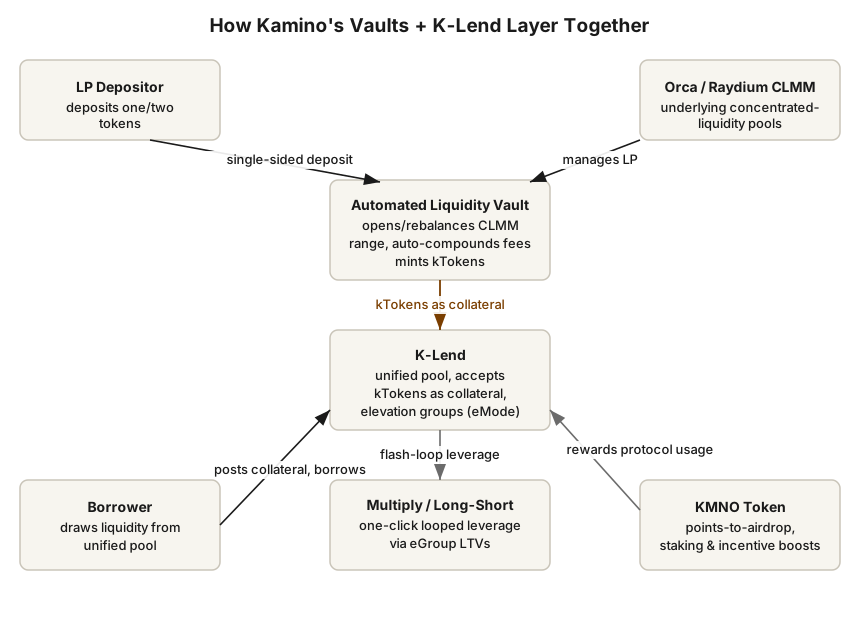
Kamino's design is a layered composition of three primitives:
Automated Liquidity Vaults. Users deposit one or two tokens; the vault opens a concentrated-liquidity position on Orca/Raydium within an algorithmically chosen price range, rebalances when price drifts, and auto-compounds fees. Depositors receive kTokens — fungible receipt tokens representing a pro-rata share of the managed LP position. This converts the operationally intensive, non-fungible CLMM position into a passive, composable asset.
K-Lend. A peer-to-pool borrowing market with a single unified liquidity pool rather than isolated pools. Its signature mechanism is "elevation groups" (eGroups, an eMode analogue): assets grouped by correlation (e.g., SOL and its liquid-staking tokens) get custom, higher LTVs and liquidation thresholds when a position stays entirely within the group. K-Lend accepts kTokens as collateral, closing the loop: LP positions become borrowable-against assets. It also uses a dynamic liquidation model and (in V2) protections such as "Scam Wick Protection" against oracle/price-spike liquidations.
Leverage products on top. "Multiply" performs one-click looped leverage (e.g., deposit jitoSOL, flash-borrow SOL, re-deposit) exploiting eGroup LTVs; "Long/Short" routes perp-style directional leverage through the lend markets.
The KMNO token launched via a points program (Season 1 snapshot March 31, 2024) with 7–7.5% of the 10B supply in the genesis airdrop, claimable April 30, 2024; KMNO is used for staking and incentive boosts. The core programs are open source (program ID KLend2g3cP87fffoy8q1mQqGKjrxjC8boSyAYavgmjD), with audits by OtterSec, Offside Labs, Certora, and Sec3 published in a public audits repo.
Outcome
Ongoing and among DeFi's clearest product-market-fit stories on Solana. Kamino became the largest Solana protocol by TVL around its 2024 token launch and, as of mid-2026, still holds the top lending/yield TVL slot (multi-billion deposits across SOL, USDC, USDT, JLP, and LST markets; peak near $2.8B), though Jito's LST stack contends for the overall Solana crown. The core contracts have had no major exploit to date. Blemishes: the March 2024 points-to-airdrop reveal angered users (initial allocations were seen as favoring large/looped farmers; Kamino publicly adjusted the distribution within days), and KMNO's pre-market pricing fell roughly 70% around debut, with the token subsequently trading far below hype-era expectations even as protocol usage grew — a familiar divergence between protocol success and token performance.
Why it worked
- It productized a real pain. Concentrated liquidity on CLMMs is actively managed, gas/attention-intensive, and produces non-fungible positions. Kamino's vaults abstracted this into a deposit-and-forget asset, then made that asset collateral — each layer created demand for the next.
- Unified liquidity + eGroups made leverage capital-efficient. Correlated-asset groups allowed high-LTV looping (LST/SOL, stable/stable) without endangering the whole pool, powering the Multiply product that drove much of the TVL.
- Timing and ecosystem fit. Kamino rode Solana's 2023–2025 resurgence (LST growth, JLP, memecoin liquidity, later tokenized stocks) and integrated deeply with Orca, Raydium, Jito, and Jupiter rather than competing with them.
- Credibility practices. Open-source programs, a public audits repo with multiple firms, and a public risk dashboard supported institutional deposits.
Limitations and criticisms
The clearest weaknesses sit in the token and in concentrated systemic risk, not in protocol uptime: the KMNO genesis was criticized as rewarding mercenary loop-farmers, the debut price fell roughly 70% from pre-market levels, and KMNO's value accrual remains thin relative to protocol scale. The protocol also concentrates significant Solana systemic risk: heavy exposure to looped LST and JLP collateral means a depeg or oracle failure in a correlated group could cascade, and reliance on admin-managed risk parameters keeps meaningful trust in the core team/DAO. Hubble's original stablecoin (USDH) quietly lost relevance as a product line — Kamino is effectively the pivot that took over.
Lessons
- Wrapping an actively managed, non-fungible position (CLMM LP) into a fungible yield-bearing token, then accepting that token as loan collateral, is a powerful compounding design: each primitive feeds demand into the next.
- Correlation-aware risk tiers (eMode/elevation groups) are the key unlock for capital-efficient leverage in a unified pool — but they concentrate systemic risk in the correlation assumption itself.
- Points programs harvest TVL efficiently but convert into token resentment if allocations reward loop-size over genuine usage; Kamino's rapid public adjustment limited damage, illustrating that airdrop criteria are governance decisions, not marketing details.
- A protocol can be a runaway success while its token underperforms; without explicit value accrual, token price and protocol health decouple.
- Pivots beat sunk costs: Hubble's stablecoin ambitions mattered less than the internal tool (Kamino) that found product-market fit.
Redesign (EDITORIAL — hypothesis, not fact)
This section is editorial speculation. A redesigned Kamino would (1) tie KMNO directly to protocol cash flows or safety-module underwriting from genesis, making the token a claim on risk-bearing rather than a points rebate, and avoiding the trust hit of a resented airdrop; (2) publish eGroup correlation assumptions as on-chain, continuously stress-tested parameters (e.g., depeg-scenario circuit breakers that automatically deleverage Multiply positions gradually instead of liquidating at cliff thresholds); (3) cap any single correlated collateral family (LST loops, JLP) as a share of unified-pool liabilities to bound cascade risk; and (4) distribute genesis tokens on time-weighted, sybil-resistant usage with a hard per-wallet cap disclosed before the points season begins, so farming strategy cannot diverge from intended behavior.
Sources
- Kamino Lend open-source repository (program ID KLend2g3cP87fffoy8q1mQqGKjrxjC8boSyAYavgmjD) — primary (contract)
- Kamino Lend Litepaper — primary (docs)
- Kamino official docs (kamino.com/docs) — primary (docs)
- Kamino audits repository (OtterSec, Offside Labs, Certora, Sec3) — primary (audit)
- Hubble Protocol launches Kamino Finance (Aug 2022 press release) (news)
- CoinDesk: Solana DeFi protocol Kamino sets KMNO token airdrop for April (2024) (news)
- CoinDesk: KMNO airdrop sparked outrage; Kamino responded with changes (news)
- The Defiant: Kamino Finance debuts token with 70% drop in price (news)
- Solana Compass: Kamino Finance project review, programs, token, metrics (analysis)
- Lightspeed podcast: Kamino 2.0 with Marius Ciubotariu and Mark Hull (retrospective)
Related experiments
Last verified: 2026-07-27 · Spot an error? Suggest a correction