Liquity
An immutable, governance-free protocol that lets ETH holders mint the LUSD stablecoin as 0%-interest loans, secured by a Stability Pool and instant redemptions instead of active monetary policy.
▶ Run interactive simulation animated mechanism with editable parameters
How it works onchain
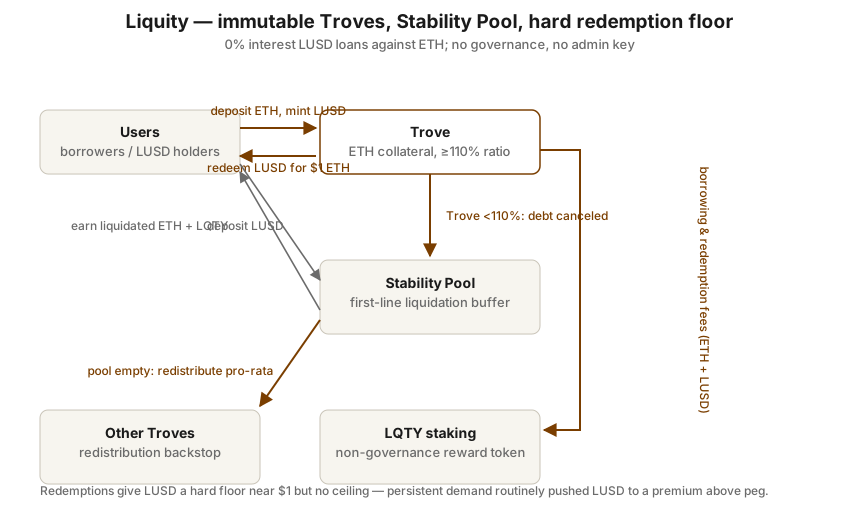 Open full-size diagram
Summary
Liquity is a decentralized borrowing protocol that launched on Ethereum mainnet on 5 April 2021. It lets ETH holders lock collateral into a position called a Trove and mint LUSD, a USD-pegged stablecoin, as an interest-free loan. Its defining thesis was that a stablecoin could hold its peg through pure mechanism design — instant arbitrage redemptions, an incentivized Stability Pool, and algorithmically adjusted one-time fees — rather than through governance, interest-rate policy, or an admin key. The v1 contracts are fully immutable and have no governance: no parameter can be changed, no upgrade can be pushed, and no one can pause the system. It was founded by Robert Lauko (a former DFINITY researcher) and Rick Pardoe, and was audited by Trail of Bits and Coinspect prior to launch. It became a canonical example of a "governance-minimized" DeFi primitive and heavily influenced later CDP-stablecoin designs.
Design (Mechanism)
- Troves & interest-free borrowing. A user deposits ETH and mints LUSD against it. There is no ongoing interest; the cost is a one-time borrowing fee (0.5%–5%) that is algorithmically adjusted based on recent redemption activity.
- 110% minimum collateral ratio. Troves must stay above 110% collateralization — far lower than MakerDAO-style systems of the era — enabling high capital efficiency.
- Stability Pool. LUSD holders deposit into a Stability Pool. When a Trove falls below 110%, its debt is cancelled against pooled LUSD and the pool's depositors receive the liquidated ETH collateral (typically at a small profit), plus LQTY rewards. This is the first line of liquidation defense.
- Redistribution. If the Stability Pool is ever empty, liquidated debt and collateral are redistributed pro-rata to remaining, safer Troves — guaranteeing the system always clears bad debt without external backstops.
- Redemptions (the peg floor). Any LUSD holder can always redeem 1 LUSD for $1 of ETH from the riskiest Troves. This creates a hard arbitrage floor near $1: if LUSD trades below peg, arbitrageurs buy it cheap and redeem for a dollar of ETH.
- LQTY token. A secondary, non-governance token (100M cap). Staking LQTY earns a share of borrowing and redemption fees in ETH and LUSD; it also incentivized early adopters and independent frontend operators.
- No official frontend / no admin key. Liquity ships no canonical UI; independent frontends run the app and take a share of LQTY rewards ("kickback rate"). The protocol has no governance and immutable code — verified independently by Trail of Bits and Coinspect.
Outcome
Status: technically_successful_commercially_unsuccessful. As a piece of engineering, Liquity v1 was a success: the immutable contracts ran for years without a protocol-level exploit, held their design invariants through severe market stress, and never required a rescue. But commercially, adoption peaked early and then eroded sharply. TVL and LUSD supply reached their high in the 2021 bull market (reported in the billions of dollars) and subsequently declined by the great majority — LUSD supply shrank into the low tens of millions by the mid-2020s. The protocol continued operating, but its stablecoin never achieved durable scale. The team ultimately built a successor, Liquity V2 (BOLD), which replaced 0% interest with user-set interest rates and reordered redemptions by interest rate rather than collateral ratio — a direct response to v1's structural problems.
Why it worked
- Robust liquidations under stress. The Stability-Pool-plus-redistribution design cleared undercollateralized debt instantly and cheaply, avoiding the auction failures and keeper dependencies that plagued other CDP systems in volatile markets.
- Credible neutrality. Immutability and the absence of an admin key meant no rug, no governance capture, and no discretionary parameter changes — a genuinely trust-minimized primitive that appealed to censorship-resistance maximalists.
- Capital efficiency. A 110% minimum ratio and 0% interest made it attractive to leverage-seeking ETH holders relative to interest-bearing competitors.
Where the design broke
- The peg was one-sided. Redemptions enforce a hard floor near $1 but nothing caps the upside. Demand for a censorship-resistant, interest-free stablecoin routinely exceeded supply, so LUSD frequently traded at a premium above $1 — a "dollar" that cost $1.02–$1.05 is a poor medium of exchange and hard to grow.
- Redemption risk deterred borrowers. Because redemptions hit the lowest-collateralized Troves first, even prudent borrowers could have their positions partially closed and their ETH exposure involuntarily reduced. This "redemption anxiety" discouraged borrowing and capped organic demand for LUSD.
- Immutability cut both ways. With no ability to adjust parameters or add collateral types, v1 could not adapt to market structure (e.g., staked-ETH collateral, changing rate environments) — pushing the team to launch an entirely new protocol rather than iterate.
- Yield competition. In a rising-rate environment, an unproductive stablecoin holding lost to yield-bearing alternatives, accelerating supply decline.
Lessons
- A redemption floor is not a peg. A one-sided arbitrage mechanism stabilizes the downside but lets persistent demand push a scarce, credibly-neutral asset to a premium; symmetric stabilization (or elastic supply incentives) is needed for a true peg.
- Incentive-aligned liquidations beat auctions. Pre-funding liquidations via an incentivized Stability Pool, with redistribution as a backstop, is more resilient than keeper-run auctions under fast-moving stress — a design many later protocols echoed.
- Immutability is a strong guarantee and a hard constraint. Zero governance maximizes trust-minimization but forecloses adaptation; a protocol must decide up front whether it is a "finished" primitive or a system that will need to evolve. Liquity effectively answered "finished," then had to ship a v2.
- Borrower UX is a product feature. Mechanisms that are theoretically fair (redeeming the riskiest Troves) can still repel users if they create unpredictable, involuntary outcomes.
Redesign (EDITORIAL — hypothesis, not fact)
The following is analysis and speculation, not established fact.
Liquity's core failure mode was economic, not technical: a hard $1 floor with no ceiling in a supply-constrained market produces a chronic premium, while collateral-ratio-ordered redemptions tax the best-behaved borrowers. A redesign would keep the immutable-liquidation engine (Stability Pool + redistribution) but attack the peg asymmetry directly. One approach: introduce a user-set interest rate that also determines redemption priority, so borrowers can pay to move themselves to the back of the redemption queue — precisely the direction Liquity V2/BOLD later took, which validates the diagnosis. Complementarily, the premium problem argues for a supply-side release valve: dynamically lowering the effective borrowing cost (or offering a small redemption rebate) when LUSD trades persistently above peg, so that minting new supply becomes attractive exactly when the market signals scarcity. A more radical hypothesis is to abandon strict immutability in favor of a narrowly-scoped, on-chain rate controller — a bounded, transparent parameter (not a discretionary admin key) that adjusts fees toward a peg target within hard-coded limits — preserving most of v1's credible neutrality while restoring the adaptability its total immutability sacrificed. The central tension any redesign must resolve is the one v1 exposed: the more you constrain governance to earn trust, the less the system can defend its own peg when the market moves against the fixed rules.
Sources
- Liquity Goes Live on Ethereum Mainnet (official blog) — primary (docs)
- Liquity V1 Docs — General FAQ — primary (docs)
- Liquity v1 monorepo (contracts, SDK, dev UI) — primary (contract)
- Liquity Team page (founders, official socials) — primary (docs)
- LUSDToken on Etherscan — primary (contract)
- A Glance into Liquity — Interview with Dr. Robert Lauko (analysis)
- Reflections on Liquity LUSD V2 (analysis of V1 shortcomings) (analysis)
- Liquity V2 Whitepaper (successor design) (docs)
Related experiments
Last verified: 2026-07-26 · Spot an error? Suggest a correction