Pendle Boros
Pendle's funding-rate derivatives venue that tokenizes perpetual-futures funding into tradable Yield Units (YU), letting traders go long/short or hedge funding-rate exposure on margin.
▶ Run interactive simulation animated mechanism with editable parameters
How it works onchain
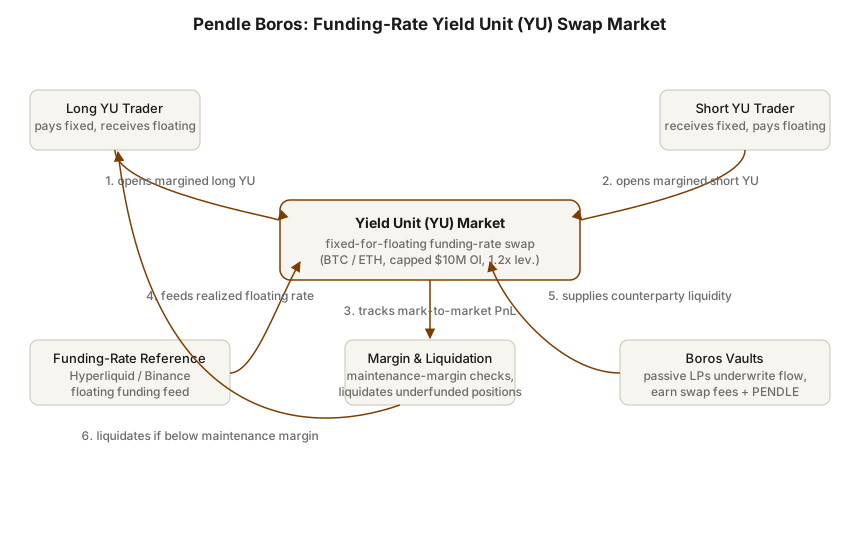 Open full-size diagram
Summary
Boros is a derivatives product built by the Pendle team that lets traders directly buy and sell exposure to perpetual-futures funding rates. It launched on Arbitrum on August 6, 2025, initially covering BTC and ETH funding markets referenced against exchanges like Hyperliquid and Binance. Where Pendle's original protocol splits yield-bearing tokens into principal and yield components, Boros applies the same "separate the yield stream from the underlying" logic to a new asset class: the periodic funding payments exchanged between longs and shorts on perpetual futures. It is pitched as crypto's answer to a TradFi interest-rate swap desk, but for funding rates instead of LIBOR/SOFR.
Design (Mechanism)
Boros tokenizes floating funding-rate cash flows into a unit called a Yield Unit (YU). One YU-BTC or YU-ETH represents the funding yield accrued on one unit of notional (1 BTC or 1 ETH) on a reference perpetual market until a set maturity. Traders open margined positions by going long or short YU:
- Long YU = betting funding rates rise (paying a fixed rate, receiving the floating funding stream).
- Short YU = betting funding rates fall or hedging an existing funding-payment liability (receiving fixed, paying floating).
Each side effectively enters a fixed-for-floating swap: one party locks in a fixed implied APR while the other remains exposed to the exchange's realized floating funding rate. This lets a market-neutral trader running a cash-and-carry or basis trade lock in a known funding cost/yield instead of being at the mercy of funding-rate volatility, or lets a directional trader speculate purely on where funding is headed without touching spot or the underlying perp position itself.
Positions are opened on margin with maintenance-margin and liquidation mechanics analogous to a perpetual futures exchange: if a trader's net balance (collateral plus/minus mark-to-market PnL) falls below the maintenance threshold, the position is liquidated. At launch, Pendle capped risk with conservative parameters — reported limits of roughly $10 million open interest per market and 1.2x leverage — a deliberate throttle while the mechanism, oracle/reference-rate feeds, and liquidation engine were battle-tested with real capital. The docs also describe planned "Boros Vaults" for passive liquidity providers to earn swap fees, PENDLE incentives, and carry by underwriting the other side of trader flow, plus a referral/fee-rebate program.
Reference funding data is sourced from major perpetual venues (Hyperliquid, Binance, with Bybit integration planned), and additional markets (SOL, BNB) were slated to follow BTC and ETH shortly after launch.
Outcome
Boros went live on Arbitrum on August 6, 2025 and is Pendle's newest product line, extending the company's yield-tokenization thesis beyond DeFi lending/staking yields into CEX-referenced funding rates. Early usage reportedly included cross-exchange funding-rate arbitrage strategies delivering quoted fixed APRs in the roughly 6-11% range across BTC/ETH markets between venues like Hyperliquid and Binance, according to Pendle's own promotional material. Independent, audited TVL/volume figures were not found in the sources reviewed. Given the product is only weeks to months old as of this writing and still operating under capped risk parameters, its durability, adoption at scale, and liquidation-engine track record cannot yet be assessed.
Why it worked
- Boros reuses Pendle's proven core insight (splitting yield from principal, pricing implied fixed rates via an AMM/order-book style venue) and applies it to a genuinely underserved market: funding rates are one of the largest recurring cash flows in all of crypto derivatives, yet before Boros there was no clean, capital-efficient way to hedge or speculate on them directly, short of running an offsetting perp position with extra directional risk.
- It targets a real, immediate pain point for market-neutral funds and cash-and-carry traders: funding-rate volatility erodes otherwise "safe" basis trades, and Boros lets them convert a floating liability into a fixed one.
- Launching with conservative caps (limited OI, low leverage) is a sound risk-management choice for a brand-new derivatives primitive with novel liquidation logic.
Where the design broke
- Too early to assess durable success or failure; no independent post-launch data (TVL, sustained volume, liquidation events, or growth trend) was found in the sources reviewed.
- The product depends on accurate, timely off-chain funding-rate reference data from centralized exchanges, introducing an oracle/data-integrity dependency that is a potential attack surface or failure point not present in Pendle's original on-chain-only yield markets.
- Adoption is inherently niche: the addressable user base (sophisticated basis traders and funding-rate speculators) is much smaller than Pendle's original core market of yield-bearing token holders.
Lessons
- Composable financial primitives (splitting a cash flow into fixed and floating legs) can be re-applied across very different underlying yield sources — DeFi staking yield, and now CEX-referenced funding rates — without reinventing the core mechanism.
- Launching a new derivatives primitive with capped notional and low leverage is a reasonable way to de-risk the first weeks of real capital exposure to unproven liquidation and oracle logic.
- Bridging TradFi risk-management concepts (interest-rate swaps) into crypto-native venues can create new hedging tools where previously the only option was a blunt, capital-inefficient synthetic (e.g., paired perp positions) to approximate the same exposure.
Redesign (EDITORIAL)
EDITORIAL — hypothesis, not fact. If Boros were rebuilt from scratch, a few speculative changes could reduce its main risks. First, diversify and decentralize the funding-rate reference feeds earlier (e.g., a multi-oracle median across several CEXs plus on-chain perp DEXs) rather than relying on a small set of centralized venues, to reduce single-source manipulation or outage risk. Second, introduce insurance-fund-backed vaults explicitly sized and stress-tested against historical funding-rate tail events (e.g., the extreme funding spikes seen during past market dislocations) before raising the OI caps, rather than raising limits primarily in response to demand. Third, consider offering shorter-dated, more granular maturities (e.g., daily/weekly YU strips) alongside longer ones, since funding-rate regimes can shift quickly and traders may want finer-grained hedging instruments than a single medium-term maturity allows.
Sources
- Boros Overview | Pendle Documentation — primary (docs)
- Boros by Pendle - Funding Futures — primary (official site)
- Pendle to Let Traders Speculate on Bitcoin, Ether Funding Rates (CoinDesk) (news)
- Cross-Exchange Funding Rate Arbitrage: A Fixed-Yield Strategy Through Boros — primary (project blog)
- Boros: Funding Rate Futures on Pendle (OAK Research) (analysis)
Related experiments
Last verified: 2026-07-27 · Spot an error? Suggest a correction