Parcl
A Solana perpetuals exchange that lets traders go long or short synthetic indexes tracking real estate prices in specific cities, without owning any property.
▶ Run interactive simulation animated mechanism with editable parameters
How it works onchain
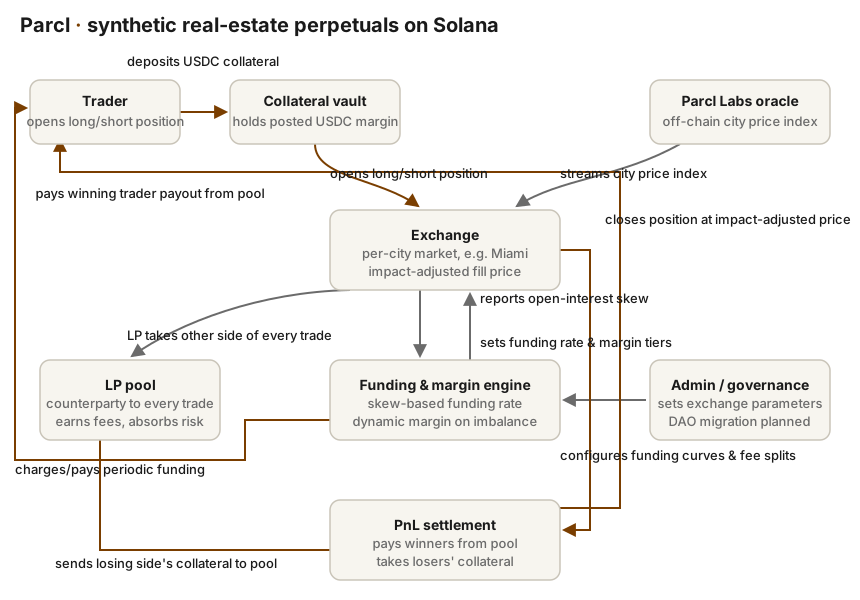 Open full-size diagram
Summary
Parcl is a derivatives exchange on Solana that lets users take leveraged long or short positions on synthetic indexes representing residential real estate prices in named cities (for example, Miami, New York, or Los Angeles), without ever buying, financing, or holding physical property. Traders post collateral, open a perpetual futures position against a per-city index, and pay or receive funding depending on which side of the market is crowded. First launched in February 2023, the protocol went through v2 and, in November 2023, a rebuilt v3 architecture modeled closely on Synthetix-style perpetual futures design. Parcl was one of the more prominent "real-world assets" (RWA) narratives of the 2023–2024 Solana cycle, and it shipped a native PRCL token via airdrop in April 2024.
Design (Mechanism)
Parcl's core innovation is applying a synthetic-perpetuals model — the same basic primitive used by crypto-native perp DEXs like Synthetix and GMX — to an asset class that cannot be transferred or settled onchain: single-family home prices. Rather than trading a real property, users trade a city-level price index licensed or derived from real estate data (the same data business, Parcl Labs, that underpins the protocol's oracle feeds).
The protocol is organized into "exchanges," each with one collateral asset and one liquidity-provider (LP) pool. Markets belong to a specific exchange, and the LP pool is the counterparty to every trade placed on that exchange's markets:
- LPs as underwriters. Rather than matching traders peer-to-peer or against an order book, LPs collectively take the other side of all positions. They earn the bulk of trading fees in exchange for absorbing directional risk, effectively acting as the exchange's insurance fund.
- Skew-based funding and margin. Because there's no external spot market to arbitrage real estate prices, Parcl needs its own incentives to keep long and short open interest balanced. A funding rate charges the "cost of carry" based on how skewed (long- or short-heavy) a market is over time, while initial margin requirements are set dynamically higher for trades that would increase an existing imbalance — discouraging traders from piling further onto an already-lopsided side.
- Price-impact-adjusted fills. Each trade's execution price incorporates its marginal effect on skew, averaged against the market's prior skew — a mechanism meant to price in the temporary liquidity cost of moving the book, similar to slippage models in AMM-based perps.
- Governance. Exchange- and market-level parameters (funding curves, margin tiers, fee splits) are configurable by a protocol admin key, with a stated path toward migrating control to a DAO.
Because the underlying "asset" is a real estate price index rather than a liquid, arbitrage-able spot market, the entire system depends on trusting the accuracy and update cadence of Parcl Labs' proprietary housing-price data feed — there is no way for a trader to redeem the perpetual for the underlying home, so the index feed itself is the ultimate source of truth and the primary point of trust in the design.
Outcome
Parcl's v3 relaunch in November 2023 drove a sharp jump in usage: protocol TVL rose from roughly a few thousand dollars to more than $75 million within a few months, reflecting real trading and LP activity rather than pure token speculation. The PRCL token launched via airdrop on April 16, 2024, distributing roughly 80 million tokens at an initial reference price near $0.83.
The airdrop marked the protocol's commercial peak and its inflection point. TVL, which had reached about $184.5 million just before distribution, fell to roughly $110.7 million within two weeks — a roughly 40% drop consistent with the broader "airdrop-and-sell" pattern seen across other Solana token launches that cycle (e.g., Wormhole's W, Tensor's TNSR). The token itself fell from its $0.83 launch price to roughly $0.45 within its first trading day.
The longer-run trajectory has been far steeper: as of mid-2026, PRCL trades near $0.006 (roughly 99% below its launch price), and protocol TVL sits around $5.2 million — a decline of more than 97% from its April 2024 all-time high near $185.6 million. The protocol remains live and technically functional (it saw a temporary TVL rebound of roughly 400% during a 2025 rally tied to prediction-market integrations), but neither the token nor the platform's deposited capital has recovered to anywhere near its post-launch highs.
Why it worked
Parcl solved a genuine structural problem: residential real estate is the largest asset class in the world, but it is illiquid, geographically fragmented, and nearly impossible to short or hedge at retail scale. By packaging city-level price exposure into a perpetual future backed by an LP pool rather than physical settlement, Parcl gave traders a way to speculate on (or hedge against) regional housing trends with the same leverage and liquidity mechanics as a crypto perp — something no existing real estate product offered to retail users. Borrowing the Synthetix-style LP-pool-as-counterparty design was also a pragmatic choice: it let Parcl bootstrap deep, continuous liquidity on day one without needing organic two-sided order flow for a niche synthetic market, and the skew-based funding/margin system gave it a credible mechanism for keeping that liquidity solvent as directional bets piled up.
Limitations and criticisms
- The index is the whole product, and it's a black box. Unlike a crypto perp referencing a liquid, publicly auditable spot price, Parcl's real estate indexes are proprietary constructions from Parcl Labs. Traders have no independent way to verify the feed against a transparent, continuously-updating market price, which concentrates significant trust in a single data provider.
- Thin real-world settlement linkage invites reflexivity. Because positions never settle against actual property transactions, the "price" being traded is fundamentally a sentiment index about a sentiment index — it can decouple from real housing fundamentals for long stretches, and skew-based funding only rebalances trader positioning, not the underlying data.
- Token launch absorbed and then evaporated most of the platform's capital. The airdrop briefly maximized TVL by attracting mercenary liquidity and points-farming activity, but a large share of that capital left within weeks, and neither TVL nor token price has been durable since — a pattern common to points/airdrop-driven DeFi launches generally, not unique to real estate as an asset class.
Lessons
- Wrapping an illiquid, non-transferable real-world asset class in a synthetic-perpetuals shell can create genuine trading demand, but it shifts the entire trust burden onto the index/oracle provider rather than removing it — the "hard part" of real estate settlement is displaced, not solved.
- LP-pool-as-counterparty designs (borrowed from Synthetix/GMX) bootstrap liquidity fast, but they also mean every trader's leveraged win is funded by depositors' capital; skew and funding-rate mechanisms mitigate, but don't eliminate, the risk of one-sided markets during strong directional narratives (e.g., a housing-crash trade).
- Token-incentive launches (points programs, airdrops) can produce headline TVL and volume numbers that substantially overstate a protocol's durable product-market fit; the multi-week and multi-year TVL/price decline after Parcl's April 2024 airdrop illustrates how much of the "growth" was airdrop-farming rather than sustained real estate-hedging demand.
Redesign (EDITORIAL)
The following is a hypothesis for how this design could be improved, not a factual claim about the project's plans.
A more robust version of Parcl's model might separate "index construction" from "index trust" by sourcing multiple independent, published real estate data feeds (e.g., regional MLS aggregates, Zillow/Redfin-style indexes, county recorder data) and computing the tradable index as a transparent, on-chain-verifiable median or TWAP across them, rather than relying on a single vertically-integrated data provider. This would let third parties audit and reconstruct the index without needing to trust Parcl Labs' methodology in isolation. Second, decoupling token distribution from a single large airdrop event — instead vesting rewards over a much longer horizon tied to sustained trading/LP activity rather than a snapshot — could reduce the mercenary-capital spike-and-exit pattern that has characterized most points-driven Solana launches, Parcl included. Finally, publishing a standing, public post-mortem of index-versus-realized-price divergence (i.e., how well the synthetic index actually tracked verifiable local home-price data over time) would let users independently assess whether the "hedge" the product promises is doing its job, rather than taking the funding-rate mechanism's balance as a proxy for the index's real-world accuracy.
Sources
- Protocol Overview | Parcl Docs — primary (docs)
- Parcl v2 Whitepaper — Parcl blog — primary (docs)
- Parcl Protocol Whitepaper – Help Center — primary (docs)
- Solana-based betting platform Parcl loses 40% TVL after airdrop | The Block (news)
- Parcl on Solana: Project Review, Programs, Token, Metrics | Solana Compass (analysis)
- Parcl Price: PRCL/USD Live Price Chart, Market Cap & News | CoinGecko (market-data)
Related experiments
Last verified: 2026-07-28 · Spot an error? Suggest a correction