Osmosis
App-specific Cosmos AMM chain that pioneered superfluid staking, bonded liquidity gauges, and in-protocol arbitrage capture — becoming the liquidity hub of IBC before a 90% TVL decline pushed it toward merging into the Cosmos Hub.
▶ Run interactive simulation animated mechanism with editable parameters
How it works onchain
 Open full-size diagram
Summary
Osmosis is the flagship experiment in building a DEX not as a smart contract but as an entire sovereign blockchain. Launched on June 19, 2021 by former Tendermint developers Sunny Aggarwal, Josh Lee (also creator of the Keplr wallet), and Dev Ojha, Osmosis is a Cosmos SDK appchain whose state machine is an AMM — the "AMM Laboratory." Because the exchange owns its whole stack (consensus, mempool, staking, governance), it could experiment with mechanisms impossible in contract-based DEXes: superfluid staking (LP shares simultaneously secure the chain), protocol-owned arbitrage (ProtoRev), and validator-level MEV mitigation. It became the liquidity center of the IBC ecosystem, peaking around $1.8B TVL in March 2022, then fell roughly 90% with the Terra collapse and the broader Cosmos decline. It remains live and revenue-generating (over $19M cumulative protocol revenue; ~$180M TVL and 80+ connected chains in 2026), but in March 2026 the team proposed "COSMOSIS" — converting all OSMO into ATOM and merging the protocol into the Cosmos Hub. Hub governance narrowly rejected the first version in April 2026; revised versions funded by DEX revenue remain under debate.
Design (Mechanism)
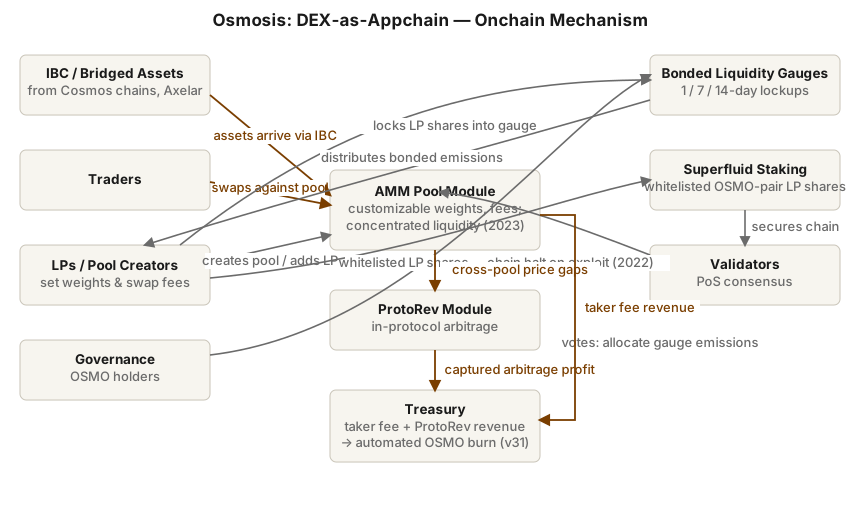
- DEX-as-appchain. Osmosis is its own proof-of-stake chain; pools, routing, and incentives are native chain modules (Go), later augmented by CosmWasm contracts. Assets arrive via IBC transfers from other Cosmos chains (and later via bridges like Axelar for EVM assets).
- Customizable AMM pools. Rather than one bonding curve, pool creators set weights, swap fees, and curve parameters — the "laboratory" thesis that AMM design should be user-parameterized. Concentrated ("supercharged") liquidity was added in 2023.
- Bonded liquidity gauges. LP incentives flow to gauges keyed by lockup duration (e.g., 1/7/14-day unbonding). Longer commitments earn more, and OSMO governance votes on which gauges receive emissions — an on-chain market for directing liquidity mining.
- Superfluid staking (v7 "Carbon," March 2022). Bonded LP shares in whitelisted OSMO pairs can be simultaneously delegated to validators, so the same capital earns swap fees and staking rewards while securing consensus — feasible only because the DEX and the staking module live in one state machine.
- Fairdrop tokenomics. No VC token sale at genesis: 100M OSMO at genesis, half fairdropped to ATOM stakers (quadratically weighted, rewarding small holders and stakers over exchange balances), half to a strategic reserve. Emissions follow a "thirdening": annual issuance cut by one-third each year.
- Protocol-captured MEV and fees. The ProtoRev module performs cyclic arbitrage in-protocol, capturing backrunning profit for the treasury (over $2M in 2025 alone); a taker fee (2023) plus automated OSMO burns (v31) turned volume into protocol revenue.
Outcome
Osmosis became the de facto interchain DEX: the primary venue for ATOM and virtually every IBC asset, at peak routing the majority of all IBC volume, with TVL around $1.8B in Q1 2022. On June 8, 2022, an input bug in the LP join/exit logic (deposits could be instantly withdrawn for ~50% more) was exploited for about $5M; validators halted the chain within minutes, most funds were returned (two members of the FireStake validator admitted taking ~$2M and cooperated), and the team covered residual losses from reserves — a demonstration that a sovereign chain can hard-stop an exploit in a way contract DEXes cannot. The Terra collapse and multi-year Cosmos-wide decline nonetheless cut TVL and volume drastically (to roughly $80–200M range in later years; ~$180M in 2026). The protocol kept shipping (concentrated liquidity, ProtoRev, taker fees, permissionless pool creation in v30, token burns in v31) and accumulated $19M+ in revenue, but OSMO's value languished. In March 2026 Osmosis proposed the COSMOSIS merger: converting circulating OSMO to ATOM at a fixed rate with a six-month claim window. Cosmos Hub governance narrowly rejected it in April 2026; a revision funding conversions from DEX revenue instead of ATOM minting is still being debated, and OSMO spiked 185% in May 2026 on renewed merger speculation.
Why it worked
- Sovereignty enabled genuinely new mechanisms. Superfluid staking, in-protocol arbitrage capture, and a 12-minute validator halt during the exploit all depended on owning the full stack — Osmosis validated the appchain thesis better than any other DEX.
- First-mover on IBC. Launching weeks after IBC went live made Osmosis the default liquidity hub for an entire ecosystem with no incumbent competitor.
- Legitimacy from the fairdrop. Quadratic distribution to ATOM stakers seeded a large, aligned user base and cemented community credibility (no VC genesis allocation).
Where the design broke
- Fate coupled to the Cosmos ecosystem. As an IBC-native venue, Osmosis's addressable volume collapsed with Terra (its largest counterpart chain) and never recaptured flow that migrated to Ethereum L2s and Solana.
- Heavy emissions bought mercenary TVL. Bonded gauges slowed but did not stop the exit; OSMO inflation diluted holders faster than fee revenue accrued for most of its life — the taker fee and burns arrived after the peak.
- Appchain overhead. Maintaining consensus, validators, and a full chain for one application is costly; by 2026 the team itself argued consolidation into the Cosmos Hub beat continued sovereignty — a striking self-reversal of the appchain thesis.
Lessons
- Owning the full stack turns a DEX into a mechanism-design laboratory: superfluid staking and protocol-captured arbitrage are only possible when the exchange, mempool, and staking system share one state machine.
- Sovereign chains can respond to exploits (halt, patch, restitute) in ways immutable contracts cannot — but the same power reintroduces social-layer trust assumptions.
- Liquidity incentives keyed to lockup duration shape commitment, not just quantity, of capital — yet even time-locked incentives cannot retain liquidity when the surrounding ecosystem contracts.
- Fairdrops buy legitimacy cheaply at genesis; sustainable value still requires converting volume into protocol revenue early, not after the cycle peaks.
- The appchain-vs-shared-infrastructure tradeoff is dynamic: sovereignty was worth its overhead at $1.8B TVL and arguably is not at $180M, as Osmosis's own merger proposal concedes.
Redesign (EDITORIAL — hypothesis, not fact)
This section is editorial speculation. A redesigned Osmosis would launch fee capture and burns at genesis rather than year three, tying gauge emissions to realized protocol revenue per pool so incentives cannot outrun income. Superfluid staking would extend to non-OSMO pairs via trust-minimized restaking to reduce dependence on the native token's price. Most importantly, it would treat sovereignty as a rented, not owned, property — built from day one to fall back to shared security (ICS or a hub merger) via a pre-committed governance path once TVL-to-overhead ratios cross a threshold, avoiding the multi-year limbo of the COSMOSIS negotiation. An honest version of the fairdrop would also vest quadratic allocations against usage milestones, filtering claim-and-dump recipients from actual liquidity providers.
Sources
- Osmosis official site — primary (docs)
- osmosis-labs/osmosis — The AMM Laboratory (GitHub) — primary (contract)
- Bonded Liquidity Gauges — Osmosis docs (GitBook) — primary (docs)
- Osmosis Chain Halted Amid Possible $5M Exploit — CoinDesk (news)
- Osmosis to Cover Possible $5M Exploit Loss — CoinDesk (news)
- State of Osmosis Q1 2022 — Messari (analysis)
- COSMOSIS: Acquisition and Merger of Osmosis into the Cosmos Hub (draft proposal, Cosmos Hub Forum) — primary (governance)
- Osmosis introduces Superfluid Staking — CryptoSlate (news)
- Osmosis Surges 185% as COSMOSIS Merger Debate Returns — crypto.news (news)
Related experiments
Last verified: 2026-07-27 · Spot an error? Suggest a correction