Sense Finance
A permissionless Ethereum fixed-income protocol that stripped yield-bearing assets into Principal and Yield Tokens traded on a custom AMM, which wound down in 2023 after failing to win the yield-trading market.
▶ Run interactive simulation animated mechanism with editable parameters
How it works onchain
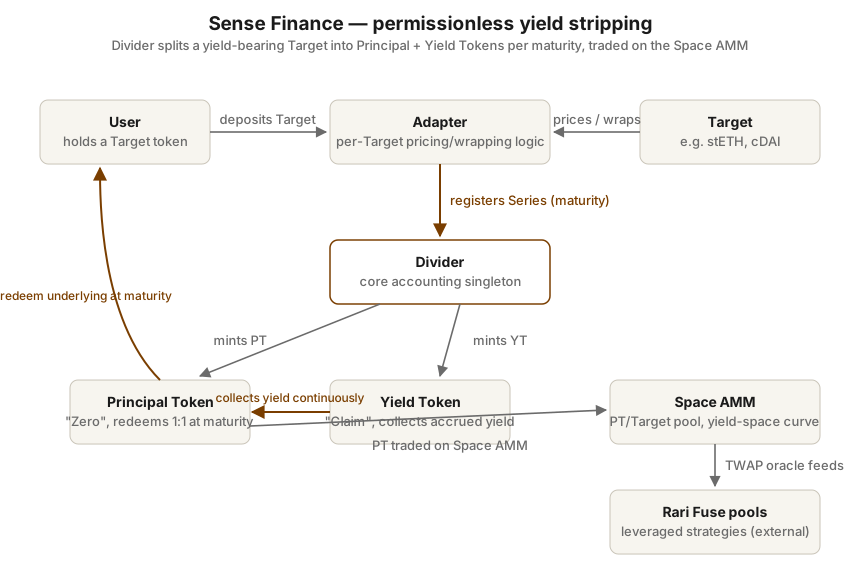 Open full-size diagram
Summary
Sense Finance was a decentralized fixed-income protocol on Ethereum mainnet that let users "strip" any yield-bearing asset into two fixed-term components: a Principal Token (PT, originally "Zero") redeemable 1:1 for the underlying at maturity, and a Yield Token (YT, originally "Claim") that collects the yield accrued until maturity. This recreated the traditional-finance bond-stripping primitive (STRIPS) on-chain, enabling fixed rates (buy PTs at a discount), leveraged yield speculation (buy YTs), and rate hedging.
The team — co-founders Kenton Prescott and Josh Levine, both ex-MakerDAO — raised a $5.2M seed in August 2021 led by Dragonfly with Bain Capital Ventures, Nascent, Variant, Robot Ventures, and theLAO. Sense v1 went live on mainnet on March 24, 2022 via a "guarded launch" with issuance caps (whitelisted stETH and Compound cTokens), hitting its cap in 22 days. Despite clean engineering, multiple audits (Spearbit, ABDK, Fixed Point Solutions, Peckshield, Sherlock), and a responsibly disclosed near-miss oracle bug, the protocol never achieved sustainable traction in the 2022–23 bear market. The project announced a wind-down, deprecating its UI in Q4 2023 and asking users to withdraw by December 1, 2023. The team pivoted to Rumpel Labs (points tokenization), launched September 2024 under the same GitHub organization.
Design (Mechanism)
- Divider (accounting core). A singleton contract (
0x86bA3E96...e6E0) that "divides" a Target (a yield-bearing token like stETH or cDAI) into ERC-20 PTs and YTs for a chosen maturity ("Series"). At maturity, PTs redeem for the underlying value; YTs redeem the yield accrued over the term. The system used a "Collect" YT design where yield could be collected continuously as it accrued. - Adapters and Adapter Factories. Each Target integrates through an Adapter that tells the Divider how to price/wrap it. Adapter Factories for major protocols (Compound, Aave, Lido) were intended to make listing permissionless: anyone could deploy an adapter for a supported protocol's yield asset with a single call. This "infra protocol" framing positioned Sense as a base layer for yield stripping, tranching, and DAO bond issuance.
- Space AMM. A custom Balancer-v2-based pool implementing a yield-space-style invariant for PT/Target pairs, designed so PTs trade at a discount converging to par at maturity — concentrating liquidity around plausible interest rates rather than a constant product curve. Space embedded a TWAP oracle used by downstream integrations (e.g., Sense Fuse pools on Rari Capital for leveraged strategies).
- Guarded launch. Issuance caps and whitelisted Targets at launch, with a roadmap to progressive permissionlessness — an explicit risk-throttling mechanism rather than an unrestricted deploy.
- No token. Sense wound down without launching a governance/incentive token; usage was not subsidized by emissions.
Outcome
Technically the protocol worked as designed: series were issued, PTs/YTs traded on Space, and the guarded-launch cap filled in 22 days. Security was handled seriously — five audit firms, an Immunefi bounty program, and a critical missing-access-control bug in Space's onSwap() oracle path (which could have let attackers manipulate the oracle feeding Sense's Rari Fuse pools) was reported by whitehat "Reptile71590," fixed on mainnet, and paid the full $50,000 bounty before any exploit occurred.
Commercially it underperformed. The 2022 bear market crushed demand for yield derivatives; the Rari/Fuse ecosystem Sense integrated with was itself exploited (April 2022) and unwound; and competitor Pendle ultimately captured the yield-trading category when demand returned via LSD/points meta in 2023–24. Sense announced its wind-down with UI deprecation in Q4 2023 and a withdrawal deadline of December 1, 2023. The founders relaunched as Rumpel Labs (offchain-points tokenization), live on Ethereum September 13, 2024. There was no exploit or loss of user funds reported; the wind-down was orderly.
Why it worked
- Sound primitive. PT/YT stripping is a faithful port of a proven TradFi mechanism, and Sense's "Collect" YT and maturity-converging AMM were mechanically coherent.
- Security culture. Multiple audits, a live bug bounty, and a public disclosure post turned a critical oracle bug into a $50k bounty instead of a drained protocol — a genuine operational success.
- Credible team and backers. Ex-MakerDAO founders and a strong seed syndicate gave the project runway and integration credibility (Lido, Compound, Balancer, Rari).
- Guarded launch discipline. Caps limited blast radius during the riskiest period and demonstrably met demand (cap filled in 22 days).
Where the design broke
- Timing. Launching a rates protocol in March 2022 meant building through collapsing yields and risk appetite; by the time yield trading boomed (LSTs, restaking points), Sense had already lost momentum.
- Dependency risk. Its leverage story ran through Rari Capital's Fuse, which was exploited weeks after Sense's launch, amputating a key use case.
- Category winner-take-most. Pendle, with a token, aggressive incentive flywheels, and a points-era product-market fit, absorbed the fixed-yield market; tokenless Sense had no comparable liquidity-bootstrapping lever.
- Complexity vs. demand. PT/YT mechanics are cognitively expensive; in 2022 the organic user base for hedging DeFi rates was small relative to the infrastructure built for it.
Lessons
- Being early to a real category is not the same as winning it. Sense validated on-chain yield stripping, but the category's eventual winner was the protocol still standing (and incentivizing) when demand arrived.
- A great disclosure process is survivable; a missing
msg.sendercheck is not. The Space oracle bug shows how one absent access-control condition on an AMM callback can silently underpin oracle integrity for downstream lending markets — and how bounties plus fast patching neutralize it. - Composability is a liability channel. Sense's most compelling use cases were routed through a third-party protocol (Rari Fuse) whose failure it could not control; mechanism designers should price partner-protocol risk into their core roadmap.
- Tokenless purity has a cost. Without emissions, Sense couldn't subsidize liquidity through the bear; whether that trade-off is principled or fatal depends on whether the category rewards patience or momentum.
- Orderly wind-downs preserve reputational capital. Clear deadlines, withdrawal support, and no user losses let the same team relaunch (Rumpel) with credibility intact.
Redesign (EDITORIAL — hypothesis, not fact)
This section is editorial analysis — a hypothesis, not established fact. A redesigned Sense might have survived by (1) narrowing to one killer market — stETH fixed rates — instead of building generalized adapter infrastructure before demand existed; (2) internalizing its leverage/lending loop (an isolated PT-collateral money market) rather than outsourcing it to Rari Fuse, removing the fatal dependency; (3) shipping a minimal token or fee-share incentive to bootstrap Space liquidity through the bear, since AMM depth is the actual product in yield trading; and (4) holding V1 in maintenance mode at low burn until the 2023 LST rate boom, when its exact primitive became the hottest niche in DeFi — the mechanism was right, and a two-year runway-preservation strategy might have made Sense the Pendle of that cycle. The counter-hypothesis: Pendle's win owed as much to relentless BD and points-market opportunism as to survival, and a leaner Sense would still have needed that operational aggression.
Sources
- Sense Protocol official site (with wind-down notice) — primary (docs)
- Sense Docs — Core Concepts & Smart Contracts — primary (docs)
- sense-v1 smart contracts (GitHub) — primary (contract)
- Sense Finance: Divider — Etherscan — primary (contract)
- Sense Finance Raises $5.2m to add a new dimension to DeFi (Kenton Prescott, Medium) — primary (retrospective)
- Sense Protocol Guarded Launch (Kenton Prescott, Medium) — primary (docs)
- Disclosure: Fixing a critical bug in the Sense Space Oracle (Joshua Levine, Medium) — primary (audit)
- Sense Finance Access Control Issue Bugfix Review (Immunefi) (audit)
- Steadfast and Ambitious: Our 2022 Recap and 2023 Roadmap (Sense Finance, Medium) — primary (retrospective)
- Sense Finance Raises $5.2M to Bring Yield Trading to DeFi (CoinDesk) (news)
- Understanding Rumpel (Messari) — successor project context (analysis)
Related experiments
Last verified: 2026-07-26 · Spot an error? Suggest a correction