UXD Protocol
Solana stablecoin backed 1:1 by delta-neutral perpetual-futures positions that held its peg through the Mango Markets exploit but never found product-market fit and voted itself out of existence in 2024.
▶ Run interactive simulation animated mechanism with editable parameters
How it works onchain
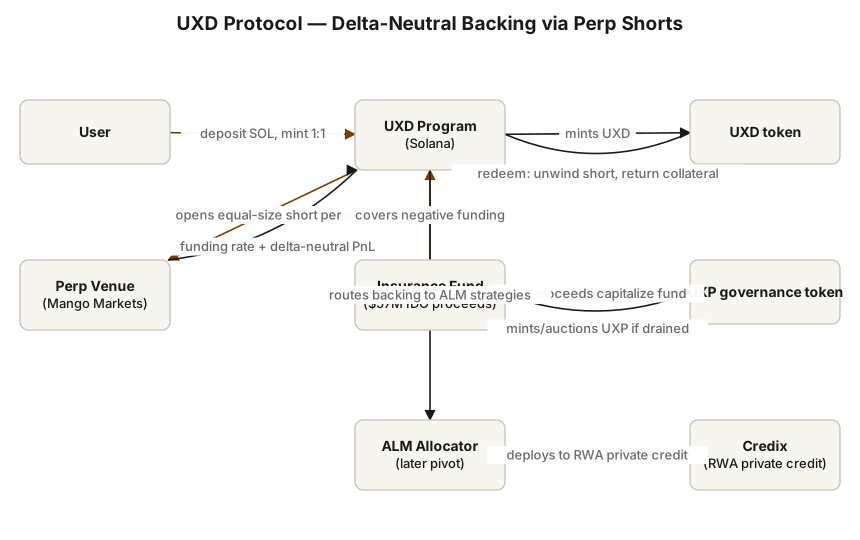 Open full-size diagram
Summary
UXD Protocol was an attempt to solve the "stablecoin trilemma" — decentralization, stability, and capital efficiency — by backing a dollar token 1:1 with delta-neutral derivatives positions rather than overcollateralized crypto or fiat reserves. Founded by Kento Inami (ex-bitFlyer corporate strategy, ex-derivatives administrator at a Japanese bank), the project began as "Soteria" in late 2020 and rebranded to UXD in August 2021. It raised $3M in September 2021 in a round led by Multicoin Capital (with Alameda Research, CMS Holdings, and Defiance Capital participating), then raised roughly $57M from 3,676 investors in a November 2021 IDO of its UXP governance token at $0.19 — proceeds that capitalized an insurance fund. UXD went live on Solana mainnet-beta on January 18, 2022. The peg held throughout its life, including through the October 2022 Mango Markets exploit that trapped nearly $20M of its backing, but demand never materialized: TVL peaked around $40M and had shrunk to ~$7.5M when the DAO voted in August 2024 to wind the protocol down and redeem holders in USDC.
Design (Mechanism)
- Delta-neutral backing. A user deposits $1 of crypto (initially SOL) and receives 1 UXD. The protocol simultaneously opens an equal-sized short perpetual-futures position on a derivatives DEX (originally Mango Markets on Solana). Long spot + short perp = a position whose USD value is invariant to price moves, so each UXD is fully backed by exactly $1 of value without overcollateralization. Redemption unwinds the short and returns collateral.
- Native yield from funding rates. Perp shorts typically earn the funding rate. Positive funding accrued to the protocol (with plans to pass it to UXD holders and the insurance fund).
- Insurance fund. The $57M IDO capitalized a fund that pays funding when rates go negative, so holders never face a haircut. At the time of the Mango exploit it held over $53.5M.
- UXP as recapitalization backstop. UXP governed the protocol, was slated to receive protocol cash flows, and served as the "reserve of last resort": if the insurance fund drained, new UXP would be minted and auctioned to recapitalize — the MakerDAO MKR debt-auction pattern applied to a delta-neutral design.
- Guarded launch. Mainnet-beta launched with a 10,000 UXD per-address cap and a 1,000,000 UXD global supply cap, raised progressively.
- Later pivot to "Asset Liability Management." After the Mango exploit exposed counterparty concentration risk, UXD generalized into an ALM-module stablecoin routing backing across strategies: delta-neutral perps, overcollateralized lending markets, and real-world assets (notably Credix private-credit pools), and expanded beyond Solana (Optimism, per the founder's multichain announcements).
Outcome
Status: technically_successful_commercially_unsuccessful. The mechanism worked: UXD held its $1 peg, and even the worst-case event — $19.9M of backing frozen in the October 2022 Mango Markets exploit — was absorbed because the insurance fund exceeded the exposure; UXD later recovered the full amount when Mango's stolen funds were partially returned, and resumed operations. But growth never came. TVL peaked near $40M (versus a $57M insurance fund — the backstop was larger than the product), and by August 2024 UXD's market cap was ~$7.45M. On August 19, 2024 the team proposed sunsetting; the DAO vote ran ~1 million votes in favor with zero against. The team's own verdict: the model "does lead to the stablecoin being stable, but is not exciting enough for DeFi users and does not offer enough advantage over centralised stablecoins." Wind-down terms included minting UXD/USDC for redemptions, liquidating illiquid Credix RWA positions over up to two years, retaining two engineers to service redemptions, letting UXP holders claim USDC from the insurance fund in a phased conversion, and burning ~$7.5M of UXP. UXP traded up ~40% on the announcement — the wind-down distribution was worth more than the going concern.
Why it worked
- The hedge math was sound. Long spot + short perp genuinely produces a stable-value backing portfolio; the peg never broke in ~2.5 years of operation.
- Massively overcapitalized backstop. Raising a $57M insurance fund before scaling meant the Mango exploit ($19.9M exposure) was survivable even before recovery — a rare case of a stablecoin surviving the loss of a large share of its backing venue.
- Honest, orderly exit. Governance chose solvent wind-down with full USDC redemption rather than a slow zombie decline or a risky yield-chasing pivot, preserving user funds and some UXP value.
Where the design broke
- The capacity ceiling was structural. Delta-neutral supply is capped by open interest on the perp venues you can safely use; Solana's derivatives liquidity (Mango, then successors) was thin, so UXD could never scale to compete with USDC.
- Counterparty concentration. Backing lived inside one exploitable perp DEX; Mango's manipulation exploit froze ~half of UXD's backing overnight and forced the pivot away from the original thesis.
- Negative/low funding regimes turned the "native yield" pitch into a cost center during the 2022–23 bear market, eliminating the main user incentive versus holding USDC.
- The pivot diluted the identity. The ALM-module version — largely USDC, lending positions, and illiquid Credix private credit — was neither decentralized nor differentiated, and the RWA sleeve later complicated redemptions.
- No distribution advantage. As the team admitted, a stablecoin that is merely stable, without superior yield, composability, or censorship-resistance in practice, gives DeFi users no reason to switch.
Lessons
- A stablecoin's scale limit is its hedging venue's liquidity. Delta-neutral designs inherit the open-interest capacity and the solvency of the derivatives markets they use; on decentralized perps that ceiling was low. (Ethena later validated the mechanism at scale by hedging on deep centralized venues — trading decentralization for capacity.)
- Insurance funds should be sized to counterparty concentration, not just funding-rate volatility. UXD survived Mango only because its backstop happened to exceed its single-venue exposure; that was prudence, not the design guarantee.
- "Stable" is table stakes, not a product. Users adopt a stablecoin for yield, distribution, or censorship-resistance; a mechanism that only replicates USDC's stability with extra risk has negative product-market fit.
- Raising the backstop before finding demand inverts the problem. A $57M insurance fund for a $40M-peak product meant the war chest outlived the war; capital raised should scale with proven demand.
- Solvent DAOs can and should choose euthanasia. UXD's zero-opposition sunset vote and phased USDC redemption is a model for winding down a failed-but-solvent protocol.
Redesign (EDITORIAL — hypothesis, not fact)
This section is editorial analysis — a hypothesis, not a factual claim. A revived UXD-style design should treat venue risk as the first-class variable: spread the short leg across many venues (decentralized and, via bankruptcy-remote custody such as off-exchange settlement, centralized ones) with hard per-venue exposure caps enforced on-chain, so no single exploit can freeze a large share of backing. Second, make the funding-rate yield the product: pass through positive carry to a staked tranche (as Ethena later did with sUSDe) while an unstaked tranche absorbs none of the downside, funded by a dynamically sized insurance buffer targeted at a multiple of worst-observed negative-funding drawdowns plus the largest single-venue exposure. Third, cap supply programmatically at a conservative fraction of aggregate open interest across approved venues, and publish the capacity headroom so integrators can size positions. Finally, pre-commit in the constitution to an automatic wind-down trigger (e.g., sustained TVL below insurance-fund size for N months) — UXD showed orderly exit is possible; making it a rule rather than a vote would remove the zombie-protocol failure mode entirely.
Sources
- What is UXD Protocol? (official docs) — primary (docs)
- Overview of UXD Protocol (official Medium) — primary (docs)
- UXD Launches Mainnet Beta (official Medium) — primary (docs)
- $UXP IDO (official Medium) — primary (docs)
- UXDProtocol/uxd-client (program IDs and mint addresses) — primary (contract)
- UXD Raises $3M to Bring Algorithmic Stablecoins to Solana (CoinDesk) (news)
- UXD Protocol Affected by Nearly $20 Million in Mango Attack (TokenInsight) (news)
- Solana projects reopen after getting funds back from Mango Markets (The Block) (news)
- Solana-based UXD Protocol's DAO is voting on whether to sunset its stablecoin (The Block, Aug 19, 2024) (news)
- Solana protocol with $7.5m in deposits shuts down as its model 'isn't exciting enough' (DL News) (news)
- UXD Stablecoin mint on Solana Explorer — primary (contract)
Related experiments
Last verified: 2026-07-26 · Spot an error? Suggest a correction