Opyn Squeeth
The first 'power perpetual' — a perpetual derivative tracking ETH², giving liquidation-free convex long exposure in a single ERC-20 (oSQTH), later wound down in 2024 citing regulatory constraints.
▶ Run interactive simulation animated mechanism with editable parameters
How it works onchain
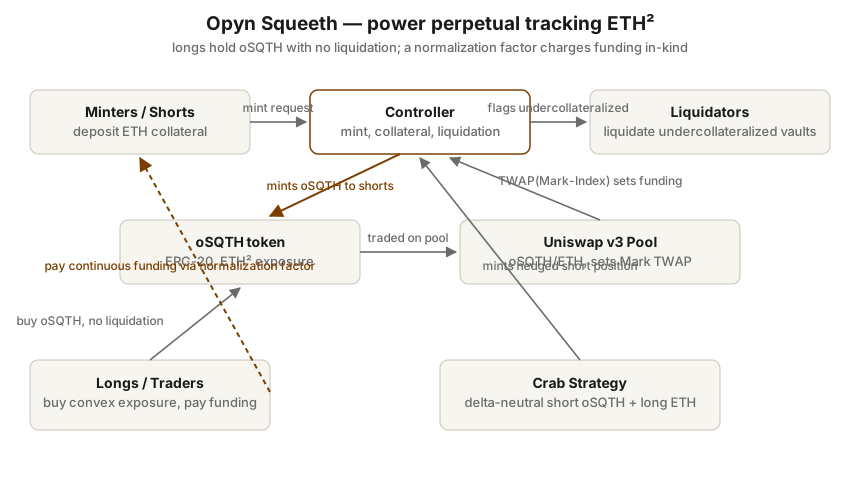 Open full-size diagram
Summary
Squeeth ("squared ETH") was the first live implementation of the power perpetual, a derivative primitive proposed in an August 17, 2021 Paradigm research post co-authored by Dave White and Dan Robinson with Opyn's research team (Zubin Koticha, Andrew Leone, Alexis Gauba, Aparna Krishnan). Launched by Opyn on Ethereum mainnet in January 2022, Squeeth tracked an index of ETH² (in USD terms), packaging pure convexity — options-like gamma exposure with no strikes, no expiries, and no liquidations for longs — into a single ERC-20 token, oSQTH, tradable on Uniswap v3. A companion vault, the Crab Strategy, went live days later, letting depositors run a delta-neutral short-Squeeth position to harvest funding. The mechanism proved technically robust through the brutal 2022 drawdowns. Co-founders Zubin Koticha and Alexis Gauba left crypto in November 2023, and the Squeeth protocol was formally shut down on November 4, 2024, citing regulatory constraints, with positions redeemable at a settlement price via the Squeeth Portal.
Design (Mechanism)
- Index and payoff. oSQTH targets exposure to ETH². Because x² is convex, longs gain more when ETH rises than they lose when it falls by the same amount — "pure gamma" exposure that would otherwise require a continuously rolled options strip. Per the Paradigm paper, a power perpetual consolidates much of an options market's liquidity into one instrument.
- Minting (short side). Anyone could mint oSQTH by depositing ETH collateral into the Controller contract (0x64187ae0...93D5) at a minimum collateralization ratio; undercollateralized short vaults were liquidatable. Minters are short ETH² and earn funding.
- Funding via normalization factor. Longs pay shorts a continuous funding rate proportional to TWAP(Mark − Index), where Mark comes from the oSQTH/ETH Uniswap v3 pool TWAP. Funding is charged in-kind: rather than cash payments, a "normalization factor" decays the amount of ETH² each oSQTH represents, so funding accrues continuously and no positions need to be touched. The official docs specify a 420-hour (17.5-day) funding period.
- No liquidations for longs. Buying oSQTH on Uniswap is just holding a token; the leverage-like convexity carries no margin calls. Only shorts (minters) face liquidation.
- Crab Strategy. Launched days after Squeeth, Crab held a short oSQTH position hedged with long ETH, periodically rebalanced to stay delta-neutral, converting Squeeth's persistently positive funding into yield during sideways markets (Crab v2 followed in mid-2022).
- Security. Contracts were audited by Trail of Bits, Akira, and Sherlock, with Sherlock coverage and an Immunefi bug bounty, per the official Squeeth FAQ.
Outcome
Squeeth worked as designed: the peg mechanism, funding, and liquidation machinery survived the May 2022 (Luna/UST) and November 2022 (FTX) crashes without a protocol failure or exploit, and Crab delivered positive carry in flat markets (CoinDesk reported ~14% returns over a stretch of late 2022). Koticha has claimed $15B+ cumulative volume across Opyn's products (founder statement; not independently verified). But regulatory constraints, not mechanism failure, ended the experiment: the founders departed in November 2023 (research lead Andrew Leone became CEO), and the Squeeth protocol was shut down on November 4, 2024 with zero-price-impact settlement withdrawals. Opyn's brand pivoted to a new perps product ("Opyn Markets"), and Coinbase later acquired Opyn's leadership team. Outcome classified as abandoned — a technically sound mechanism deliberately wound down under regulatory constraints and thinning demand.
Why it worked
- A genuinely new primitive. Power perpetuals compress an entire options surface's convexity into one fungible, DeFi-composable ERC-20 — elegant versus fragmented strike/expiry orderbooks that plagued onchain options (including Opyn's own earlier oToken markets).
- Long-side UX was excellent. No expiries, no rolling, no liquidations for buyers; convex upside with sub-2x-style downside decay.
- In-kind funding via the normalization factor was a clever gas-efficient design: continuous funding without cash transfers, settlement crank, or position churn.
- The two-sided product loop (long oSQTH speculators paying funding to Crab depositors) gave both bulls and yield-seekers a reason to show up, briefly making Squeeth one of DeFi's most discussed structured-product venues.
Where the design broke
- Chronically expensive carry. ETH² funding embeds an implied-volatility premium; in the 2022 bear market longs bled continuously, so speculative demand for holding oSQTH decayed, shrinking the funding that paid Crab and thinning Uniswap liquidity.
- Cognitive overhead. "Perpetual exposure to ETH² with in-kind funding via a normalization factor" was hard to explain; the addressable audience was quant-leaning traders, not retail.
- Single-pool oracle dependence. Mark price derived from one Uniswap v3 pool's TWAP concentrated liquidity risk in a single venue.
- Wound down despite technical merits. Regulatory constraints on the US-incorporated operating company, not any contract failure, drove the founder exodus and the eventual November 2024 shutdown.
Lessons
- Mechanism success ≠ product success. Squeeth's math and contracts held up under extreme stress, but a derivative whose long side pays volatility-premium funding in a bear market loses its demand engine; carry costs are a product feature, not a footnote.
- Novel primitives carry a pedagogy tax. Instruments requiring a primer to understand cap their own liquidity; the more compressed and elegant the payoff, the more the UI must translate it into familiar terms (effective leverage, breakevens).
- Operator-level centralization is a shutdown vector regardless of contract decentralization. Opyn Inc.'s control of the front-end, APIs, and settlement portal made an orderly wind-down possible — but also meant a single company's fate determined the protocol's fate, independent of the contracts' own immutability.
- Design the wind-down. Opyn's orderly shutdown — settlement price, zero-price-impact withdrawals via a portal — is a model for retiring a derivatives protocol without stranding users.
- Structured wrappers (Crab) can outshine the base asset. The vault that monetized the primitive's funding attracted more mainstream interest than the raw instrument, a recurring DeFi pattern.
Redesign (EDITORIAL — hypothesis, not fact)
This section is editorial hypothesis, not historical fact. A revived power perpetual would likely do better as (1) a fractional power (e.g., ETH^1.5 or ETH^0.5) to cut the funding bleed that starved long demand, or a family of powers sharing unified short-side collateral; (2) priced off multi-venue or oracle-blended marks rather than a single Uniswap v3 TWAP; (3) fronted by intent-based UX that quotes positions in familiar terms ("2x-at-current-price, no liquidation") while hiding the normalization factor; and (4) operated by a non-US, credibly neutral deployer with geofencing from day one — or launched inside a regulated perps venue, which is roughly the path the ecosystem (and Opyn's successor team) took. The Crab insight — sell the yield wrapper, not the exotic — suggests leading with the delta-neutral vault as the flagship and treating the power perp as backend plumbing.
Sources
- Power Perpetuals (Paradigm research post, Aug 17, 2021) — primary (docs)
- Squeeth Primer: a guide to understanding Opyn's implementation of Squeeth (Wade Prospere, Opyn) — primary (docs)
- Squeeth FAQ / official docs (incl. post-shutdown withdrawal instructions) — primary (docs)
- oSQTH token contract on Etherscan — primary (contract)
- CFTC Issues Orders Against Operators of Three DeFi Protocols (Press Release 8774-23, Sept 7, 2023) — primary (governance)
- Squeeth Portal (settlement/withdrawal interface confirming Nov 4, 2024 shutdown) — primary (docs)
- Automated Squeeth Strategies: The Crab Strategy Is Now Live (Opyn) — primary (docs)
- Opyn's New 'Squeeth' Raises Ether Trading to the Power of Two (CoinDesk, Jan 18, 2022) (news)
- Opyn co-founders to step down citing recent CFTC action (The Block, Nov 2023) (news)
- DeFi Options Platform Opyn's 'Crab Strategy' Generates 14% Return in Comatose Ether Market (CoinDesk, Oct 2022) (news)
- Coinbase acquires Opyn's leadership team (The Block) (news)
Related experiments
Last verified: 2026-07-26 · Spot an error? Suggest a correction