Polymarket
The largest onchain prediction market, built on Polygon using Gnosis Conditional Tokens, a hybrid off-chain order book, and UMA's optimistic oracle for resolution.
▶ Run interactive simulation animated mechanism with editable parameters
How it works onchain
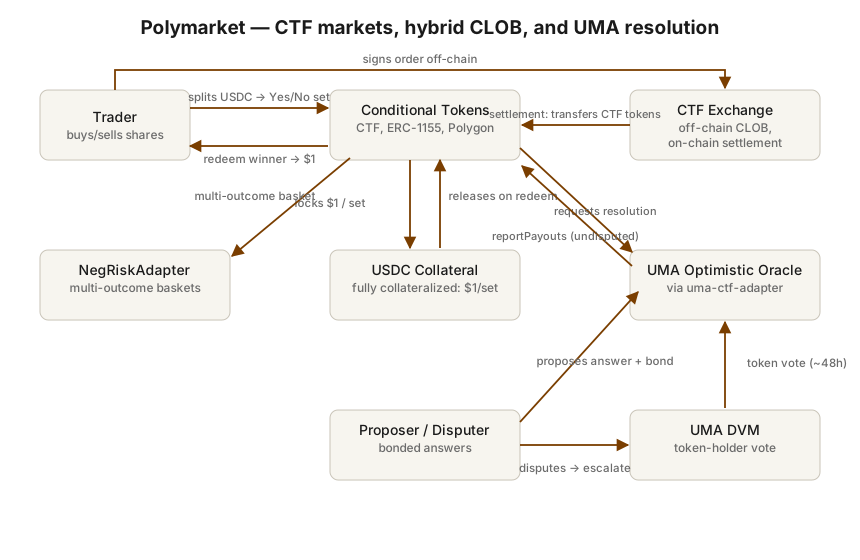 Open full-size diagram
Summary
Polymarket is a blockchain-based prediction market where users trade shares in the outcomes of real-world events — elections, sports, macro data, crypto prices, and cultural events. Founded by Shayne Coplan and launched in June 2020, it grew from a pandemic-era side project into the dominant onchain prediction market, reaching an all-time-high monthly trading volume around $2.5 billion in October 2024 during the U.S. presidential election cycle. In October 2025, Intercontinental Exchange (ICE), the parent of the New York Stock Exchange, announced a strategic investment of up to $2 billion at a $9 billion post-money valuation, cementing Polymarket as arguably the most commercially successful application built on a public blockchain's Conditional Tokens standard.
Mechanically, Polymarket combines three primitives: Gnosis's Conditional Token Framework (ERC-1155 outcome shares), an off-chain central-limit order book (CLOB) with on-chain settlement, and UMA's optimistic oracle for resolving which outcome occurred. Its core proposition is that money-weighted markets produce sharper forecasts than polls or punditry, because participants have "skin in the game."
Design (Mechanism)
Each Polymarket market is a condition created via the Gnosis Conditional Token Framework (CTF), deployed on Polygon at 0x4d97dcd97ec945f40cf65f87097ace5ea0476045. Collateral (USDC) is split into a complete set of outcome tokens — for a binary market, a matched Yes and No ERC-1155 pair. Every complete set is fully collateralized: exactly $1.00 of collateral backs each Yes/No pair, so a set can always be redeemed for $1 and, after resolution, the winning outcome token pays $1 while the losing one pays $0. This split/merge design means the protocol never runs an AMM bonding curve for price discovery in current markets.
Trading happens through a hybrid CLOB: orders are signed off-chain and matched by Polymarket's operator, but settlement executes on-chain via the CTF Exchange contract (0x4bfb41d5b3570defd03c39a9a4d8de6bd8b8982e), giving non-custodial settlement with the UX and price granularity of an order book. Multi-outcome and mutually-exclusive event sets use the NegRiskAdapter (0xd91e80cf2e7be2e162c6513ced06f1dd0da35296), which lets a basket of related binary markets share collateral efficiently (buying "No" across all candidates should not require full collateral for each).
Resolution is the mechanism's crux. Polymarket uses UMA's Optimistic Oracle via the open-source uma-ctf-adapter. A proposer posts an answer with a bond; if undisputed within a challenge window, it is accepted "optimistically." If disputed, the question escalates to UMA's Data Verification Mechanism, where staked UMA token holders vote on the correct outcome, with correct voters rewarded and the loser's bond slashed. This makes Polymarket able to resolve arbitrary human-language questions — a flexibility mechanical price-feed oracles cannot match — at the cost of introducing a token-weighted governance surface into settlement.
Outcome
Status: major_success (with unresolved oracle-governance tensions).
Polymarket became the reference onchain prediction market. Its 2024 election markets attracted mainstream media citations as a real-time probability gauge, and October 2024 monthly volume peaked near $2.5 billion. Commercially, the ICE deal (up to $2B at a $9B valuation, October 2025) and the reported acquisition of CFTC-regulated exchange/clearinghouse QCEX for ~$112 million positioned Polymarket for a compliant U.S. relaunch.
On the mechanism side, several high-profile UMA resolution disputes (e.g., a ~$60M+ Bitcoin-sale market, the "Zelensky suit" market ~$215M, and a Ukraine mineral-deal market that resolved "Yes" despite no agreement) exposed the oracle-governance attack surface.
Why it worked
- Full collateralization + CTF made outcome shares trustless and composable without protocol solvency risk — every pair is always worth $1.
- Hybrid CLOB delivered CEX-grade UX (tight spreads, limit orders) while keeping settlement and custody on-chain, sidestepping the capital inefficiency of AMM-only prediction markets.
- UMA optimistic oracle allowed near-unlimited market breadth from arbitrary natural-language questions, letting Polymarket list timely markets faster than any manually-adjudicated competitor.
- Timing and narrative: the 2024 U.S. election gave prediction markets a mainstream moment, and Polymarket owned the liquidity and the media citations.
Limitations and criticisms
- Oracle capture risk: token-weighted UMA voting lets large UMA holders ("whales") swing disputed resolutions, and the ~$750 USDC dispute-bond barrier discourages small-holder challenges. Multiple markets have resolved against the apparent factual truth.
- Centralized operator dependency: the CLOB matching engine and market creation are operator-controlled, so "decentralized prediction market" describes settlement, not governance or listing.
Lessons
- Settlement is only as trustworthy as the oracle. A fully-collateralized, elegant token design is undermined if the human-judgment layer resolving "what happened" can be economically captured. Oracle design is the real prediction-market problem.
- Hybrid off-chain/on-chain architectures win on UX. Polymarket's CLOB-plus-on-chain-settlement pattern outcompeted pure-AMM prediction markets, showing that non-custodial settlement, not full on-chain execution, is what users actually need.
- Dispute mechanisms need economically fair access. High bonds and token-weighted voting concentrated resolution power; broad-based, cheaply-challengeable dispute paths are essential to perceived legitimacy.
Redesign (EDITORIAL — hypothesis, not fact)
The following is the researcher's analytical hypothesis, not established fact.
The clearest weak point is resolution capture. A redesign would decouple breadth (arbitrary questions) from finality (who decides), reducing single-oracle dominance:
- Multi-oracle quorum with divergence escalation. Route resolution through two or more independent oracle systems (e.g., UMA plus an attestation-based or committee oracle). Auto-finalize only when they agree; escalate divergences to a slower, higher-bond human panel. This makes a single token-holder cartel insufficient to force an outcome.
- Reputation-weighted, not purely stake-weighted, dispute voting. Blend UMA-style stake with a slashing-adjusted accuracy score so that being wrong repeatedly costs voting power, dampening pure-capital capture.
- Sliding dispute bonds indexed to market size. Fixed ~$750 bonds are trivial on $200M markets and prohibitive on tiny ones; a bond scaled to open interest better aligns challenge incentives with stakes.
- Objective-first market templates. For questions with machine-verifiable ground truth (prices, official vote counts, on-chain events), default to deterministic data feeds and reserve the optimistic-oracle human layer only for genuinely subjective questions — shrinking the attackable surface.
- Transparent resolution SLAs and appeal windows surfaced in-UI, so traders price in resolution risk rather than discovering it during a contested vote.
The goal: keep Polymarket's winning combination of full collateralization, CLOB UX, and arbitrary-question breadth, while making the "what actually happened?" layer economically and reputationally expensive to capture.
Sources
- Polymarket Documentation — Conditional Token Framework overview — primary (docs)
- Polymarket / UMA — CTF Adapter (resolution via UMA Optimistic Oracle) — primary (contract)
- Polymarket: CTF Exchange contract on PolygonScan — primary (contract)
- Polymarket: Conditional Tokens contract on PolygonScan — primary (contract)
- Polymarket + UMA (legacy docs) — primary (docs)
- Shayne Coplan (@shayne_coplan) — ICE $2B strategic investment announcement — primary (retrospective)
- $60M+ Polymarket dispute puts UMA's token-voting oracle on trial (The Defiant) (analysis)
- Community protests UMA whale oracle vote / manipulation claims (Cryptopolitan) (analysis)
- ICE invests up to $2B in Polymarket at $9B valuation (ICE investor relations) — primary (news)
- Polymarket — Wikipedia (background/context) (analysis)
Related experiments
Last verified: 2026-07-26 · Spot an error? Suggest a correction