DAOstack
An early open-source Ethereum framework for building DAOs whose signature contribution was 'holographic consensus,' a GEN-token prediction market that let small, engaged subgroups make decisions on behalf of large collectives.
▶ Run interactive simulation animated mechanism with editable parameters
How it works onchain
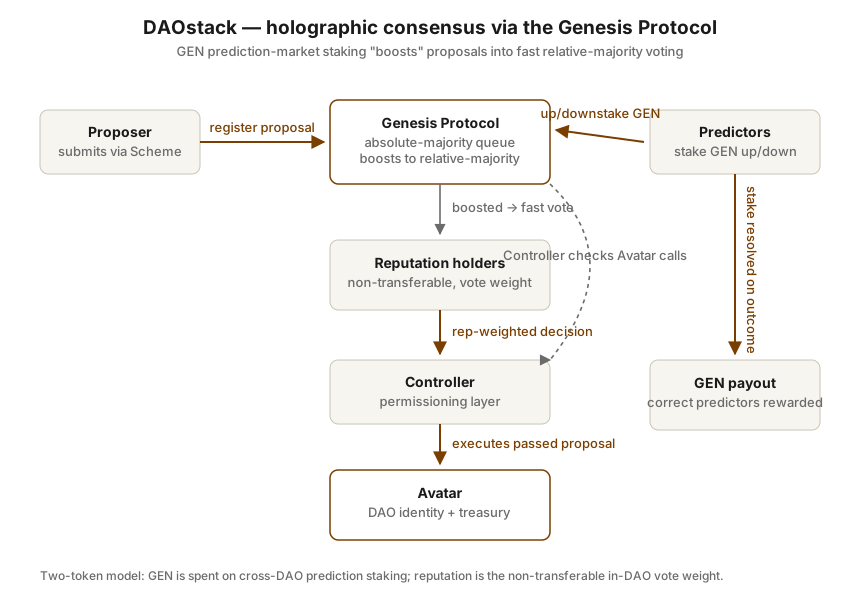 Open full-size diagram
Summary
DAOstack was one of the first serious attempts to build a general-purpose "operating system" for decentralized autonomous organizations on Ethereum. Founded in 2017 by Israeli theoretical physicist Matan Field (CEO) together with Adam Levi (CTO) and others (Oren Sokolowsky and a ~20-person team spanning Israel, the US and Europe), the project marketed itself as "the WordPress for DAOs." It shipped a modular Solidity smart-contract framework called Arc, a JavaScript client library (arc.js), a public GraphQL indexing layer, and an end-user governance dApp called Alchemy. DAOstack raised roughly $30M in a May 2018 GEN token sale — the main sale famously sold out in about 65 seconds. The project's flagship intellectual contribution was holographic consensus, a novel governance primitive designed to let large DAOs make many decisions quickly without a majority voting on each one. Despite genuine technical achievements and adoption by notable DAOs (Genesis, dxDAO, PrimeDAO), the project never found a durable business model; it wound down quietly at the end of 2022 after depleting its treasury, and the GEN token collapsed to near-zero.
Design (Mechanism)
The core problem DAOstack set out to solve is a governance scalability trilemma: absolute-majority voting (>50% of all voting power) is resilient to attack but does not scale — most token holders never vote, so decisions stall. Relative-majority voting (majority of those who happen to vote in a window) scales but is vulnerable to spam and low-turnout capture.
Holographic consensus bridges the two via a prediction market layered on top of governance, implemented in the Genesis Protocol:
- Every proposal starts in a slow, safe absolute-majority regime with a long voting period.
- A permissionless predictors network stakes the GEN token on whether a proposal will pass or fail (upstaking vs. downstaking). Predictors are speculators, not voters.
- When a proposal attracts enough net GEN staking (crosses a dynamic threshold), it becomes "boosted" — it moves into a faster relative-majority regime with a shorter window, so a small quorum can decide it.
- Predictors who bet correctly are rewarded; those who bet wrong lose their stake. The economic claim is that rational predictors will surface exactly the proposals the wider membership would approve, and downstake spam — turning the risk of a small subgroup deciding against the collective's will into an arbitrage opportunity.
Voting power itself came from non-transferable "reputation" (a soulbound-style score) rather than transferable tokens, separating governance weight from tradable capital. This produced an explicit two-token model: reputation for decision weight inside a DAO, and GEN for cross-DAO prediction-market staking. Arc's architecture centered on a per-DAO Avatar (identity/treasury), a Controller (permissioning), Reputation and Token contracts, and pluggable Schemes and global constraints. Deployments included the internal Genesis DAO (which governed DAOstack itself), dxDAO (governing Gnosis's DutchX exchange, one of the largest DAOs of its era), and PrimeDAO.
Outcome
technically_successful_commercially_unsuccessful. DAOstack delivered working, audited-in-practice infrastructure that governed real money and spun out influential DAOs — dxDAO in particular managed a significant treasury and outlived DAOstack the company. Holographic consensus became a widely cited idea in mechanism-design circles. But the framework was heavy and hard to use, on-chain governance gas costs were high, and the promised prediction-market flywheel never generated enough genuine speculative demand for GEN to be economically self-sustaining. The company gradually pivoted attention and downsized; a 2021 update signaled reduced activity, and by the end of 2022 DAOstack ceased operations, stating it had exhausted its treasury. The shutdown was quiet enough that GEN continued trading for years; a sharp final collapse (reported ~99.99% from peak) drew renewed attention in mid-2025.
Security note: on 6 February 2019, the live Genesis Alpha DAO was exploited for roughly $15,000 in ETH. The root cause (per co-founder Adam Levi's post-mortem) was not classic reentrancy but a "repeated calls to an untrusted contract" flaw in the Universal Controller: a malicious avatar returned a fake reputation address on the first call and the victim DAO's real reputation address on the second, letting the attacker mint 66% of Genesis Alpha's reputation and vote its funds out in a single transaction.
Why it worked
- A genuinely novel primitive. Holographic consensus articulated the scalability-vs-resilience trade-off clearly and offered a concrete, incentive-compatible mechanism (prediction-market boosting) to attack it — durable intellectual influence beyond the product itself.
- Real, modular infrastructure. Arc/arc.js plus a subgraph and the Alchemy front-end formed a full stack that let non-technical users create proposals and vote, and that governed real treasuries (dxDAO, PrimeDAO).
- Reputation/token separation. Decoupling non-transferable governance weight from a tradable asset anticipated later "soulbound" and reputation-based governance thinking.
Where the design broke
- No sustainable business/token model. The GEN prediction market never bootstrapped enough independent speculative liquidity; without it, boosting rarely functioned as designed at scale, and GEN had weak fundamental demand.
- Complexity and cost. Arc was intricate and expensive to deploy and operate on mainnet Ethereum; onboarding was hard and gas costs high, limiting adoption relative to lighter competitors (e.g., Aragon, Moloch, later Snapshot/off-chain voting).
- Treasury exhaustion, not exploitation. The 2019 Genesis Alpha hack was small and survivable; the company ultimately ran out of money and wound down in 2022. Governance activity had thinned well before that.
- Market timing. It bet on heavyweight fully-on-chain governance just as the field drifted toward cheap off-chain signaling (Snapshot) plus minimal on-chain execution.
Lessons
- A clever mechanism is not a product. Holographic consensus was intellectually strong, but the prediction-market flywheel needed real, sustained third-party staking demand that never materialized — mechanisms that depend on liquid speculation must bootstrap that liquidity explicitly.
- Usability and cost dominate adoption. Heavyweight on-chain frameworks lost to lighter tools; the market rewarded "good-enough" off-chain voting over theoretically superior but expensive on-chain governance.
- Framework companies must decouple their runway from a single token. DAOstack's fate was tied to GEN and a fixed ICO treasury; when both faded, the company had no recurring revenue and shut down even though its DAOs kept running.
- Composability contracts are an attack surface. The Genesis Alpha exploit shows that letting DAOs call arbitrary external contracts (avatars) demands strict "check once, cache the result" discipline against inconsistent-return attacks.
Redesign (EDITORIAL — hypothesis, not fact)
The following is the researcher's analysis and speculation, not established fact.
A modern DAOstack would likely keep holographic consensus as an optional accelerator rather than the whole system. The clearest failure was economic: GEN staking was a standalone market with no organic demand. A redesign would fold prediction-based boosting into a hybrid off-chain/on-chain model — proposals surface and signal cheaply via a Snapshot-style layer, and a boosting market (denominated in a widely held asset like ETH or the DAO's own token, not a bespoke framework token) escalates contested items to on-chain execution. Killing the dedicated GEN token removes the reflexive death-spiral risk and the need to constantly manufacture speculator demand.
On sustainability, the company should never have been solvency-coupled to an ICO treasury. A credible v2 would charge protocol-level fees or subscriptions (per-DAO SaaS for hosted indexing, front-end, and support), giving recurring revenue independent of token price — so the framework survives even if a single token does not. Technically, migrating heavy Arc logic to an L2 (or app-chain) would neutralize the gas-cost objection that made full on-chain governance impractical in 2018–2020. Finally, the composability exploit argues for a hardened controller that treats every external avatar call as untrusted, caches addresses within a transaction, and defaults to time-locked execution so that any single-transaction reputation-capture attack has a mandatory dispute window. Whether even a perfectly-executed version could beat the market's revealed preference for cheap off-chain governance is the open question — DAOstack may have been right too early rather than simply wrong.
Sources
- Holographic consensus — part 1 (Matan Field, DAOstack) — primary (docs)
- Holographic Consensus / Genesis Protocol — DAOstack Developer Portal — primary (docs)
- A Technical Analysis of the Genesis Alpha Hack (Adam Levi) — primary (audit)
- DAOstack Token Sale Successfully Concluded — primary (governance)
- DAOstack Token Sale Announcement & FAQ — primary (governance)
- GEN token contract on Etherscan — primary (contract)
- The rise and fall of DAOstack: lessons for decentralized autonomous organizations (PeerJ CS) (analysis)
- DAOstack in 2021 (Eric Arsenault) — primary (retrospective)
- DAOstack Token crashes after a quiet 2022 shutdown (Crypto Times) (news)
Related experiments
Last verified: 2026-07-26 · Spot an error? Suggest a correction