MetaDAO
The first live onchain futarchy, where prediction markets on a token's price — not token-holder votes — decide governance proposals, later pivoting into a futarchy-governed token launchpad on Solana.
▶ Run interactive simulation animated mechanism with editable parameters
How it works onchain
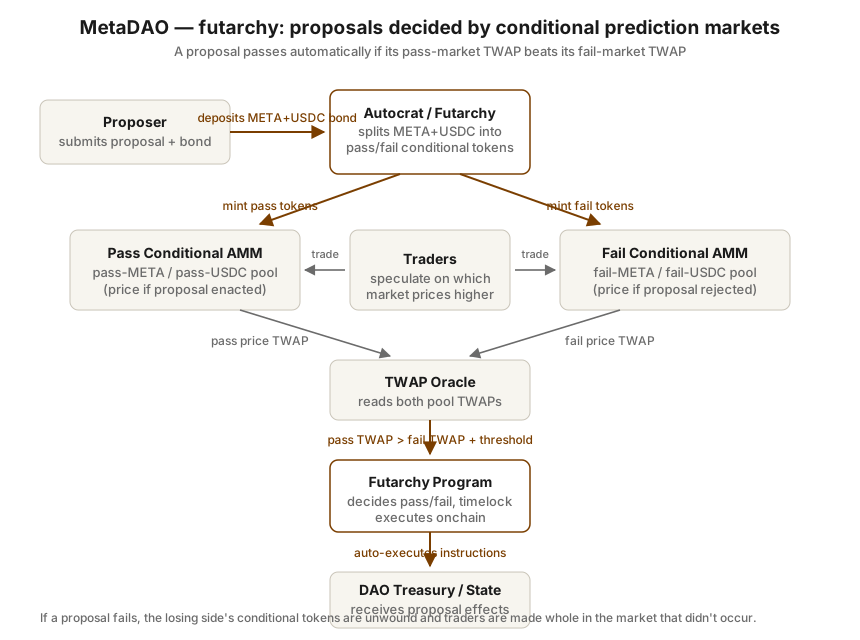 Open full-size diagram
Summary
MetaDAO is the first production deployment of futarchy, the governance mechanism proposed by economist Robin Hanson in which an organization "votes on values, but bets on beliefs." Instead of token holders voting yes/no on proposals, MetaDAO opens two conditional prediction markets for each proposal — one priced in a world where the proposal passes, one where it fails — and lets traders decide. If the market says the token (META) will be worth more with the proposal enacted, the proposal passes automatically and is executed onchain. It launched on Solana mainnet on 8 November 2023 with a ~$10,000 treasury and an airdrop to roughly 65 early participants, and was created by the pseudonymous engineer Proph3t, who says he began building it in 2022 out of frustration with organizational politics in Ethereum DeFi. In 2024–2025 MetaDAO evolved from a pure governance experiment into a futarchy-governed token launchpad and capital-formation layer, becoming one of Solana's most-discussed 2025 launch venues.
Design (Mechanism)
The core program historically called autocrat (later futarchy) implements decision markets:
- Conditional/split tokens. When a proposal is submitted, the base asset (META) and a stablecoin (USDC) are deposited and minted into conditional versions: pass-META / pass-USDC and fail-META / fail-USDC. These trade in separate AMM pools.
- Two markets, one metric. Each conditional pair has its own price. The protocol reads a time-weighted average price (TWAP) from both pools over the proposal window (originally ~3 days).
- Decision rule. If the pass-market TWAP exceeds the fail-market TWAP by a set threshold (reported around 3%), the proposal is deemed value-accretive and executes automatically; the losing side's conditional tokens are unwound and traders are made whole in the market that didn't occur. This makes governance a market forecast of "does this proposal raise the token's price," not a popularity vote.
- Skin in the game. Proposers must seed initial liquidity (reported around $10,000) into the conditional markets, which both deters spam and gives the markets depth.
- Onchain execution. Passing proposals carry executable Solana instructions run through a timelock, so the market's decision is enforced without a human gatekeeper.
The mechanism deliberately targets classic DAO failure modes: voter apathy, plutocratic whale voting, and governance theater. Anyone who thinks the market is mispricing a decision can trade against it, so influence flows to those willing to back beliefs with capital rather than to the largest passive holders.
In 2024–2025 MetaDAO packaged this as Futarchy-as-a-Service (FaaS) for other Solana projects, and then built a launchpad (program moontUz…) plus a bid-wall liquidity mechanism. New tokens raise via oversubscribable ICO-style sales and are then governed by futarchy from day one, with protocol revenue coming from a 0.25% trade fee on Futarchy AMM trades. Robin Hanson himself was retained as an adviser in February 2025 — a decision that was itself made by a futarchy market on whether hiring him would raise META's price.
Outcome
Status: ongoing. MetaDAO survived from a $10k experimental treasury into a revenue-generating protocol:
- Ran a series of real onchain futarchy proposals from late 2023 onward (its own treasury, spending, and hiring decisions were made by markets).
- Onboarded partner teams to futarchic governance (reporting mentions Drift, Sanctum, Marinade among ecosystem participants).
- The launchpad, live from around April 2025, reportedly facilitated multiple ICOs (e.g., Umbra, Omnipair, Avici, Loyal) with tens of millions raised and heavy oversubscription (large committed capital, most of it refunded).
- Protocol revenue swung with market cycles: reported >$1M from the Futarchy AMM in Q4 2025, then ~$556k in Q1 2026 (a sharp quarter-over-quarter decline), while the treasury grew substantially.
Metrics vary by source and quarter and should be treated as approximate; exact figures beyond the primary docs are secondary reporting.
Why it worked
- A genuine first. MetaDAO delivered a working, mainnet futarchy — a mechanism that had been theorized since 2000 but never run at stake — which gave it strong narrative and researcher/insider interest.
- Aligned incentives. Requiring proposer liquidity and settling on token price gave every decision an objective, tradeable metric and real skin in the game, avoiding the apathy of one-token-one-vote systems.
- Credible neutrality via code. Fully open-source programs, onchain execution, and a public transparency dashboard let outsiders verify that markets — not insiders — actually drove decisions, which was reinforced by adding Hanson (futarchy's inventor) as adviser.
- Product pivot into demand. Reframing futarchy as a fair-launch/capital-formation layer met a hot 2025 Solana demand (post-memecoin appetite for "fairer" launches), giving the mechanism a paying use case beyond pure governance idealism.
Limitations and criticisms
- Revenue cyclicality. Protocol revenue is highly cyclical (Q1 2026 fell ~78% QoQ), tying the protocol's health to speculative launch demand rather than a steady fee base.
- Thin markets, manipulation surface. Futarchy depends on liquid, informative conditional markets; with modest liquidity, TWAP-based decisions can be swayed by a well-capitalized actor, and the "price" being forecast is itself speculative and reflexive.
- Complexity and UX friction. Conditional split tokens, dual pools, and market-based voting are hard for ordinary participants to reason about, concentrating real influence among sophisticated traders — arguably a new elite rather than broad participation.
- Metric myopia. Optimizing purely for short-horizon token price can under-weight decisions whose value is long-term, ethical, or hard to price, a known theoretical critique of futarchy that MetaDAO inherits.
Lessons
- Mechanisms need a business, not just elegance. Futarchy stayed niche as pure governance; it gained traction only once wrapped as a launchpad/capital-formation product with fee revenue — proving even elegant mechanism design needs a demand-side wedge.
- Skin-in-the-game gating works. Requiring proposers to post liquidity simultaneously solved spam prevention, market depth, and incentive alignment — a reusable pattern for any market-based governance.
- Your decision metric becomes your value system. Settling governance on token price makes the protocol maximize exactly that; designers must consciously choose a metric that proxies what they actually care about, because the mechanism will optimize it literally.
- Legitimacy is earned by verifiability. Open-source code, onchain auto-execution, and recruiting the mechanism's own academic inventor gave MetaDAO credibility that marketing could not.
Redesign (EDITORIAL — hypothesis, not fact)
The following is the researcher's analysis, not established fact. Futarchy's central vulnerability is that decisions ride on possibly-thin, reflexive markets scored by a single metric (token price). A redesign could: (1) Blend the decision metric — pass proposals on a composite of price TWAP plus a slower-moving fundamental (e.g., protocol revenue or TVL bonded into the conditional markets) to blunt short-term speculative reflexivity and metric myopia. (2) Add market-quality guardrails — require minimum liquidity depth and a minimum number of independent counterparties before a proposal is eligible to settle, plus circuit-breakers if a single wallet dominates a conditional pool, reducing single-actor manipulation of the TWAP. (3) Subsidize informed trading — deploy a bounded market-maker/liquidity subsidy (à la LMSR) so decision markets are informative even for low-attention proposals, addressing the thin-market failure mode. (4) Two-tier governance — reserve futarchy for economic/parameter decisions where price is a good proxy, but route rights-, ethics-, or constitution-level questions to a values vote, since those resist honest pricing. The hypothesis: futarchy is strongest as a component inside a hybrid system, not as the sole governance primitive.
Sources
- MetaDAO Protocol Docs — Analytics & Program Addresses — primary (docs)
- MetaDAO futarchy programs (open-source Solana programs) — primary (contract)
- Proph3t's homepage (founder statement on origin of MetaDAO) — primary (retrospective)
- MetaDAO GitHub organization (links official site + socials) — primary (contract)
- 'The Goal Is Number Go Up': Inside a DAO's Radical Governance Experiment (CoinDesk) (news)
- MetaDAO Hires Futarchy's Creator Robin Hanson as Adviser (news)
- How MetaDAO became Solana's breakout token launchpad (Solana Compass / Lightspeed) (analysis)
- Understanding futarchy on Solana (Blockworks) (analysis)
Related experiments
Last verified: 2026-07-26 · Spot an error? Suggest a correction