Augur
The first decentralized prediction market on Ethereum, using a REP-token dispute/forking oracle to resolve real-world event outcomes without a trusted operator.
▶ Run interactive simulation animated mechanism with editable parameters
How it works onchain
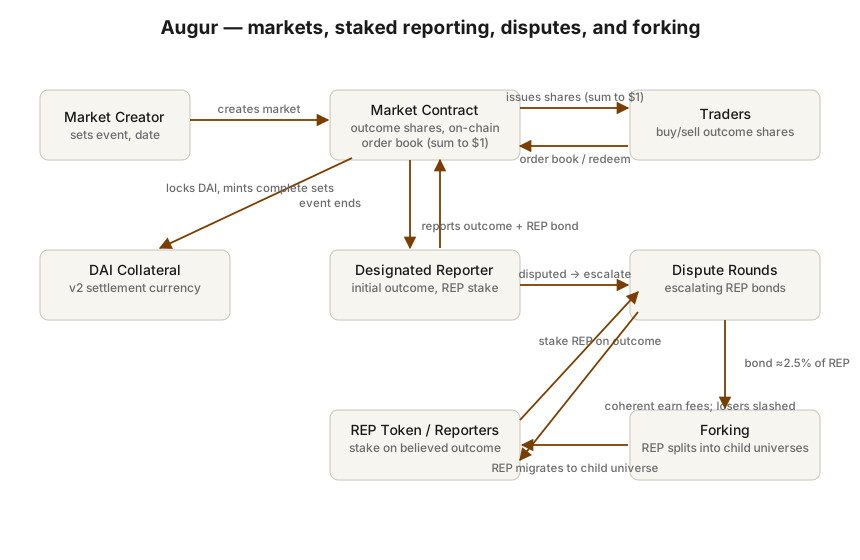 Open full-size diagram
Summary
Augur is a decentralized prediction market protocol on Ethereum, developed by the Forecast Foundation, which was founded in 2014 by Jack Peterson, Joey Krug, and Jeremy Gardner. It raised roughly $5 million in a 2015 token sale of its REP ("Reputation") token — one of Ethereum's earliest crowdsales — and shipped a public beta in March 2016 before deploying to Ethereum mainnet on July 9, 2018. Augur's central claim was that anyone could create a market on any future event, anyone could trade shares of the possible outcomes, and — critically — the resolution of "what actually happened" would be produced not by a company but by a decentralized, incentive-aligned oracle secured by REP holders. It was widely regarded as the first credible attempt to build a trust-minimized oracle for arbitrary real-world facts. A substantially redesigned Augur v2 launched in July 2020, switching the settlement currency from ETH to DAI. The project is technically pioneering but never achieved durable commercial traction; a "reboot" under the Lituus Foundation with next-generation oracle work is ongoing as of 2026.
Design (Mechanism)
Augur combines three layers: a market/trading layer, a settlement layer, and a decentralized oracle.
- Markets and shares. A creator posts a market about a future event (binary, categorical, or scalar) with a resolution date and designated reporter. The protocol mints complete sets of outcome shares that always sum to $1 (in v2, 1 DAI). Traders buy and sell these shares on an on-chain order book, so share prices act as crowd-sourced probability estimates.
- The oracle (reporting). Resolution is Augur's real innovation. After an event concludes, a designated reporter posts an initial outcome, staking REP. If nobody disputes, that outcome stands. If someone disagrees, they can post a dispute bond in REP, escalating the market into successive dispute rounds. Each round requires a larger bond, and REP holders stake on the outcome they believe is true. REP that reports honestly (with the eventual consensus) earns fees and settlement rewards; REP staked on the losing side is redistributed to correct reporters — a token-curated, skin-in-the-game oracle.
- Forking (last resort). If a dispute escalates until a bond reaches roughly 2.5% of all REP, the system forks: the entire universe of REP splits into parallel "child universes," one per possible outcome. REP holders must migrate their tokens into the universe representing the outcome they believe is true; the universe capturing the majority of migrated REP becomes canonical, and REP in losing universes becomes worthless. Forking makes attacking the oracle economically self-defeating — a dishonest majority would destroy the value of the very asset it corrupted. Forks are deliberately rare and slow (up to ~60 days).
- v2 changes (2020). Settlement moved to DAI (removing ETH price volatility from open positions), "invalid" became a first-class tradeable outcome rather than a penalty, reporting windows were tightened, and gas costs were reduced. An auction-based DAI–REP mechanism was introduced to price reporting fees against open interest.
Outcome
Technically, Augur delivered on its core promise: it ran a fully non-custodial, permissionless prediction market with a working decentralized oracle, and its dispute/fork design remains an influential piece of mechanism design. The REP contract at 0x1985365e9f78359a9B6AD760e32412f4a445E862 was minted to all 56,338 accounts holding legacy REP at launch. Commercially, however, adoption stayed thin. The mainnet client had to be run locally (no hosted front end at launch), UX was slow and expensive on Ethereum gas, and settlement could take up to 90 days in disputed cases. Reported weekly active users hovered around a few hundred despite a nine-figure token valuation, and trading volume repeatedly dwindled toward negligible levels between hype cycles. Even Augur's best moment — the 2020 US election — was followed by TVL collapsing by roughly 80%. The later dominance of Polymarket (billions in 2024 election volume) underscored that Augur pioneered the category but did not win it.
Why it worked
- Genuine oracle innovation. The staked-reporting-plus-forking design gave a concrete, game-theoretically defensible answer to "how do you resolve subjective real-world questions without a trusted party," influencing later oracle and dispute-resolution systems.
- Credible neutrality. Contracts were immutable and permissionless; no operator could freeze funds or censor markets, which was the whole ideological point and a real differentiator in 2018.
- First-mover legitimacy. As one of Ethereum's earliest DApps and crowdsales — advised by Intrade's Ron Bernstein and Vitalik Buterin — it seeded the entire onchain prediction-market thesis.
Where the design broke
- Terrible UX and cost. Running a local node, high gas fees, thin order books, and long resolution windows made ordinary use painful; liquidity was chronically poor.
- Slow finality. Multi-round disputes and the possibility of month-long forks meant capital could be locked far longer than casual bettors would tolerate.
- Uncensorable market creation cut both ways. Within weeks of launch, morbid "assassination markets" betting on the deaths of Donald Trump and others surfaced and drew wide press coverage. Permissionless market creation, Augur's ideological strength, meant the protocol had no filtering or takedown mechanism for market content — the same design that removed a trusted operator also removed any point of control over what markets could exist.
- Product–market mismatch. The maximally decentralized architecture optimized for censorship-resistance over usability, exactly the opposite of what mainstream prediction-market users later rewarded in curated, low-friction competitors.
Lessons
- A correct oracle is necessary but not sufficient. Augur solved the hard theoretical problem (trust-minimized resolution) yet lost commercially because latency, cost, and UX — not oracle correctness — determined adoption.
- Permissionlessness has a governance/PR cost. Fully open market creation invites distasteful or offensive markets; teams need a story (curation, front-end filtering, or off-chain moderation) for handling them while preserving the base-layer neutrality.
- Settlement speed is a product feature. Dispute-and-fork mechanisms that can lock funds for weeks-to-months are fundamentally incompatible with high-velocity retail betting; competitors won partly by making resolution feel fast.
- Being first is not being final. Augur validated the category and then watched more usable, more curated successors capture the volume — a recurring pattern in onchain experimentation.
Redesign (EDITORIAL — hypothesis, not fact)
The following is the researcher's analysis and speculation, not established fact. A modern Augur redesign would likely keep the fork-as-backstop oracle but relegate it to an extreme tail case, layering a fast optimistic oracle (single reporter + short challenge window, escalating to REP dispute only on contest) so that the vast majority of markets resolve in hours, not months. Deploying on a low-fee L2 (or app-chain) would remove the gas tax that throttled Augur's order books, and a native AMM/LMSR-style liquidity engine rather than a thin order book would guarantee tradeable prices in low-participation markets — arguably Augur's single most fatal gap versus Polymarket. On the front end, a curated, hosted, mobile-first interface with an explicit, transparent policy for delisting distasteful markets (while leaving the base protocol permissionless) could preserve credible neutrality at the contract layer while removing the reputational risk. Finally, tying REP rewards to actual protocol fee revenue rather than speculative token value would better align reporters during the low-volume periods when the oracle proved weakest. The core hypothesis: Augur's mechanism was largely right and roughly a half-decade early; the losing bets were on Ethereum L1 economics, order-book liquidity, and an all-or-nothing view of decentralization at the UX layer.
Sources
- Augur Launches — REP migration completed (official announcement) — primary (governance)
- Deployment Details & REP Migration (official) — primary (governance)
- Augur: a Decentralized Oracle and Prediction Market Platform (whitepaper v2.0) — primary (docs)
- Augur official website — primary (docs)
- Augur (software) — Wikipedia (analysis)
- The record-breaking $152M battle over the blockchain betting tool Augur — CoinDesk (news)
- Crypto gambling ... bets placed on Trump's murder — Forbes (news)
- Volume on the Augur prediction market platform is seriously dwindling — Coin Rivet (news)
- A veteran of prediction markets: from Augur's 'Innovation Theater' to Polymarket — PANews (analysis)
- The History of Crypto Prediction Markets — The Defiant (analysis)
Related experiments
Last verified: 2026-07-26 · Spot an error? Suggest a correction