Pyth Network
A first-party financial oracle where exchanges, market makers, and trading firms publish their own prices directly on-chain, aggregated into a confidence-weighted feed that apps pull on demand instead of paying for constant push updates.
▶ Run interactive simulation animated mechanism with editable parameters
How it works onchain
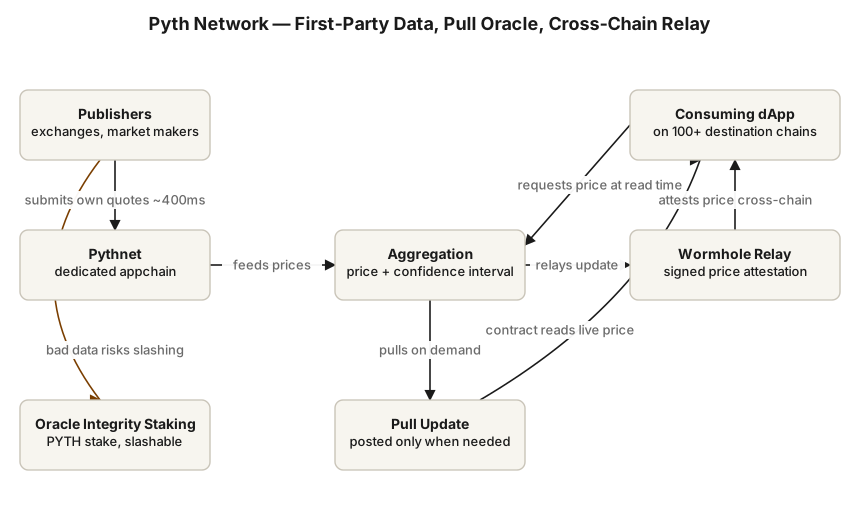 Open full-size diagram
Summary
Pyth Network is an oracle protocol that flips the traditional oracle model: instead of relying on third-party node operators who scrape prices from public APIs, Pyth pays exchanges, market makers, and trading firms (Jane Street, CBOE, Binance, OKX, Bybit, and 100+ others) to publish their own proprietary quotes directly on-chain. Those first-party submissions are aggregated into a single price with an explicit confidence interval, written to a dedicated appchain (Pythnet), and relayed via Wormhole to 100+ blockchains where any application can "pull" the latest price on demand rather than paying for continuous push updates. It launched on Solana on August 26, 2021, incubated inside Jump Trading, and was later spun into an independent entity, Douro Labs, in mid-2023.
Design (Mechanism)
Pyth's core innovation is the first-party data model: publishers are the institutions that actually make markets in an asset, not intermediaries re-selling exchange data. Each publisher submits a price plus a confidence interval (their own estimate of uncertainty) at high frequency to Pythnet, a dedicated Solana-fork appchain built for this purpose. An on-chain aggregation algorithm combines all publisher submissions into a single aggregate price and confidence band, weighting for outliers, roughly every ~400ms.
Delivery uses a "pull" architecture: rather than a data feed being pushed on-chain continuously (which is expensive and wasteful when most price ticks are never read by a contract), a relayer/keeper (or the consuming dApp itself) fetches a signed price update off-chain and posts it on-chain only at the moment it's needed — e.g., right before a liquidation check or a perp funding calculation. Cross-chain propagation of the aggregated Pythnet price to the 100+ supported chains is handled through Wormhole's guardian network, which attests to and relays the signed price payloads. Publishers stake PYTH tokens and can be penalized (via Oracle Integrity Staking) for submitting bad data, tying data quality to economic skin-in-the-game. The PYTH token, launched via the November 2023 TGE and retrospective airdrop to ~90,000 wallets, governs protocol parameters through the Pyth DAO and is used for the publisher staking/slashing layer.
Outcome
Pyth became one of the largest oracle networks in DeFi within about two years of the PYTH token launch, reporting hundreds of price feeds spanning crypto, equities, ETFs, FX, and commodities, integrated by hundreds of applications across dozens of chains, and securing several billion dollars of TVL in protocols that depend on its feeds (perp DEXs and lending markets being the largest consumers). It has expanded beyond crypto price feeds into traditional finance data ("Pyth Pro") and has pursued partnerships aimed at bringing institutional and government economic data (e.g., U.S. Department of Commerce GDP data) on-chain. The project remains active and continues shipping; no exploit or collapse has been publicly reported against the core protocol.
Why it worked
- First-party data sidesteps the "garbage in, garbage out" problem that plagued earlier node-operator oracles: publishers are the actual liquidity providers/market makers for an asset, so their quotes are what they're willing to trade at, not a scraped API value.
- Pull-based delivery is dramatically cheaper for high-frequency, low-read-rate feeds. Perp DEXs and lending protocols that only need a price at the moment of liquidation or trade execution don't have to subsidize thousands of unused on-chain price writes per day.
- Confidence intervals give consuming contracts a native uncertainty signal (useful for widening liquidation buffers during volatile or illiquid moments) that a bare point-price oracle can't provide.
- Aggressive multichain distribution via Wormhole let Pyth become the default oracle on many newer L2s and appchains that lacked an incumbent like Chainlink, capturing "first mover" integrations broadly.
Limitations and criticisms
- Governance and slashing mechanics for Oracle Integrity Staking remain relatively young compared to the maturity of the network's data footprint, meaning economic security guarantees are less battle-tested than the raw feed coverage suggests.
- Reliance on Wormhole for cross-chain relay introduces a dependency on a separate bridge's security model; a Wormhole-level compromise could, in principle, propagate stale or falsified prices to chains beyond Pythnet itself.
- Publisher concentration risk: even with 100+ contributors, aggregate prices for thinner assets can still be dominated by a small number of active publishers, echoing (in a different form) the centralization critique leveled at earlier oracle designs.
Lessons
- Sourcing data from the entities that actually generate it (first-party) is a structurally stronger trust model than paying intermediaries to fetch and relay public API data.
- Pull-based oracle delivery can be a significant cost and efficiency win for use cases where price reads are infrequent relative to price changes, compared to always-on push feeds.
- Publishing an explicit confidence interval alongside a price, rather than a single point estimate, gives downstream protocols a tool to manage risk during volatile or thin-liquidity conditions.
- Token-based staking/slashing for data publishers is a promising alignment mechanism, but its real security value only becomes clear after it has been tested by an actual attempted manipulation or major publisher failure.
Redesign (EDITORIAL)
EDITORIAL — hypothesis, not fact. A next iteration could reduce bridge-dependency risk by settling aggregation directly on each destination chain via light-client or zk-proof verification of Pythnet state, rather than routing every cross-chain update through Wormhole's guardian set — trading some latency for a strictly weaker trust assumption. It could also expose per-publisher historical accuracy scores on-chain (not just an aggregate confidence interval), letting consuming contracts optionally weight or exclude specific publishers, which would make publisher-concentration risk visible and manageable rather than hidden inside the aggregate.
Sources
- Pyth Network — official site — primary (official)
- Pyth Network Documentation — Price Feeds Overview — primary (docs)
- Pyth Network — Retrospective Airdrop announcement — primary (official)
- CoinDesk — Pyth Token Debuts Near $500M Valuation as 90,000 Wallets Receive Airdrop (news)
- Douro Labs — team page — primary (official)
- Pyth Network — Where Pyth is Now: Looking Towards 2024 — primary (official)
Related experiments
Last verified: 2026-07-27 · Spot an error? Suggest a correction