dYdX
Decentralized perpetuals exchange that migrated from Ethereum L1 margin trading to a StarkEx L2 orderbook and finally to its own Cosmos appchain, testing whether a CEX-grade orderbook can be progressively decentralized.
▶ Run interactive simulation animated mechanism with editable parameters
How it works onchain
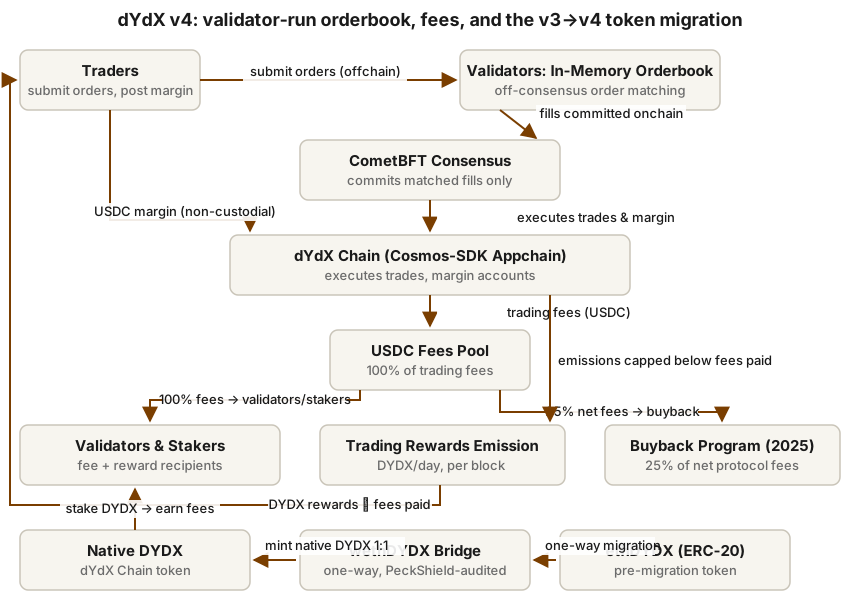 Open full-size diagram
Summary
dYdX is one of the longest-running experiments in decentralizing a professional derivatives exchange. Founded in 2017 by ex-Coinbase/Uber engineer Antonio Juliano, it began as Ethereum L1 margin-trading and lending contracts, became the dominant decentralized perpetual-futures venue on a StarkEx zk-rollup (v3, 2021), and in late 2023 migrated to its own Cosmos-SDK appchain (dYdX Chain, v4) where validators themselves run the orderbook. Its September 2021 retroactive DYDX airdrop — 75M tokens to past users, worth up to ~$100K per wallet at listing — helped normalize retroactive distribution as a growth mechanism. The site today claims over $1.5T lifetime volume across 220+ markets. Yet dYdX also illustrates the cost of serial re-architecture: during its v3→v4 transition, Hyperliquid seized perp-DEX market leadership, and in October 2024 Juliano returned as CEO and cut 35% of staff, saying the company needed revitalizing "or we will fade."
Design (Mechanism)
v1/v2 (2017–2020, Ethereum L1): Solo margin and lending contracts settling fully onchain; an offchain orderbook with onchain settlement. Gas volatility made small trades uneconomical.
v3 (2021–2024, StarkEx): A central-limit orderbook and matching engine operated by dYdX Trading Inc., with trades batch-settled via StarkWare's StarkEx zk-STARK validity proofs to Ethereum. Users held non-custodial collateral (USDC margin, cross-margined perpetuals) while enjoying CEX-like latency and zero per-trade gas. This "hybrid" design traded decentralization of matching for performance.
Token layer (Sept 2021): 1B DYDX (Ethereum ERC-20, 0x92D6...eff5), with a retroactive airdrop for pre-snapshot users in five usage tiers, ongoing trading rewards, liquidity-provider rewards, a USDC liquidity-staking pool, and a safety module. Governance controlled reward parameters; fee discounts tied to DYDX holdings. Early epochs showed classic reward-farming: traders churned volume to harvest DYDX, and governance repeatedly cut emissions.
v4 (2023–, dYdX Chain): A standalone Cosmos-SDK / CometBFT proof-of-stake chain, open-sourced in October 2023, alpha mainnet October 2023 and full trading with rewards from November 2023. The key mechanism: each validator maintains the orderbook in memory; orders are matched off-consensus and only fills are committed in blocks, so no central operator matches trades and no entity (including dYdX Trading Inc.) collects trading fees — all protocol fees (USDC) go to validators and stakers. Trading rewards (initially 50,000 DYDX/day) are emitted per block proportional to fees paid, capping rewards below fees to blunt wash-trading. Token migration used the permissionless one-way wethDYDX bridge contract from ethDYDX to native DYDX (audited by PeckShield); v3 and its Ethereum governance were subsequently sunset in late 2024. The 2024 "dYdX Unlimited" upgrade added permissionless market listings and MegaVault, a master USDC liquidity pool seeding new markets. In March 2025, governance approved a buyback program directing 25% of net protocol fees to purchase DYDX.
Outcome
Partial success. dYdX proved out each architectural stage: v3 was for years the highest-volume decentralized perp venue, at times exceeding Coinbase's spot volume; the v4 appchain launched successfully, executed one of the largest token migrations to date, and made staked DYDX productive with real USDC fee revenue. Lifetime volume exceeds $1.5T with roughly $200M open interest and 220+ markets (official site, 2026). But competitively it underperformed: by late 2024 Hyperliquid had out-executed dYdX for eight of ten months in volume and held over 3x its TVL; dYdX TVL halved from its March 2024 peak; DYDX price fell far below 2021 highs amid heavy vesting unlocks. October 2024 brought Juliano's return as CEO, a 35% workforce cut, and a pivot (Unlimited, MegaVault, buybacks, later Solana spot and Telegram trading). The protocol remains live and revenue-generating but no longer category-defining.
Why it worked
- Pragmatic decentralization sequencing: dYdX decentralized what it could when it could — offchain matching with onchain custody first, validity-proof settlement second, validator-run matching last — keeping trading UX competitive at every stage.
- Retroactive airdrop as legitimacy and growth: rewarding past users (rather than pre-announcing farming) created durable goodwill and set an industry template.
- Real fee flows to stakers: v4's design routes 100% of USDC protocol fees to validators/stakers, giving the token cash-flow grounding most governance tokens lack.
- Reward caps tied to fees paid limited (though did not eliminate) wash-trading economics that plagued naive trading-rewards programs.
Where the design broke
- Multi-year replatforming created a strategic opening: the Cosmos migration and token bridge spanned roughly two years of re-architecture, during which a purpose-built competitor chain (Hyperliquid) shipped faster and captured traders and mindshare.
- Emission-led volume proved mercenary: early epochs showed volume tracked DYDX rewards; when emissions fell or price dropped, farmed volume left.
- Token overhang: large investor/team allocations and unlocks from the 2021 tokenomics depressed price and morale through the migration window.
- Fragmented governance-and-entity structure (Trading Inc./Labs, Foundation, Operations subDAO, later Cayman migration) added coordination drag versus centralized competitors.
- App-chain isolation: leaving Ethereum's liquidity and composability meant depending on bridges and IBC at a time when rivals offered simpler onboarding.
Lessons
- Progressive decentralization is viable for orderbook exchanges, but each migration is a multi-quarter distraction; competitors can win the market during your rebuild.
- Retroactive airdrops buy loyalty once; ongoing trading rewards buy volume only for as long as emissions exceed fees — cap rewards below fees paid and expect volume to be partly synthetic anyway.
- A token backed by real protocol fee distribution (USDC to stakers, buybacks) survives bear markets better than pure governance rights, but cannot outrun a large unlock schedule.
- "No one collects the fees" (validator-run matching) is a real regulatory and credibly-neutral design win, and dYdX v4 is the strongest existence proof that a fully decentralized CLOB can run at scale.
- Being first and biggest is not a moat in perp DEXs; latency, listings velocity, and unified UX (Hyperliquid's playbook) beat brand.
Redesign (EDITORIAL — hypothesis, not fact)
Editorial hypothesis. In hindsight, dYdX might have fared better by skipping the general-purpose Cosmos SDK migration and instead building the v4 validator-orderbook as a minimal single-purpose chain with the bridge and onboarding UX prioritized from day one — i.e., compressing the two-year replatform. Tokenomics could have been redesigned at migration: a supply cut or conversion-ratio reset to neutralize the 2021 unlock overhang, with staking rewards paid exclusively from fees (no ongoing emissions) plus fee-funded buybacks from launch rather than 2025. Finally, permissionless listings and a shared liquidity vault (MegaVault) were arguably the correct moves shipped two years late; launching v4 with them might have pre-empted the listings-velocity advantage that Hyperliquid exploited.
Sources
- The History of dYdX (so far) — Antonio Juliano — primary (retrospective)
- Introducing DYDX — dYdX Foundation — primary (docs)
- ethDYDX token contract — Etherscan — primary (contract)
- wethDYDX Smart Contract | DYDX Token Migration docs — primary (docs)
- Understanding Rewards and Fees on the dYdX Chain — dYdX Foundation — primary (docs)
- dYdX Chain officially launches on mainnet as standalone Cosmos Layer 1 — The Block (news)
- dYdX CEO Juliano fires 35% of workforce and promises pivot — CoinDesk (news)
- The Return — dYdX blog (Juliano) — primary (retrospective)
- dYdX v3 Sunset — Governance & Token FAQs — dYdX Foundation — primary (docs)
- Users celebrate massive DYDX token airdrop as transfer restrictions lift — CoinDesk (news)
Related experiments
Last verified: 2026-07-27 · Spot an error? Suggest a correction