Goldfinch
Undercollateralized real-world credit protocol that lent stablecoins to fintech lenders in emerging markets via a tranched 'trust through consensus' model, originated $100M+ in loans, then wound down in 2026 after multi-year borrower defaults.
▶ Run interactive simulation animated mechanism with editable parameters
How it works onchain
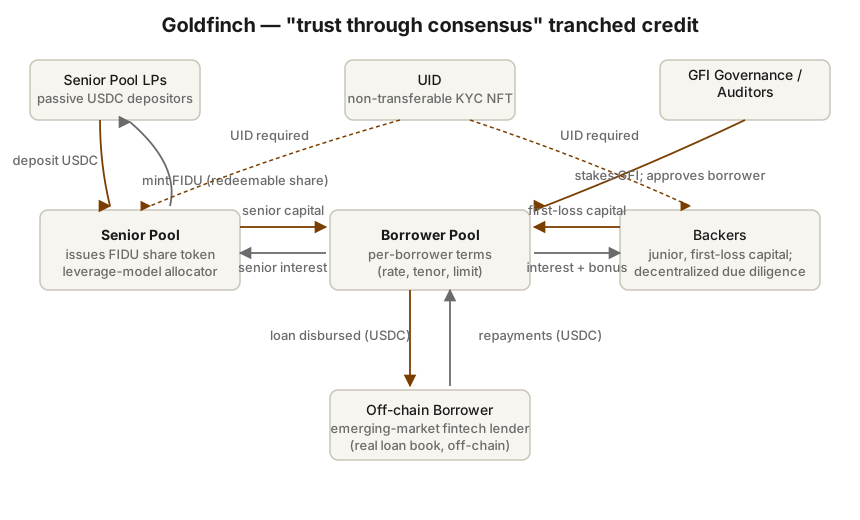 Open full-size diagram
Summary
Goldfinch was the flagship experiment in bringing undercollateralized, real-world credit onchain. Founded in July 2020 by ex-Coinbase employees Mike Sall and Blake West and operating on Ethereum from roughly January 2021, it lent USDC to off-chain fintech lenders — motorcycle-taxi financiers in Kenya, consumer lenders in Southeast Asia and Latin America, and later US credit funds — without requiring crypto collateral. Backed by a16z and Coinbase Ventures and governed by the GFI token (launched January 2022), Goldfinch originated over $100M in loans at its peak and became the reference design for "RWA private credit" in DeFi. But its core bet — that a decentralized network of capital providers could underwrite real-world credit risk — did not survive contact with actual defaults. Three publicly documented borrower failures (Tugende, Stratos, Lend East) burned roughly $18M, GFI fell ~99.8% from its peak, and the 2025 pivot to "Goldfinch Prime" (onchain access to institutional private credit funds) failed to gain traction. In June 2026, GIP-87 — proposed by core developer Warbler Labs and passed unanimously by GFI voters — moved the protocol into maintenance mode, wound down Prime, and limited operations to collecting remaining legacy borrower payments.
Design (Mechanism)
Goldfinch's central mechanism was "trust through consensus": instead of collateral, creditworthiness was established by the willingness of independent participants to stake first-loss capital on a borrower.
- Borrower Pools: Off-chain lending businesses ("Borrowers") proposed pools with terms (rate, tenor, limit). Loans funded real loan books off-chain; repayments flowed back onchain in USDC.
- Backers (junior tranche): Individuals performed due diligence and supplied junior, first-loss capital directly to specific pools, earning higher yield for concentrated risk. Backer participation acted as a decentralized underwriting signal.
- Senior Pool (senior tranche): Passive LPs deposited USDC into a single diversified Senior Pool (proxy at 0x8481a6Eb…F822), which automatically allocated senior capital to pools using a "leverage model" keyed to how much Backer capital each pool attracted. Senior capital was protected by the junior tranche and paid a portion of its interest to Backers ("backer bonus"). Senior Pool LPs received FIDU, a redeemable share token.
- UID: A non-transferable KYC identity NFT gating participation for compliance — an early production example of soulbound-style identity in DeFi.
- Auditors & governance: GFI holders governed protocol parameters; an auditor role staking GFI to approve borrowers was designed (partially realized in practice). GFI also served for staking rewards and backer incentives.
The design deliberately kept credit assessment human and off-chain while making capital formation, tranching, and cash-flow distribution trustless onchain.
Outcome
Through 2021–2022, Goldfinch scaled to roughly $100M+ in active loans across ~dozens of pools and became the most-cited undercollateralized RWA lender. Thirteen loans were fully repaid. Then the credit cycle arrived: in 2022–2023, Kenyan borrower Tugende breached covenants (quietly moving $1.9M to its distressed Ugandan parent) and defaulted on a $5M loan, later written down. In October 2023, $7M of a $20M facility to US credit fund Stratos was written to zero after undisclosed investments in a real-estate startup and a token position; Warbler Labs backstopped affected backers. In April 2024, Lend East repaid only ~$1.75M of a ~$10M facility (per DL News, the third default), bringing publicly documented losses to ~$18M. Warbler Labs meanwhile launched Heron Finance, an SEC-registered robo-advisor (Dec 2023), and in 2025 relaunched the protocol around "Goldfinch Prime," offering onchain exposure to large private credit funds. Prime failed to attract sufficient deposits. On June 12, 2026, Warbler posted GIP-87 proposing an orderly wind-down of Prime and "maintenance mode" for legacy collections, with a US trust structure for remaining claims and a $150,000 USDC wind-down fee to Warbler; the Snapshot vote passed with 100% YES in late June 2026. GFI trades ~99.8% below its all-time high, and some legacy depositors remain stranded awaiting recoveries.
Why it worked
- The tranching mechanics, Senior Pool leverage model, and onchain cash-flow distribution executed as designed for years — the smart-contract layer was never exploited.
- It genuinely moved crypto capital into productive emerging-market lending at scale ($100M+ originated), proving demand on both sides of the market.
- UID showed a workable compliance-identity primitive, and the backer/senior split correctly priced relative risk between tranches.
- Transparent onchain repayment flows made defaults visible and auditable in a way traditional private credit is not.
Why it failed or underperformed
- Underwriting was the product, and it failed. Backers lacked the tools, information rights, and incentives of professional credit analysts; covenant breaches (Tugende, Stratos) went undetected until losses were realized.
- No enforcement edge: onchain lenders had weaker recourse than local banks — recovery depended on off-chain legal processes across jurisdictions.
- Correlated macro exposure: emerging-market fintech borrowers were hit simultaneously by rising global rates, exactly when crypto capital also retreated.
- Trust migrated back to the center: Warbler Labs' backstops and quarterly reviews revealed that "decentralized credit" was, in practice, dependent on one core team.
- The Prime pivot competed against established tokenized-treasury and institutional credit products without a distribution advantage.
Lessons
- Undercollateralized lending is a credit-underwriting business wearing a protocol costume; if the underwriting layer is amateur or under-incentivized, tranching only redistributes losses, it does not prevent them.
- Onchain transparency of repayments does not equal transparency of borrower balance sheets — covenant monitoring and information rights must be engineered as deliberately as the contracts.
- First-loss "skin in the game" signals are weak when junior stakes are small relative to reputational or airdrop incentives to participate.
- Cross-jurisdiction legal recourse is the real collateral in RWA lending; a protocol without an enforcement strategy holds unsecured IOUs.
- When a core team repeatedly backstops losses, governance should treat that as evidence the decentralization premise has failed and re-price risk accordingly.
Redesign (EDITORIAL — hypothesis, not fact)
This section is editorial speculation. A revived design would invert Goldfinch's trust stack: require professional, licensed delegates (local NBFIs, credit funds) to underwrite and hold a large, verifiable first-loss position (10–20% of the pool, lockup ≥ loan tenor), with retail capital only ever senior. Borrower covenants would be encoded as machine-checkable attestations (bank-account data feeds, audited NAV oracles) with automatic drawdown freezes on breach — Tugende's $1.9M related-party transfer should have halted disbursements, not surfaced in a postmortem. Recovery rights would be pre-packaged: each pool tied to a bankruptcy-remote SPV in an enforceable jurisdiction, with the trustee obligated to onchain claim-holders — essentially what GIP-87's wind-down trust improvised after the fact, but designed in from day one. Finally, governance token emissions should never subsidize junior risk-taking; yields must clear on credit fundamentals alone, or the pool should not fill.
Sources
- Goldfinch official site (Prime shutdown notice) — primary (docs)
- Goldfinch developer docs — SeniorPool contract reference — primary (docs)
- GIP-87: Maintenance Mode of Goldfinch Operations and Wind-Down of Goldfinch Prime — primary (governance)
- SeniorPool proxy on Etherscan — primary (contract)
- Investing in Goldfinch — a16z crypto (analysis)
- Goldfinch's third default shows just how risky undercollateralised crypto lending can be — DL News (news)
- RWA Protocol Goldfinch Writes Down $7M of $20M Stratos Loan to $0 — The Defiant (news)
- Crypto lender Goldfinch faces bumpy road after motorbike company defaults on $5m loan — DL News (news)
- a16z-Backed Goldfinch Finance Winds Down After Originating $100M in Loans — The Defiant (news)
- Goldfinch set to shutter Prime after community vote backs wind-down proposal — The Block (news)
- Warbler Labs launches SEC-registered robo-advisor on a blockchain (Heron) — Axios (news)
- Goldfinch: A DeFi Credit Protocol — Nansen Research (analysis)
Related experiments
Last verified: 2026-07-27 · Spot an error? Suggest a correction