Neutrino USD (USDN)
Waves-native algorithmic stablecoin backed by WAVES collateral and 15% staking yields that depegged dozens of times, helped strand ~$500M of bad debt on Vires Finance, and was finally converted into the non-pegged index token XTN in 2023.
▶ Run interactive simulation animated mechanism with editable parameters
How it works onchain
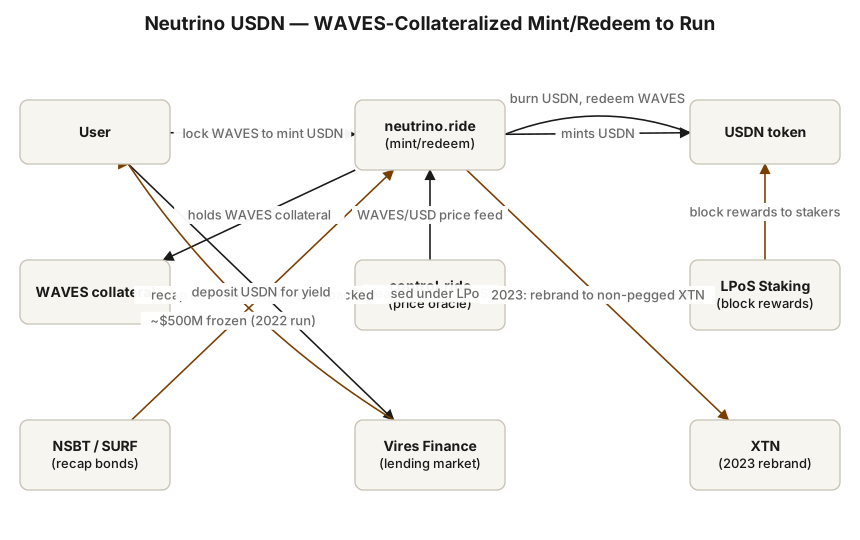 Open full-size diagram
Summary
Neutrino USD (USDN) was the flagship algorithmic stablecoin of the Waves blockchain. Launched in beta by Ventuary Lab (with KozhinDev and Tradisys) in November 2019, it was minted by locking WAVES — the chain's own volatile native token — into a set of Ride-language smart contracts, and redeemed by burning USDN for $1 worth of WAVES at oracle prices. Its signature draw was a ~8–15% APY on staked USDN, sourced from Waves' leased-proof-of-stake rewards on the locked collateral. USDN grew into a several-hundred-million-dollar asset and was bridged to Ethereum and BNB Chain, but its endogenous collateral and yield-driven demand made it structurally reflexive. It reportedly lost its dollar peg 38 times from 2020 onward, cratered to ~$0.73 in April 2022 after a pseudonymous analyst published on-chain analysis alleging insider manipulation of the collateral base, slipped again during the Terra/UST collapse in May 2022, and left more than $500M of bad debt frozen in the Waves lending market Vires Finance. In February 2023, governance abandoned the peg entirely, rebranding USDN as the free-floating "Neutrino Index Token" (XTN), which subsequently traded at a small fraction of a dollar.
Design (Mechanism)
- Mint/redeem swap: Users sent WAVES to the neutrino.ride contract (3PC9BfRwJWWiw9AREE2B3eWzCks3CYtg4yo) to mint USDN at the oracle-reported WAVES/USD price; redeeming burned USDN for $1 of WAVES. Arbitrageurs were expected to keep the market price at $1.
- Endogenous collateral and reserves: All backing was WAVES held by the contract. When WAVES appreciated, the surplus formed a reserve buffer; when WAVES fell, the system became under-collateralized ("backing ratio" < 1).
- NSBT recapitalization bonds: When reserves fell short, the protocol auctioned NSBT (Neutrino System Base Token) at a discount to recapitalize the contract — buyers effectively bet on recovery. NSBT doubled as the governance token, and later a second recapitalization/governance token, SURF, was added.
- Staking yield: Locked WAVES collateral was leased under Waves' LPoS consensus; block rewards were converted and paid to USDN stakers (advertised up to ~15% APY), making USDN primarily a yield product.
- Oracles: A control.ride contract with a small oracle set (later supplemented by Band Protocol) supplied the WAVES/USD price.
- Cross-chain wrappers: USDN was ported to Ethereum (ERC-20, Aug 2020) and BNB Chain to chase DeFi yield demand.
Outcome
Failed. USDN never suffered a single catastrophic exploit; instead it bled credibility through repeated depegs — reportedly 38 between 2020 and late 2022. The decisive blow came in April 2022, when pseudonymous analyst 0xHamz published on-chain evidence alleging the Waves team was looping USDN deposits on Vires Finance to borrow USDC and buy WAVES, artificially pumping the collateral that backed USDN. Ivanov countered by accusing Alameda Research of manipulation, but confidence broke: WAVES crashed ~40% in a week, USDN fell to ~$0.73, and Vires lenders were left with over $500M they could not withdraw. The Terra/UST collapse in May 2022 knocked USDN to ~$0.88 again, and a further depeg followed in December 2022. In February 2023, after a governance process, USDN was rebranded as XTN, a non-pegged "index token" backed by a basket of Waves-ecosystem assets — a formal abandonment of the stablecoin claim. XTN thereafter traded at pennies. Ivanov promised a "revival plan" and a new stablecoin, but USDN holders were never made whole at par.
Why it worked
- For roughly two years the arbitrage loop plus NSBT bond auctions genuinely absorbed volatility; the mint/redeem contract functioned as designed and was never hacked.
- The LPoS-funded staking yield was a real (not purely emissions-based) cash flow, giving USDN one of the more defensible yield stories among algorithmic stablecoins and driving rapid adoption on Waves, Ethereum, and BNB Chain.
- Deep integration with its host chain — USDN was the core asset of Waves DeFi (Vires, Swop.fi, Waves.Exchange) — created captive demand.
Where the design broke
- Endogenous collateral reflexivity: USDN was backed by the token whose ecosystem's health depended on USDN. WAVES down → backing ratio down → confidence down → redemptions → WAVES sell pressure. The same doom-loop as UST, with extra steps.
- Yield as the product: Demand was overwhelmingly mercenary yield-seeking. When the implied yield or the collateral story weakened, holders exited en masse rather than arbitraging the peg back.
- Circular collateral leverage: The 0xHamz analysis alleged that USDN deposits were looped back into WAVES purchases, meaning part of the "reserve" was leveraged exposure to the same asset rather than exogenous inflow. Once that structure was publicized, the system became a confidence trade, and confidence evaporated in April 2022.
- Recapitalization tokens too small: NSBT/SURF auctions could absorb small shocks but were dwarfed by a genuine run; the backing ratio stayed deeply below 1 after mid-2022.
- Contagion: UST's collapse triggered a run the mechanism could not counter.
Lessons
- A stablecoin collateralized by its own ecosystem's volatile token is short a put on that ecosystem; the peg holds only while the collateral narrative does. Exogenous collateral (or over-collateralization with liquidation) is the survivable design.
- High advertised staking yield attracts capital that is structurally the first to flee; yield-driven demand is anti-stability demand during stress.
- Bond/recapitalization tokens (NSBT, SURF — like Terra's post-hoc proposals) only work for shocks smaller than the market's belief in recovery; they cannot stop a full run.
- Alleged insider leverage that inflates the collateral asset converts a mechanism-design problem into a trust problem; on-chain transparency means such loops are likely to surface (as in the 0xHamz analysis), and the surfacing of the allegation itself can trigger a run regardless of whether it is ever adjudicated.
- Repeated small depegs are not "resilience" — 38 recoveries taught holders to exit faster each time, thinning the arbitrage support until one shock became terminal.
- Rebranding a failed stablecoin into a "floating index token" resolves the protocol's liability without restoring holders; expect that endgame when reading any endogenously-backed peg.
Redesign (EDITORIAL — hypothesis, not fact)
This section is editorial hypothesis, not established fact. A salvageable Neutrino would have inverted its collateral policy: cap USDN issuance to a conservative fraction (e.g., 30–50%) of the liquid, free-float WAVES market cap, hold a growing share of reserves in exogenous assets (BTC, ETH, fiat-backed stables accumulated from LPoS yield), and publish the backing ratio with automatic issuance freezes below 1. The LPoS yield was the genuinely novel ingredient — routing real staking cash flow to stablecoin holders — and could have funded an exogenous reserve buildup instead of a headline APY, turning reflexive growth into progressive de-risking. Strict on-chain rules barring protocol-affiliated addresses from levering USDN against its own collateral (or at least surfacing such loops in a public dashboard) would have addressed the loss of confidence that followed the 0xHamz allegations and preceded the run. Finally, redemption gates priced by backing ratio (small haircuts when under-backed, rather than a hard $1 promise the contract cannot keep) would have converted death-spiral runs into orderly, Dai-in-2020-style soft depegs. The honest conclusion, though, is that a small-cap L1's native token cannot safely back a growth-stage stablecoin at all; the redesign that survives is the one that stops being algorithmic on the way up, not on the way down.
Sources
- Neutrino Protocol documentation (contracts, token model) — primary (docs)
- Neutrino Protocol FAQ (official Medium) — primary (docs)
- USDN is transitioning from stablecoin to Neutrino Index Token XTN (Waves blog) — primary (governance)
- Ventuary Labs launches Neutrino – the first Waves blockchain stablecoin (Nov 2019) (news)
- The Neutrino Depeg in Three Analytics (IntoTheBlock) (analysis)
- Crisis in Terra's UST Stablecoin Spreads to Neutrino USD on Waves (CoinDesk, May 2022) (news)
- Waves founder's role in lost $530m raises questions about who's to blame (DL News on Vires Finance) (analysis)
- Waves Blockchain Founder Sasha Ivanov Promises USDN Revival Plan, New Stablecoin (CoinDesk, Dec 2022) (news)
Related experiments
Last verified: 2026-07-26 · Spot an error? Suggest a correction