Compound (lending)
Algorithmic pooled money market on Ethereum whose cToken model and June 2020 COMP liquidity-mining launch set the template for DeFi lending and ignited 'DeFi Summer'.
▶ Run interactive simulation animated mechanism with editable parameters
How it works onchain
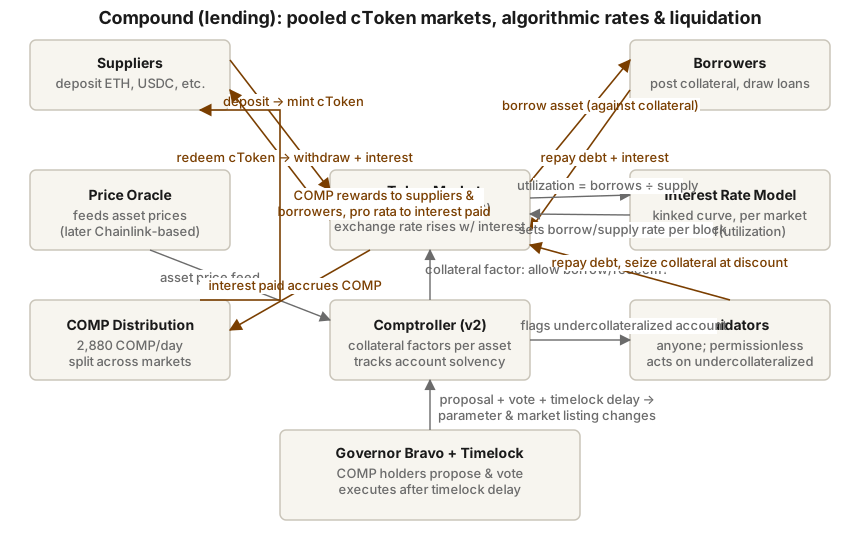 Open full-size diagram
Summary
Compound is the canonical onchain money market: a set of Ethereum smart contracts that pool depositors' assets and lend them to overcollateralized borrowers at algorithmically set interest rates. Founded by Robert Leshner and Geoffrey Hayes (Compound Labs, incorporated August 2017, backed by an $8.2M seed from a16z, Polychain, and Bain Capital Ventures in May 2018), the protocol went live on Ethereum mainnet on September 27, 2018 with five assets (ETH, DAI, USDC, BAT, REP). Its three design contributions — the cToken interest-accruing receipt token, the utilization-based interest-rate curve, and (in June 2020) COMP liquidity mining with onchain Governor/Timelock governance — became the default patterns copied across DeFi. The COMP launch is widely credited with triggering "DeFi Summer" 2020, taking DeFi's total value locked from roughly $700M to ~$15B in a year. Compound remains live and governed by its DAO, though it long ago ceded lending market leadership to Aave.
Design (Mechanism)
Pooled lending with cTokens (v1/v2). Suppliers deposit an asset into a shared pool and receive cTokens (cETH, cUSDC, etc.), fungible ERC-20s whose exchange rate against the underlying rises continuously as borrowers pay interest. This turned lending positions into composable building blocks other protocols could hold, wrap, or use as collateral.
Algorithmic interest rates. Each market's borrow rate is a function of utilization (borrows ÷ supply) defined by an onchain interest-rate model, typically a kinked curve that rises slowly to an optimal utilization point and steeply beyond it. Supply rates equal borrow rates times utilization minus a reserve factor. No order books, no negotiation — rates are recomputed every block.
Overcollateralization and liquidation. The v2 Comptroller (0x3d98...Cd3B) enforces per-asset collateral factors; accounts whose borrow value exceeds their collateral capacity can be partially liquidated by anyone, with the liquidator repaying debt and seizing collateral at a discount (liquidation incentive). Price feeds came from an oracle system (later Chainlink-based).
COMP distribution and governance. On June 15–17, 2020 Compound began distributing COMP to suppliers and borrowers pro rata to interest paid — 2,880 COMP/day initially split across markets. COMP holders vote through Governor (later Governor Bravo) with a Timelock, making Compound one of the first fully onchain-governed major protocols: every parameter change, market listing, and upgrade goes through proposal, vote, and timelock delay.
Compound III "Comet" (August 2022). A ground-up redesign: each deployment has a single borrowable base asset (initially USDC) against multiple collateral assets that earn no yield and cannot be borrowed, isolating risk that in v2 could cascade across the shared pool.
Outcome
Major success with lasting caveats. Compound defined the pooled-lending category and its COMP launch made it briefly the largest DeFi protocol, TVL jumping from under $100M to over $600M within weeks and peaking in the billions. The liquidity-mining mechanism it popularized became the dominant (and often pathological) growth tool of 2020–2021. Governance was fully handed to the DAO in 2020.
Costs of the design also showed up onchain. In November 2020 a DAI price spike on Coinbase Pro (then an oracle input) triggered ~$85–90M of liquidations. In September–October 2021, Proposal 62 shipped a Comptroller with a > where >= belonged, mis-distributing COMP with roughly $80M (per Leshner, up to ~280,000 COMP) at risk — and the 7-day governance process meant no one could pause it quickly. In July 2024 the compound.finance frontend/DNS was compromised (contracts unaffected), and the same month whale "Humpy" and the "Golden Boys" passed Proposal 289 moving ~$24M of treasury COMP to their goldCOMP vault; it was rescinded only after the DAO agreed to a staking program directing 30% of reserves to COMP stakers. Compound remains ongoing across Ethereum and multiple L2s, but Aave decisively won market share, and Compound Labs' team largely moved on (Leshner to Superstate; a Compound Foundation was later stood up to steward development).
Why it worked
- cTokens made lending composable. A yield-bearing ERC-20 receipt was legible to every other protocol, letting Compound become infrastructure rather than an app.
- Algorithmic rates removed negotiation. Utilization curves gave instant, continuous price discovery for money — a genuinely new mechanism versus peer-to-peer predecessors like ETHLend.
- COMP mining aligned growth with ownership at exactly the right moment. Paying users in governance tokens converted usage into distribution and bootstrapped both liquidity and a decentralized voter base; it was the single most-copied growth mechanism in DeFi history.
- Credible decentralization. Real onchain governance with a timelock earned trust from institutions and integrators, and the protocol's core contracts have never suffered a direct pool-draining hack.
Limitations and criticisms
- Liquidity mining bought mercenary capital. Much of the farmed TVL was recursive supply-borrow loops chasing COMP, inflating metrics and selling pressure without durable users; when emissions fell, share migrated to Aave, which shipped features (aTokens' rebasing UX, more assets, safety module, cross-chain deployments) faster.
- Governance-as-deployment-pipeline is slow and unforgiving. Proposal 62 showed that when a bug ships through a 7-day governance process with no pause guardian for distributions, the DAO can only watch; the 2024 Humpy episode showed token-weighted voting is purchasable when turnout is low and the token is cheap relative to the treasury.
- Shared-pool risk in v2 forced conservative asset listings and still allowed oracle events (Nov 2020 DAI spike) to cause mass liquidations; fixing it required the full v3 rewrite.
Lessons
- Making positions into tokens (cTokens) is worth more than the yield itself; composability is the distribution channel.
- Liquidity mining is a one-time distribution event, not a business model — it acquires capital, not loyalty, and competitors can copy it the same week.
- Onchain governance needs asymmetric brakes: fine-grained pause guardians and faster emergency paths, because a timelock that protects users from admins also protects bugs from admins.
- Token-weighted voting over a large treasury invites raids; quorum, delegation health, and treasury custody design matter as much as the lending mechanism.
- Risk isolation (v3's single borrowable asset) trades capital efficiency for blast-radius control — the right trade after you've watched shared pools transmit oracle shocks.
Redesign (EDITORIAL — hypothesis, not fact)
This is editorial speculation, not a factual claim. A redesigned Compound would: (1) keep Comet's isolated base-asset markets but add a protocol-owned insurance tranche funded by reserve interest instead of ad-hoc staking deals struck under governance duress; (2) replace flat token-weighted voting with time-locked vote escrow plus a security council holding only veto-and-pause powers, so a weekend whale can neither pass a treasury raid nor be stopped only by backroom settlement; (3) ship distributions and parameter changes through a staged canary deployment (small market first, auto-rollback on invariant violation) so a >= typo costs thousands, not $80M; and (4) decay emissions against retention metrics (loan duration, repeat borrowers) rather than raw TVL, taxing recursive farming loops out of profitability.
Sources
- Compound III Documentation — primary (docs)
- Compound v2 Comptroller (verified contract) — primary (contract)
- Compound: cETH Token (verified contract) — primary (contract)
- With COMP Below $100, a Look Back at the 'DeFi Summer' It Sparked (CoinDesk) (news)
- DeFi Money Market Compound Overpays Millions in COMP Rewards (CoinDesk, Proposal 62 bug) (news)
- How the tiniest of errors resulted in an $80 million loss for Compound Finance (CryptoSlate) (analysis)
- Compound v3 'Comet' launched with single borrowing model (CryptoSlate) (news)
- Compound Agrees To Distribute 30% Of Reserves To COMP Stakers To End Alleged Governance Attack (The Defiant) (news)
- Compound Labs warning that compound.finance frontend was compromised (official X) — primary (archive)
- What Happened to Compound's Crypto Lending Empire? (The Defiant) (analysis)
Related experiments
Last verified: 2026-07-27 · Spot an error? Suggest a correction