SingularDTV
Early Ethereum 'decentralized entertainment studio' that tokenized film/TV rights and IP via the SNGLS token in a 2016 crowdsale.
▶ Run interactive simulation animated mechanism with editable parameters
How it works onchain
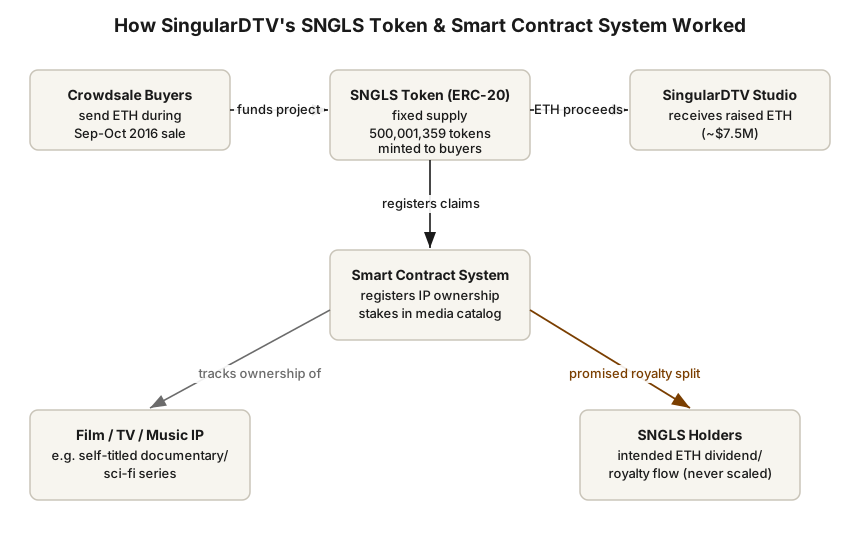 Open full-size diagram
Summary
SingularDTV was one of the earliest projects to launch on Ethereum after the mainnet went live, pitching itself as a "decentralized entertainment studio" — a blockchain-based production and distribution platform for film, TV, music, and other IP. Co-founded in 2016 by producer/screenwriter Zach LeBeau and film producer Kim Jackson, and supported by Ethereum co-founder and ConsenSys founder Joseph Lubin, SingularDTV ran a crowdsale from late September to late October 2016 that distributed its SNGLS token and raised roughly $7.5 million in ETH, reportedly selling out within minutes to tens of minutes. It is frequently cited as one of the first Ethereum ICOs and one of the first attempts to put entertainment-industry intellectual property and royalty flows directly on a public blockchain.
Design (Mechanism)
SingularDTV's core idea was to use Ethereum smart contracts as a "Smart Contract System" (SCS) that would register ownership stakes in media IP (starting with a self-titled documentary/sci-fi series about the technological singularity) and route revenue to token holders programmatically, removing layers of studio, distributor, and rights-management intermediaries. The SNGLS token, an ERC-20 with a fixed total supply of 500,001,359 tokens, was distributed via a capped crowdsale rather than mined or earned, and was pitched as both a governance/ownership instrument in the SingularDTV ecosystem and (at various points) a vehicle for dividend-like ETH distributions to holders. The team, working with ConsenSys and Swiss law firm MME, positioned the SCS as reusable infrastructure other IP holders (musicians, authors, filmmakers) could plug into to tokenize their own catalogs, rather than a one-off financing vehicle for a single show.
Outcome
The crowdsale itself succeeded financially — $7.5M in ETH raised almost instantly for what was, in September 2016, still a niche experimental use of Ethereum. SingularDTV subsequently rebranded parts of its consumer-facing effort as "Breaker," a media publication/label, while the core team pivoted toward building blockchain tooling (including work later associated with projects like FanChain, Meta and the SCS toolkit for others) rather than delivering the originally pitched decentralized-Netflix content platform at scale. The SNGLS token drifted into illiquidity over the following years and was formally delisted from Bitfinex on May 10, 2021, one of several exchanges to remove it. No major film, TV series, or content library was ever transparently and verifiably distributed to token holders with on-chain royalty flows at meaningful scale. As of this writing, singulardtv.com and related properties show little to no active development, and the project is best characterized as dormant/wound down rather than formally shut down with an announced end date.
Why it worked
- It captured genuine first-mover attention: as one of the first post-mainnet Ethereum token sales, SingularDTV benefited from scarcity of alternatives and strong narrative fit ("blockchain will disintermediate Hollywood") during the 2016 ICO wave.
- Backing from Joseph Lubin and ConsenSys lent credibility and technical resources that most contemporaneous ICOs lacked, helping the sale sell out quickly.
- The team shipped real infrastructure (an ERC-20 token, a documented Smart Contract System, legal structuring via MME) rather than only a whitepaper, which was unusual rigor for the time.
Where the design broke
- The core promise — tokenized IP with transparent on-chain royalty distribution to SNGLS holders — was never delivered at the scale implied in 2016 marketing; no verified large-scale content revenue ever flowed to token holders on-chain.
- The token's utility was ambiguous from the start (part governance token, part royalty claim, part speculative asset), which made it hard to value and easy to treat as a pure trading instrument, contributing to price collapse and eventual exchange delistings.
- Media/entertainment production is capital- and relationship-intensive in ways a token sale doesn't solve; the design put a blockchain settlement layer underneath financing, production, and distribution processes that remained exactly as capital- and relationship-intensive as before, with no mechanism addressing those bottlenecks.
- The SNGLS token carried no contractual or on-chain link to any specific production roadmap, so once activity shifted toward adjacent ventures (Breaker, FanChain, other ConsenSys-adjacent spinouts), there was no mechanism keeping the original SingularDTV product roadmap funded or prioritized.
Lessons
- A successful token sale is not the same as a successful product — SingularDTV's $7.5M raise in minutes said more about 2016 ICO mania than about product-market fit for tokenized entertainment.
- Tokens that try to be simultaneously a governance right, a royalty claim, and a speculative trading asset tend to satisfy none of those functions well and leave holders unclear on what they actually own.
- Capital-intensive, relationship-driven industries (film/TV production) are not meaningfully disintermediated just by adding a blockchain settlement layer; the bottlenecks are elsewhere (financing, distribution deals, talent, marketing).
- Being "first" on a new chain generates attention and short-term capital but is not durable without a credible, narrowly-scoped delivery plan — SingularDTV's scope (an entire entertainment industry stack) had no phased structure tying token value to incremental, deliverable milestones.
Redesign (EDITORIAL)
EDITORIAL — hypothesis, not fact. A narrower, more defensible version of SingularDTV might have scoped the "Smart Contract System" purely as a rights-registry and revenue-split primitive (e.g., an on-chain royalty-splitting contract usable by any independent creator), decoupled entirely from launching its own token or producing its own flagship content. Revenue splits could settle in stablecoins rather than a bespoke speculative token, removing the incentive misalignment between "token price appreciation" and "content actually getting made and distributed." Governance/ownership of specific projects could be represented as project-specific NFTs or fungible shares scoped 1:1 to a single production (closer to a security-token / crowdfunding model with clear legal wrapper), rather than one umbrella SNGLS token meant to represent claims across an ever-shifting slate of unrelated media. This would trade the "grand unified decentralized studio" narrative for a boring-but-credible piece of infrastructure that other creators could adopt incrementally, with success measured in actual royalty dollars settled on-chain rather than ICO dollars raised.
Sources
- SingularDTV: A Decentralized 'Netflix' On Ethereum (news)
- An Ethereum Journey to Decentralize All Things — primary (blog)
- SingularDTV and a SNGLS Visa-Debit Token Card — primary (blog)
- SNGLS (SingularDTV) Token Tracker — Etherscan — primary (explorer)
- SingularDTV — Delisted (Bitfinex support notice) (exchange notice)
- SNGLS ‐ SingularDTV (GitHub wiki notes / contract analysis) (technical)
Related experiments
Last verified: 2026-07-27 · Spot an error? Suggest a correction