Zora Coins
A protocol that turns every social post and creator profile into an instantly tradeable ERC-20 token backed by an automated Uniswap V4 liquidity pool.
▶ Run interactive simulation animated mechanism with editable parameters
How it works onchain
 Open full-size diagram
Summary
Zora Coins is the content-tokenization layer of Zora, an onchain media protocol built by Zora Labs (founded 2020 by ex-Coinbase employees Jacob Horne, Tyson Battistella, and Dee Goens, evolving out of the earlier Zora NFT marketplace and the Zora Network OP-stack L2). The Coins protocol reframes social media itself as a financial primitive: every post can become an instantly tradeable ERC-20 "content coin," and every user gets a profile-level "creator coin" with their username as the ticker. Each coin has a fixed one-billion supply and launches directly into a dedicated Uniswap V4 pool, so trading and price discovery exist from the first block with no manual listing.
The system is anchored by the ZORA ERC-20 token (contract 0x1111111111166b7FE7bd91427724B487980aFc69 on Base, verified source, deployed via Zora's deployer in Feb 2025) and the ZoraFactory (0x777777751622c0d3258f214F9DF38E35BF45baF3, deployed at the same address across Base and Base Sepolia). ZORA launched publicly on Base on 23 April 2025 with a 10 billion supply and a retroactive airdrop, and the token became the backing currency and gating asset for creator coins.
Design (Mechanism)
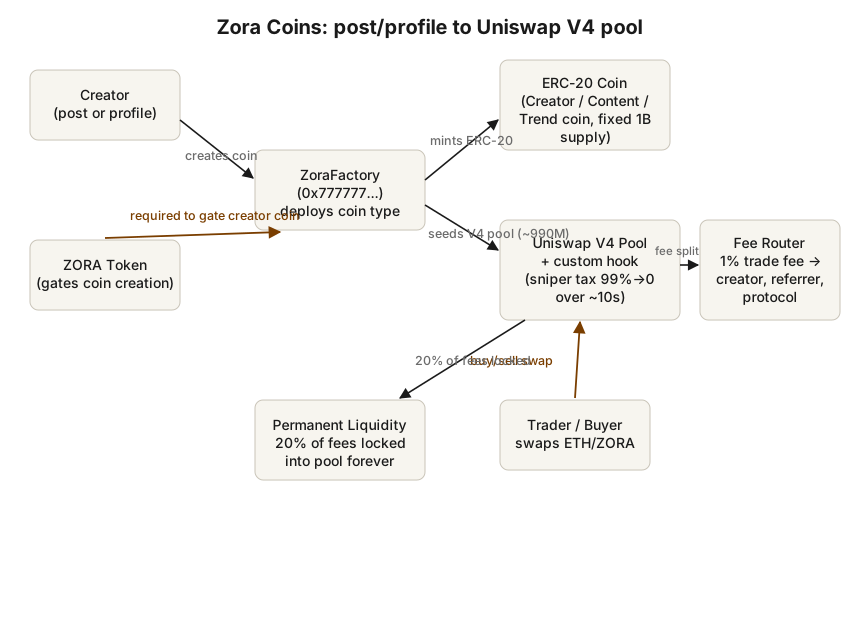
The protocol standardizes several coin types, each an immutable ERC-20 minted by the factory:
- Creator Coins — one per profile, ticker = username. Of the 1B supply, ~500M seeds the liquidity pool and ~500M vests to the creator over five years.
- Content Coins — one per post, backed by the creator's coin. ~990M enters the tradeable pool and ~10M goes to the creator at launch.
- Trend Coins — lightweight meme/cultural tokens where 100% of supply enters the pool, with a 0.01% (1 bps) fee, ~100x lower than standard coins.
Every coin deploys into a Uniswap V4 pool with a custom hook. The hook implements: (1) a sniper tax that starts at 99% and decays over ~10 seconds to blunt bot front-running at launch; (2) automatic reward routing of trading fees to the creator, referrers, and the protocol; (3) a 1% trading fee on Creator and Content coins (0.01% for Trend coins); and (4) 20% of trading fees locked as permanent pool liquidity. Coins can be backed by ETH, ZORA, or another Creator Coin, and the pool configuration selects the coin type and market curve. Because launching a Creator Coin requires ZORA, the token is designed as a demand flywheel rather than a governance token — the team explicitly framed ZORA as a "memecoin"-style participation asset rather than a vote-bearing governance instrument.
Developers integrate via the Coins SDK and the ZoraFactory, which emits distinct events per coin type (CreatorCoinCreated, CoinCreatedV4, TrendCoinCreated), letting indexers and apps distinguish the market.
Outcome
Adoption metrics were genuinely large. Reporting around Q2 2025 cited on the order of $353M in trading volume, ~$27M paid to creators, ~179,000 content creators, and millions of active traders; later cumulative figures cited ~1.5M Creator Coins generating ~$425M in volume. The ZORA token itself was highly volatile — it experienced sharp rallies (reports of moves of several hundred percent pushing market cap from ~$35M toward ~$300M in mid-2025) but also sharp declines after launch.
The launch was widely criticized. Trading began before the official announcement tweet (which was then deleted), letting insiders/snipers move first; users hit technical failures claiming the airdrop and many received little or nothing. Market cap reportedly fell from $461M to ~$167M (a ~64% drop) and ~55% within six days. DL News highlighted a ~$450M gap between the token's ~$150M market value and Zora Labs' prior ~$600M equity valuation. Only ~10% of supply went to the user airdrop while large shares went to investors (26%, incl. Haun Ventures and Coinbase Ventures), employees (19%), and treasury (25%). Content-coin trading also drew pump-and-dump accusations. Net: a real, widely-used mechanism with strong volume, but a launch marked by sequencing issues, concentrated insider allocation, and unstable secondary markets — hence partial_success.
Why it worked
- Zero-friction markets: launching every post/profile directly into a Uniswap V4 pool removed the listing bottleneck; content became liquid at creation.
- Anti-sniper hook: the decaying 99% sniper tax and permanent-liquidity lock addressed classic fair-launch failure modes at the contract level.
- Reward alignment: automated fee splits to creators and referrers gave a native, ongoing monetization path, driving genuine creator adoption (six figures of creators, tens of millions in payouts).
- Distribution advantage: riding Base and an existing Zora/NFT userbase gave immediate scale.
Where the design broke
- Launch sequencing outran the fairness mechanism: trading opened before the public announcement (later deleted), and the airdrop-claim flow failed for many users — a code-level anti-sniper design undone by a launch sequence that let early movers in ahead of the public.
- Investor-heavy tokenomics: the allocation weighted only ~10% of supply to the user airdrop against ~45%+ to team and investors combined, concentrating supply with insiders and pressuring price once trading opened.
- Ambiguous token purpose: marketing ZORA as a "memecoin" with no governance disappointed holders expecting utility/voting and invited speculation.
- Structural volatility: one-billion-supply coins per post/profile plus thin real demand produced pump-and-dump dynamics that undermined the "media as durable asset" thesis.
Lessons
- Launch mechanics are the product. A contract-level anti-sniper design only holds if the social launch (announcement timing, claim UX) also blocks early access; the effective launch fairness depends on both code and comms timing.
- Tokenomics transparency beats hype. A small user allocation next to large insider allocations shifts realized supply and price exposure toward insiders regardless of mechanism quality; publish allocations and vesting before trading.
- Liquidity ≠ value. Instant markets on every unit of content generate volume and fees but not durable price; tokenizing everything can dilute rather than capture the value of any single piece.
- Define the token's job. Oscillating between "participation asset" and "memecoin" left ZORA without a clear demand anchor beyond gating creator-coin creation.
Redesign (EDITORIAL — hypothesis, not fact)
This section is the researcher's opinion, not established fact.
A stronger design would tie coin value to demonstrated demand rather than raw supply issuance. Hypotheses:
- Demand-gated minting. Instead of minting a full 1B per post upfront, mint content-coin supply progressively along a bonding curve that only expands as real buys arrive, curbing instant pump-and-dump inventory.
- Fairer, pre-committed launches. Publish airdrop allocations, vesting, and the exact trading-open timestamp on-chain in advance; open trading atomically with the announcement, and consider a brief sealed/uniform-clearing auction to neutralize the sniper problem without a 99% tax that mostly punishes non-bot early users.
- Rebalance distribution toward users/creators. Shift a larger share to active creators and traders with longer vesting, reducing the perception (and reality) of an insider cash-out and aligning long-term supply with the people generating fees.
- Give ZORA an unambiguous sink. Route a fixed portion of protocol trading fees to buy-and-burn or to fund creator rewards, so the token's value is mechanically linked to protocol usage rather than to gating alone.
- Curate, don't tokenize everything. Make content coins opt-in for meaningful posts (or graduate from Trend coins once a demand threshold is met), so liquidity concentrates on content that actually has an audience — supporting the "durable media asset" narrative the marketing promised.
Sources
- Zora Coins Protocol Overview — primary (docs)
- Coins Contracts Introduction / Factory — primary (docs)
- ZORA Token contract (BaseScan, verified source) — primary (contract)
- zora-protocol GitHub repository — primary (contract)
- Zora's tumbling token opens $450m rift with its issuer (DL News) (news)
- ZORA Token Launch Causes 64% Market Cap Drop, Sparks Outrage (AInvest) (news)
- Zora's Token Airdrop Sparks Confusion (The Defiant) (news)
- Crypto-driven marketplace Zora raises $2M (TechCrunch) (news)
Related experiments
Last verified: 2026-07-26 · Spot an error? Suggest a correction