Colored Coins (Open Assets Protocol)
Bitcoin-native token scheme that 'colored' satoshis via OP_RETURN marker outputs to represent stocks, bonds, and real-world assets — the conceptual ancestor of tokens and NFTs, ultimately displaced by Ethereum's ERC-20.
▶ Run interactive simulation animated mechanism with editable parameters
How it works onchain
 Open full-size diagram
Summary
Colored coins were the first serious attempt to make Bitcoin carry assets other than bitcoin itself. The idea — "color" specific satoshis so they represent shares, bonds, property deeds, or loyalty points — was proposed by Yoni Assia in a March 2012 blog post ("bitcoin 2.X"), formalized in a December 2012 whitepaper by Meni Rosenfeld, and elaborated in the 2013 "Colored Coins — BitcoinX" paper whose authors included Assia, Rosenfeld, Lior Hakim, and a pre-Ethereum Vitalik Buterin. The Open Assets Protocol (OAP/1.0), authored by Flavien Charlon on December 12, 2013 and commercialized through his startup Coinprism (launched 2014), became the most widely deployed colored-coins implementation. It was adopted in high-profile institutional pilots — Nasdaq's Linq private-markets platform (2015, built with Chain.com) and Overstock's TØ cryptobond — before the entire category was displaced by Ethereum's ERC-20. Coinprism shut down in early April 2018, with Charlon delivering one of crypto's most candid founder postmortems.
Design (Mechanism)
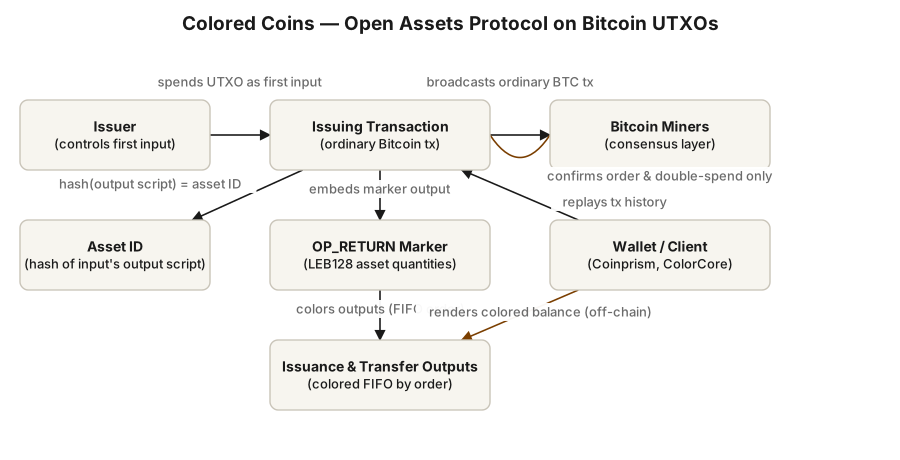
Open Assets is a metaprotocol layered on unmodified Bitcoin transactions; Bitcoin nodes see ordinary transactions, while Open Assets clients apply extra interpretation rules:
- Issuance via redemption promise. An issuer creates colored coins and associates them with a formal or informal promise to redeem them under defined terms. The token is a bearer claim; its value depends entirely on issuer trustworthiness.
- Asset IDs from UTXOs. An asset ID is the RIPEMD-160(SHA-256) hash of the output script referenced by the first input of the issuing transaction — so only whoever controls that output can issue more of the asset, without any registry.
- Marker output. A transaction opts into Open Assets with a special OP_RETURN "marker output" embedding the protocol tag and a list of asset quantities encoded as LEB128 varints (up to 2^63 − 1 units). Using OP_RETURN keeps colored data provably unspendable and out of the UTXO set.
- Order-based coloring. Outputs before the marker are issuance outputs (they receive the issuer's asset ID); outputs after it are transfer outputs, colored by consuming input asset units in order — a deterministic first-in-first-out assignment that conserves asset quantity across the transaction.
- Client-side validation. Coloring is invisible to miners and enforced by no one; wallets like Coinprism and ColorCore trace each output's color back through transaction history. Bitcoin consensus guarantees ordering and double-spend protection, but asset semantics live entirely in the client.
- Companion specs covered an Open Assets address format (to prevent accidentally sending colored coins to ordinary wallets, which destroys the coloring) and an Asset Definition Protocol for attaching issuer metadata.
Outcome
Technically, the protocol worked as specified and shipped multiple interoperable implementations. Commercially and institutionally it peaked in 2015: Nasdaq announced in May 2015 it would use Open Assets for its Nasdaq Private Market equity-management platform, and Chain.com documented the first blockchain-recorded private securities issuance on Linq that December; Overstock's TØ platform used Open Assets for its 2015 cryptobond. But by 2016–2017 token issuance had migrated wholesale to Ethereum. Coinprism announced its shutdown in March 2018 (closing early April), telling users to withdraw funds and export keys. Charlon's stated reasons: "the ecosystem has shifted towards ERC-20, which is more flexible and more powerful than bitcoin-based systems"; Bitcoin's unpredictable fees and confirmation times were unsuitable for a token platform; token activity was likely to become "heavily regulated"; and — strikingly — "in 99% of use cases we're seeing, blockchain is unfortunately a sub-optimal choice as a technology." The spec repository survives but is dormant. Outcome: technically successful, commercially unsuccessful — yet enormously influential as the direct ancestor of ERC-20 tokens, NFTs, RWA tokenization, and later Bitcoin metaprotocols (Counterparty, Omni, Ordinals/Runes).
Why it worked
- Inherited Bitcoin's security for free. Ordering, immutability, and double-spend resistance came from the most secure chain available, with zero new consensus code.
- Elegant minimalism. UTXO-derived asset IDs, OP_RETURN markers, and order-based coloring required no registry, no new opcode, and no chain fork; costs were independent of asset quantity.
- Right idea, provably. Everything colored coins promised — tokenized equities, stablecoins, collectibles, RWAs — later became multi-hundred-billion-dollar categories on other platforms. Nasdaq and Overstock validated real institutional demand as early as 2015.
Where the design broke
- Client-side validation is fragile. No miner enforces coloring; a single spend from a non-aware wallet irreversibly destroys the asset, and every wallet must replay full transaction history to verify a token.
- Hostile host chain. Bitcoin Core developers were ambivalent about non-monetary data (OP_RETURN was capped at 40, then 80 bytes), and rising fees plus 10-minute, variable confirmations made token UX poor — Charlon cited exactly this in 2018.
- Expressiveness ceiling. Colored coins could move tokens but not program them — no on-chain logic for dividends, vesting, exchanges, or composability. Buterin, a co-author of the 2013 paper, built Ethereum in part because of this limitation; ERC-20's smart-contract model won decisively.
- No sustainable business model. The protocol was free infrastructure; Coinprism's wallet/service layer had thin monetization and mounting regulatory exposure from ICO-era scrutiny.
Lessons
- A metaprotocol only borrows a base chain's security, not its ecosystem's goodwill: building on a platform whose core developers and fee market are indifferent-to-hostile to your use case is a structural risk, not a detail.
- Tokens want programmability. Pure ledger entries lose to tokens embedded in a computation environment where transfer, exchange, and issuance logic are composable — the entire colored-coins user base migrated the moment ERC-20 offered this.
- Client-side validation trades enforcement for permissionlessness; when assets can be destroyed by a non-aware wallet, the protocol's safety depends on universal software adoption it has no way to compel.
- Being first proves the thesis for someone else: colored coins correctly identified tokenization as blockchain's killer app roughly five years early, and nearly all the value accrued to successor platforms.
- Institutional pilots (Nasdaq, Overstock) are validation, not traction — they neither fund a protocol nor lock in a standard.
Redesign (EDITORIAL — hypothesis, not fact)
This section is editorial hypothesis, not historical fact. A modern redesign would keep the UTXO-hash asset-ID trick (elegant, registry-free issuer control) but abandon naive client-side history-walking for validated commitments: either a Taproot-era approach like RGB/Taproot Assets (client-side validation with compact proofs and off-chain data) or enforcement at a consensus layer, as Runes later did with protocol-aware indexers standardized enough to act as de facto consensus. Add an explicit burn-protection rule (assets unspendable by non-aware wallets via a distinct address/script format enforced at the script level, not by convention). Most importantly, pair the asset layer with a minimal execution environment — even covenant-based vaults or a sidechain — because the historical verdict is unambiguous: bare token transfer without programmability is not a defensible product. Monetize via issuance tooling and compliance services rather than wallets, since the 2018 shutdown showed the wallet layer captures none of the standard's value.
Sources
- Open Assets Protocol specification (OAP/1.0) — primary (docs)
- OpenAssets GitHub organization (reference implementations, ColorCore wallet) — primary (docs)
- Flavien Charlon — bitcoin-dev mailing list, BIP Number Request: Open Asset — primary (governance)
- CoinDesk: 'Colored Coins' Startup Coinprism Is Shutting Down (Charlon retrospective quotes) (retrospective)
- Bitcoin Magazine: Colored Coins Come To Life In CoinPrism & Open Assets (2014) (news)
- CoinDesk: Hands On With Linq, Nasdaq's Private Markets Blockchain Project (2015) (news)
- Wikipedia: Colored Coins (2012 whitepaper lineage — Assia, Buterin, Rosenfeld, Hakim, Lev) (analysis)
Related experiments
Last verified: 2026-07-27 · Spot an error? Suggest a correction