ICONOMI
2016 Ethereum ICO that sold ICN, a quasi-equity token over a crypto fund-management platform, ran buyback-and-burns, then famously converted the token into actual tokenized shares (eICN) of a Liechtenstein joint-stock company.
▶ Run interactive simulation animated mechanism with editable parameters
How it works onchain
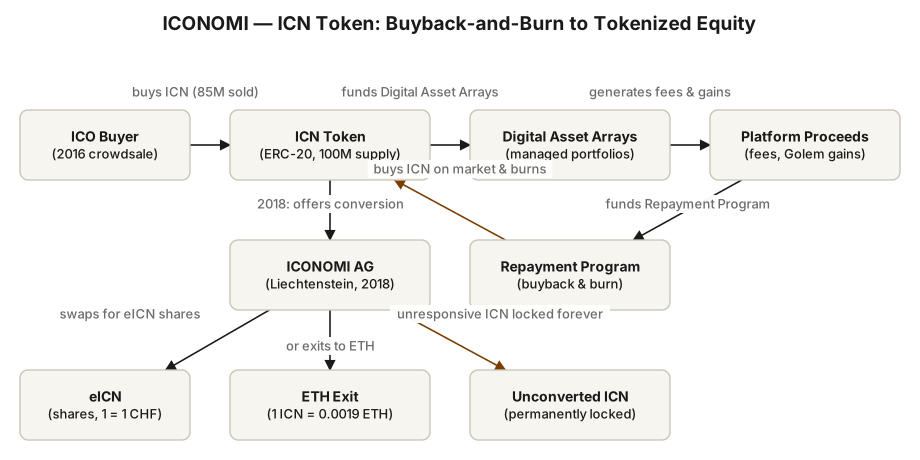 Open full-size diagram
Summary
ICONOMI was one of the earliest and largest fintech ICOs of 2016: a Slovenian team led by Tim M. Zagar and Jani Valjavec (previously of Cashila, an early European bitcoin payments company) sold 85 million of 100 million ICN tokens between August 25 and late September 2016, raising roughly $10–10.5 million. The pitch was a "fund management platform for the decentralized economy": ordinary users could buy into professionally or algorithmically managed crypto portfolios called Digital Asset Arrays (DAAs), and ICN holders would capture a share of the platform's economic success. ICN's lifecycle became a landmark case study in token design under regulatory pressure. It began as a dividend-like profit-share idea, was reshaped into a buyback-and-burn "Repayment Program" to avoid securities characterization, and finally — in 2018–2019 — was converted outright into eICN, tokenized shares of ICONOMI AG, a Liechtenstein joint-stock company, with unconverted ICN permanently locked. The company itself survives today as a regulated, largely off-chain crypto asset-management and social-trading platform (iconomi.com), while the original onchain token experiment was deliberately wound down.
Design (Mechanism)
- ICN token. An ERC-20 token on Ethereum (contract
0x888666CA69E0f178DED6D75b5726Cee99A87D698). 100 million issued; 85 million sold in the crowdsale, small allocations for marketing/bounties, the remainder to team and reserves. - Digital Asset Arrays (DAAs). The core product: tokenized baskets/portfolios of crypto assets (BTC, ETH, and altcoins) composed by managers. Users bought a DAA position rather than individual coins; managers set allocations and rebalanced; performance and fees flowed through the platform. Two flagship products were a passive index-style array and an actively managed one.
- Value accrual, v1 — dividends (abandoned). The original concept had ICN paying out a share of platform profits, which would plainly make it a security in most jurisdictions.
- Value accrual, v2 — buyback and burn. The "Repayment Program" (announced by Zagar in 2017) instead used realized platform proceeds to buy ICN on the open market and burn it via smart contract, shrinking supply. The first execution used ~1,000 ETH of realized gains from ICONOMI's early Golem investment. This was one of the earliest prominent buyback-and-burn token models, prefiguring designs later used by BNB and many DeFi tokens.
- Value accrual, v3 — token-to-equity conversion. In late 2018 ICONOMI incorporated ICONOMI AG in Liechtenstein and offered every ICN holder a conversion: swap ICN for eICN tokenized shares (1 eICN = 1 CHF of share value, at a set ICN/CHF rate) carrying real voting and profit-participation rights, or exit into ETH at 1 ICN = 0.0019 ETH. ICN was delisted from exchanges (e.g., Kraken, February 2019), and after the final deadline all unconverted ICN was permanently locked with zero value.
Outcome
The crowdsale was 2016's largest fintech ICO. The platform launched, DAAs went live in 2017, and ICN traded broadly, at one point ranking among the larger ERC-20 tokens by market cap during the 2017 bull market. But the hybrid token — not quite equity, not quite utility — proved legally untenable, and the team executed the industry's most complete "exit from token-land": ICO → buybacks → tokenized equity in a regulated company. ICN ceased to exist as a tradable asset by 2019. The business, however, continued: ICONOMI pivoted from onchain DAA tokens toward a custodial, regulated copy-trading/strategy platform operating from the UK and Slovenia, reporting 100,000+ users, MiFID II-relevant authorization, with Peter Curk as CEO and the founders still listed on the team. As an ongoing business it is a modest success; as an onchain experiment, the token and the tokenized-portfolio mechanism were abandoned — hence "partial success."
Why it worked
- Real product, credible team. Unlike most 2016–2017 ICOs, ICONOMI shipped a working platform with genuine demand (simple diversified crypto exposure) and had founders with prior regulated-fintech experience (Cashila).
- Adaptive token engineering. The team iterated on value accrual — dividends → buyback-and-burn → equity — rather than keeping a design with unresolved securities-law exposure, and communicated each step publicly.
- Orderly wind-down. Holders were given a genuine choice (equity or ETH exit), clear deadlines, and exchange delistings were coordinated; the conversion was executed without an exploit, rug, or enforcement action.
Where the design broke
- The token was a security in substance. ICN's entire appeal was profit participation; every redesign changed the token's form without changing that underlying economic function, and ultimately the only durable answer was to become actual regulated equity.
- Buyback-and-burn diluted the pitch. Burns returned value only indirectly and at management's discretion, weakening the investment case versus the original dividend story.
- Conversion terms disappointed many holders. The ETH exit rate and CHF share pricing came after a deep bear-market drawdown; late 2018 ICN holders realized large losses versus ICO-era highs, and non-responsive holders were wiped out entirely when unconverted tokens were locked.
- The onchain thesis was shed. Tokenized, permissionless fund shares (DAAs) gave way to a custodial web platform — the decentralized-asset-management experiment itself did not survive contact with regulation; that design space was later reoccupied by DeFi-native protocols (Melon/Enzyme, Set, index DAOs).
Lessons
- A token whose value proposition is "share of the profits" is equity, and no amount of buyback-and-burn re-labeling changes the endgame; design for that reality from day one.
- Token-to-equity conversion is a viable exit path from an ICO whose token functioned as equity — but it transfers holders from a liquid global market into a legal structure with narrower rights and liquidity, and laggards can be zeroed out.
- Buyback-and-burn as a compliance workaround for dividends was pioneered here years before it became DeFi orthodoxy — and ICONOMI's experience already showed its weakness: discretionary, opaque, and weaker than direct distribution.
- Surviving as a company and surviving as an onchain experiment are different things; a pivot to a regulated custodial product can save the business while ending the experiment.
Redesign (EDITORIAL — hypothesis, not fact)
This section is editorial hypothesis, not historical fact. A modern ICONOMI would split the two things ICN conflated. The fund product would be built as non-custodial onchain vaults (Enzyme/ERC-4626-style), where each "array" is a vault share token with transparent holdings, manager fees enforced by contract, and no issuer dependency — this preserves the DAA idea without the platform being a shadow fund custodian. The capital raise would either be straightforward tokenized equity from day one (issued under a sandbox/security-token regime, as eICN eventually was) or a fee-switch governance token whose claim on protocol fees is enforced onchain and disclosed as a security where required. A protocol-owned buyback could remain, but rule-based and executed transparently onchain rather than discretionary. The deepest fix is jurisdictional sequencing: incorporate the regulated entity before the sale, not two years after, so the token never has to be retroactively re-characterized and no holder faces a forced-conversion cliff.
Sources
- ICONOMI (ICN) Token Tracker — Etherscan — primary (contract)
- ICONOMI — About (team, regulation, social links) — primary (docs)
- ICONOMI presents the token issuance process (Jani Valjavec) — primary (docs)
- ICONOMI introduces Repayment Program (Tim M. Zagar) — primary (docs)
- ICN token → eICN security token — ICONOMI Help Center — primary (docs)
- Everything You Need to Know about eICN — primary (docs)
- ICN Conversion Process Begins — primary (docs)
- ICN tokens which were not exchanged are permanently locked — ICONOMI Help Center — primary (docs)
- Delisting of Iconomi (ICN) — Feb 2019 (Kraken) (news)
- The Iconomi Burn — Crypto Buybacks (Sebastian Moonjava) (analysis)
- What is Iconomi? Beginner's Guide to Digital Asset Arrays — CoinCentral (analysis)
Related experiments
Last verified: 2026-07-27 · Spot an error? Suggest a correction