Harberger Tax
A self-assessed 'always-for-sale' property mechanism, ported onchain via NFTs that owners perpetually price and continuously pay a tax on, pioneered by This Artwork Is Always On Sale and scaled by Wildcards for conservation funding.
▶ Run interactive simulation animated mechanism with editable parameters
How it works onchain
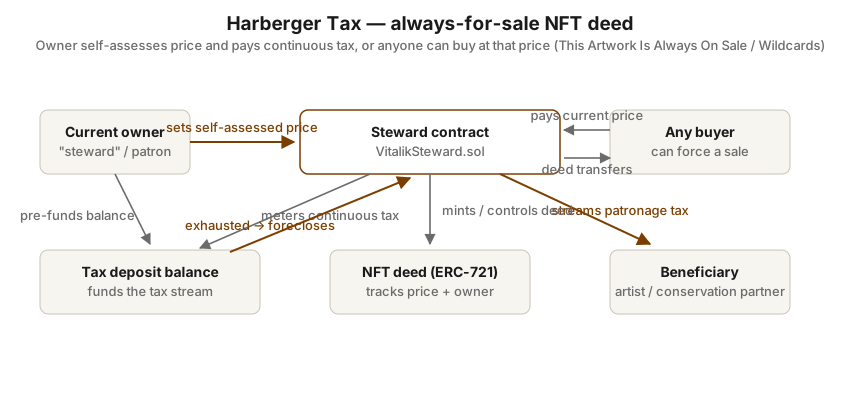 Open full-size diagram
Summary
The Harberger Tax (also called a Common Ownership Self-Assessed Tax, COST, or "SALSA") is an economic mechanism, popularized by Eric Posner and Glen Weyl's 2018 book Radical Markets, in which an owner must publicly self-assess a price for their property, is forced to sell to anyone willing to pay that price, and continuously pays a tax proportional to their own stated valuation. This design intentionally trades away some investment security in exchange for allocative efficiency: property gravitates toward whoever values it most, and undervaluation is punished by the risk of forced sale while overvaluation is punished by tax. Blockchains made the mechanism practically implementable for the first time, because smart contracts can enforce the always-for-sale property, meter the continuous tax, and automatically foreclose non-payers without a trusted intermediary.
The canonical onchain instantiation is Simon de la Rouviere's This Artwork Is Always On Sale (TAIAOS), minted on Ethereum on 21 March 2019, where a single digital artwork is perpetually for sale and its owner pays a continuous patronage stream (originally 5% per annum on their self-set price) directly to the artist. The mechanism was then scaled by Wildcards, a South African team that turned Harberger-taxed NFTs into perpetual conservation funding for endangered animals, and described itself as the "first scalable Harberger Tax contract" live on Ethereum mainnet. Todd Proebsting's Program the Blockchain "Harberger Tax Deeds" tutorial (Sept 2018) provided an early canonical reference implementation.
Design (Mechanism)
A Harberger-taxed asset onchain combines four rules enforced by the contract:
- Self-assessment. The current owner (or "guardian"/"patron") sets the price at which they will part with the asset. In TAIAOS and Wildcards the asset is an ERC-721 NFT.
- Forced/perpetual sale. Anyone may pay the current price at any moment and become the new owner. There is no auction period; the asset is always liquid at its self-assessed price. Purchase transfers ownership and the new owner immediately sets their own price.
- Continuous tax / patronage. The owner streams a tax proportional to their declared price over time. TAIAOS routes this "patronage" 100% to the artist (5% p.a. in v1); Wildcards routes it to conservation partners. Proebsting's reference deed tracks a per-account
sumOfPrices, a daily tax rate expressed as a rationaltaxNumerator/taxDenominator, and apaidThrutimestamp. - Foreclosure. Owners pre-deposit a balance from which tax is drawn. When the balance is exhausted and tax is owed, the contract forecloses: in Proebsting's deed, ownership reverts to
address(0)and price resets to zero; in TAIAOS a "digital steward" reclaims the artwork for safekeeping until re-auctioned. Partial payments advance thepaidThrutimestamp proportionally.
Wildcards' key technical contribution was scalability: rather than one contract per asset, a single steward contract (VitalikSteward.sol, built on modified OpenZeppelin ERC-721) manages ownership, pricing, and patronage accounting for many animal tokens at once. This "one steward, many deeds" architecture is what let the team claim the first scalable Harberger deployment. The core economic tension, in de la Rouviere's own framing, is between allocative efficiency (property moves to higher-value users) and investment efficiency (owners hesitate to improve assets they can lose); he cites the Radical Markets result that "in most calibrations Harberger taxation achieves 70 to 90 percent of the maximum possible allocative welfare gains."
Outcome
TAIAOS is a durable technical and artistic success but a niche one. It launched in March 2019, shipped a v2 in June 2020 (notably with a 100% patronage rate variant), and de la Rouviere later documented restoring/refactoring v1 (2021) and continued maintenance into 2026 — the piece and its concept were exhibited and recognized (e.g., referenced by the Lumen Prize). It proved the mechanism runs unattended onchain for years and inspired a family of derivatives (ThisFeedIsAlwaysForSale, the Harberger Toolkit, Geo Web's land model, an EIP-5320 draft for Harberger-tax NFTs).
Wildcards took the idea furthest commercially: an EthCapeTown hackathon winner (2019), it raised undisclosed funding from Crypto Valley Venture Capital (CV VC) and deployed a scalable steward on mainnet. But it did not reach durable scale — the flagship wildcards-world/dapp repo was archived read-only in October 2019, and the project did not become a sustained conservation-funding channel of meaningful size. Across all implementations, adoption remained small: these were compelling demonstrations rather than mechanisms that captured large TVL or user bases. Hence an outcome of technically successful, commercially unsuccessful — the code works and the mechanism is proven, but Harberger taxation has not been adopted at scale onchain.
Why it worked
- Perfect fit of mechanism to medium. Harberger taxation requires a credible, automated always-for-sale guarantee and a metered continuous tax with automatic foreclosure — exactly the things smart contracts do well and legacy institutions do poorly. The blockchain removed the enforcement problem that had kept the idea theoretical since Arnold Harberger's 1960s proposal.
- A legible, emotionally resonant framing. Wrapping a dry tax mechanism in "patronage for an artist" or "guardianship of an endangered animal" made self-assessment and forced sale feel like generosity and status rather than expropriation.
- Composability and reuse. Because the steward pattern is generic, others could fork it (data feeds, virtual land, open-source funding), turning a single artwork into a reference design.
Where the design broke
- The core UX is adversarial. Owning a Harberger asset means someone can take it from you at any moment and you must keep a funded balance or lose it to foreclosure. This "you never really own it" property is philosophically the point but commercially repellent to most collectors, who prize secure ownership.
- Weak demand for perpetual tax. For conservation (Wildcards) the model competes with simply donating; for art it competes with normal NFTs. The continuous tax is a recurring liability with uncertain upside, which suppressed the buyer pool.
- Thin liquidity and speculation mismatch. The mechanism assumes many competing valuers to drive allocative efficiency; in practice each asset had few interested parties, so forced sale rarely triggered and prices stagnated — the theoretical efficiency gains never materialized at these scales.
- No sustained engineering investment. Wildcards' core repo went inactive within months of its hackathon debut, and the scalable steward architecture received no further development after that point.
Lessons
- A mechanism being provably efficient in theory does not create demand. Harberger taxation's allocative-efficiency case is strong, but onchain adoption is gated by whether users want insecure, perpetually-taxed ownership — and mostly they do not.
- Framing carries the mechanism. The most successful deployments (artist patronage, animal guardianship) dressed self-assessment in identity and status, showing that mechanism-design experiments need a narrative wrapper to attract non-economist participants.
- Architecture matters for real deployment. Wildcards' "single steward, many assets" pattern was the genuine engineering advance over one-contract-per-deed prototypes; scalability of the accounting, not the tax rule itself, is the hard part.
- Foreclosure and pre-funded balances are the failure surface. Requiring owners to maintain a deposit or lose the asset is where users churn; any redesign must minimize the cognitive and cashflow burden of "staying current."
Redesign (EDITORIAL — hypothesis, not fact)
The following is the researcher's own analysis and speculation, not established fact.
If rebuilt today, the most promising path is to decouple the tax from ownership anxiety and target use cases where forced reallocation is a feature, not a bug. Three hypotheses:
- Harberger for scarce shared infrastructure, not collectibles. The mechanism shines where an asset is genuinely rivalrous and society benefits from reallocation — e.g., limited namespaces (ENS-style premium names), billboard/ad slots, validator/sequencer priority rights, or in-game land. Applying it to art/collectibles fought the collector's desire for permanence; applying it to congestible commons aligns incentives.
- Abstract away the balance-and-foreclosure UX. Replace the pre-funded deposit with streaming payments (e.g., Superfluid-style continuous flows) and gasless "keeper" auto-top-ups, plus clear risk dashboards, so owners never lose an asset by surprise. Foreclosure should feel like an expiring lease, not a seizure.
- Pair self-assessed price with a quadratic or retroactive public-goods split. Route patronage not to a single beneficiary but to a public-goods pool with matching, so the tax funds a broad commons and buyers gain reputational/impact returns — turning the recurring liability into a legible contribution with social upside.
The testable prediction: Harberger taxation will find product-market fit only where (a) the asset is truly congestible, (b) tax payment is a frictionless stream, and (c) the "always-for-sale" property is reframed as fair access rather than loss of ownership. Absent all three, it will keep producing elegant, admired, under-adopted demos.
Sources
- This Artwork Is Always On Sale (launch announcement) — primary (retrospective)
- simondlr/thisartworkisalwaysonsale (source repo) — primary (contract)
- What is Harberger Tax & Where Does The Blockchain Fit In? — primary (analysis)
- Implementing Harberger Tax Deeds (Program the Blockchain, Todd Proebsting) — primary (analysis)
- wildcards-world/dapp (source repo, archived Oct 2019) — primary (contract)
- South Africa's WildCards Project Becomes the First Scalable Harberger Tax Contract Live Deployment on Ethereum (news)
- SA trio behind Wildcards betting on social status to propel their endangered wildlife token (news)
- This Artwork Is Always On Sale v2 (Simon de la Rouviere) — primary (retrospective)
Related experiments
Last verified: 2026-07-26 · Spot an error? Suggest a correction