Pump.fun
A Solana launchpad that lets anyone mint a memecoin in one click and trade it instantly on an automated bonding curve, industrializing 'fair-launch' token creation.
▶ Run interactive simulation animated mechanism with editable parameters
How it works onchain
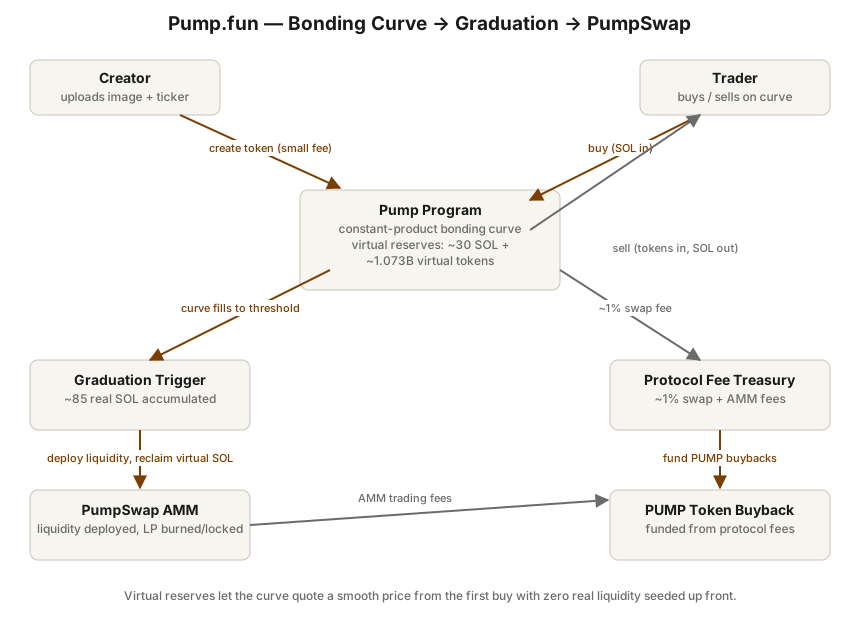 Open full-size diagram
Summary
Pump.fun is a Solana-based memecoin launchpad that launched on 19 January 2024. Its core innovation is not technical novelty but radical friction removal: anyone can create a fungible SPL token by uploading an image, name, ticker and one-line description, paying a trivial fee (fractions of a SOL). The token is instantly tradeable against an automated bonding curve with no presale, no team allocation, no vesting, and no need to seed a liquidity pool. This "fair launch" framing — every buyer, including the creator, buys from the same curve starting at the same price — was a direct response to the endemic rug-pulls of manually-deployed memecoins, and the three founders (English entrepreneurs Noah Tweedale, Alon Cohen and Dylan Kerler, operating via Baton Corporation Ltd) have said they built it after being rugged themselves.
The platform became one of the most commercially successful crypto applications ever, minting millions of tokens, capturing the large majority of Solana memecoin issuance, generating hundreds of millions of dollars in protocol fees, and culminating in a July 2025 ICO for its own PUMP token that sold out its public tranche in roughly 12 minutes.
Design (Mechanism)
Each new coin has a fixed supply of 1 billion tokens. Roughly 800 million are sold along an on-chain constant-product bonding curve initialized with virtual reserves (approximately 30 virtual SOL and ~1.073 billion virtual tokens). Virtual reserves let the curve quote a smooth, continuously rising price from the very first buy without any real liquidity being deposited up front — a key trick that removes the LP-seeding requirement entirely. Price rises non-linearly as buyers deposit SOL and falls as sellers exit through the same curve, so early buyers enjoy the lowest cost basis.
When the curve accumulates roughly 85 real SOL (historically corresponding to a ~$69,000 market cap; later documentation cites a higher threshold), the token "graduates." At graduation the protocol reclaims its 30 SOL virtual advance and deploys the remaining liquidity plus the reserved tokens into an AMM pool, with LP tokens burned/locked so liquidity cannot be pulled. Originally graduation moved liquidity to a Raydium constant-product pool for a ~6 SOL fee; in March 2025 Pump.fun launched its own native AMM, PumpSwap, making migrations instant and free and adding creator revenue sharing.
Revenue mechanics: the protocol charged a swap fee (~1%) on curve trades plus graduation fees, and after PumpSwap it captured AMM trading fees directly rather than ceding them to Raydium. In July 2025 the platform issued the PUMP token (mint pumpCmXqMfrsAkQ5r49WcJnRayYRqmXz6ae8H7H9Dfn) via an ICO, later running large PUMP buybacks funded from protocol fees. The core Pump program is deployed at 6EF8rrecthR5Dkzon8Nwu78hRvfCKubJ14M5uBEwF6P.
Outcome
Commercially, Pump.fun is a landmark success. It launched millions of tokens (reported over 6 million by early 2025), captured a dominant share of Solana memecoin creation, and generated on the order of several hundred million dollars in cumulative fees (reported figures above $700 million in revenue). The July 2025 PUMP ICO raised roughly $500–600 million, with the public tranche selling out in about 12 minutes at a ~$4B FDV — one of the largest ICOs in crypto history — and treasury reports indicate the entity later held over a billion dollars in assets.
As with most bonding-curve launchpads, the large majority of launched tokens end at zero value.
Why it worked
- Extreme friction removal. Reducing token creation to an image + one click + a tiny fee expanded the addressable market of "creators" from developers to literally anyone, driving viral volume.
- A credible anti-rug narrative. Virtual-reserve bonding curves plus locked/burned LP at graduation made the "fair launch, can't rug" story concrete, differentiating it from hand-deployed scam tokens.
- Aligned, compounding monetization. Per-trade and graduation fees scaled directly with the speculative activity the design encouraged; launching PumpSwap internalized fees previously leaking to Raydium.
- Timing and distribution. It rode Solana's cheap, fast blocks and a 2024 memecoin mania, becoming the default surface — and later monetized its own attention with the PUMP token.
Limitations and criticisms
Assessed as a mechanism rather than as a business, the design has structural constraints worth understanding:
- Outcomes are highly skewed. A bonding curve prices by order of arrival, so returns concentrate among the earliest entrants and the distribution of token outcomes has a very long tail.
- Commoditized moat. Copycats (e.g., Raydium LaunchLab) and the ease of forking bonding-curve mechanics mean dominance rests on network effects and brand, not defensible technology.
Lessons
- Removing friction is a more powerful mechanism than clever tokenomics. The bonding curve was not novel; making issuance a one-click, no-code, no-liquidity act is what created the market.
- Virtual reserves are an elegant primitive for bootstrapping continuous price discovery without upfront capital — a reusable pattern for any "instant market on creation" design.
- A trust narrative ("can't rug") is a distribution asset only as strong as its enforcement — if insider or MEV-privileged actors get preferential access, the fairness pitch collapses under its own claim.
- Owning the graduation/exit venue (PumpSwap) captures the fee stream that a launchpad otherwise donates to a downstream AMM — vertical integration of the liquidity lifecycle is where the durable margin lives.
Redesign (EDITORIAL — hypothesis, not fact)
This section is the researcher's editorial hypothesis, not established fact.
If the goal were to keep Pump.fun's frictionless issuance while reducing how concentrated outcomes are among the earliest entrants, a redesign might:
Make transaction ordering explicit and verifiable. Route the first N seconds of curve activity through an on-chain sealed-batch / uniform-clearing-price auction so latency or priority-fee advantages cannot determine who buys first. Publishing the ordering rules and priority-fee handling on-chain would make execution order auditable rather than opaque.
Add creator skin-in-the-game with time-locked, curve-linked vesting. Instead of pure fair launch, let creators optionally stake collateral that is slashed or released based on post-graduation liquidity longevity, dampening pump-and-dump churn without reintroducing classic team allocations.
Introduce graduated risk disclosure and cool-downs at the UI/contract level (e.g., a mandatory holding micro-delay or a "this token has X% chance of going to zero based on historical base rates") to give buyers visibility into the base-rate outcome distribution before they commit capital.
Fund a stabilizing rebate mechanism. Structure PUMP so protocol fees fund a public, on-chain insurance/rebate pool for graduated-token liquidity, redirecting some fee flow toward post-graduation liquidity stability instead of buybacks. The trade-off is that most of these changes reduce the transaction velocity that generates fee revenue, so the open question is whether a launchpad with these added frictions can retain the network effects that a maximally frictionless one enjoys.
Sources
- pump.fun public program documentation (PUMP_PROGRAM_README) — primary (docs)
- pump.fun official website — primary (docs)
- Wikipedia — Pump.fun (analysis)
- Blockworks — Inside pump.fun's $600M ICO (news)
- CryptoRank — Pump.fun ICO sells out in 12 minutes, $500M raised (news)
- Bitquery — Pump.fun to PumpSwap migration tracking (mechanism reference) (docs)
Related experiments
Last verified: 2026-07-26 · Spot an error? Suggest a correction